
Oak Lawn Epoxy Flooring installs basement floor epoxy in Oak Lawn, IL, serving surrounding cities including Chicago Ridge, Evergreen Park, Worth, Alsip and Bridgeview. With 20+ years of grinding and coating concrete, we treat a basement floor as a moisture question first and a color question second, because the slab under a basement is the one that decides whether any coating lasts.
Nearly half of Oak Lawn’s housing was built in the 1950s and 1960s, and a large share of them sit over full or partial basements. Those slabs were usually poured without the plastic vapor barrier that newer construction uses, and many have been painted, patched, tiled and flooded at least once since. A coating chosen for a new garage floor and rolled straight over that history is the most common basement failure we see.
So every basement estimate starts with a moisture test that is written into the scope before the price is final. The proposal then names the primer, the product line, the number of coats and the finished thickness, so the floor that goes down can be checked against the one you were quoted.
Moisture Comes First on a Basement Slab
Testing Before Any Price Is Final
We begin with an ASTM D4263 plastic sheet test, taping clear plastic to the floor to see whether moisture collects underneath. When it does, or when the slab looks doubtful, we follow with an ASTM F1869 calcium chloride emission test or ASTM F2170 in-situ relative humidity probes drilled into the concrete for a measured reading.
Those numbers decide the system. A dry slab can take a standard 100% solids epoxy; a slab with elevated readings needs a moisture-mitigation primer; and a slab with active water entry needs drainage work before anyone should coat it. You see the readings and the reasoning in writing, so the recommendation never rests on a guess.
Efflorescence and Damp Spots
A white, powdery crust on a basement floor or along the walls is efflorescence, the minerals left behind when water moves through concrete and evaporates. It is a sign that moisture is moving through the slab, even if the floor feels dry to the touch most of the year.
We grind efflorescence off and test the slab underneath, rather than coating over it. Salts that keep arriving from below push up against a coating and break the bond, so a floor that showed white powder before the install will show bubbles and peeling after it unless the moisture is managed.
Moisture-Mitigation Primers
When readings are above what a standard epoxy tolerates, a moisture-mitigation primer is applied directly to the ground concrete before the base coat. It is designed to resist vapor pressure from below and to give the rest of the system a stable surface to bond to.
A primer manages vapor through sound concrete, not running water. Where a slab has hydrostatic pressure from a high water table or leaks at cracks and joints, the answer is drain tile, a sump or crack injection first, and we say that plainly rather than selling a primer as a cure.
Sewers, Sumps and Floor Drains
Coating After a Sewer Backup
Many Oak Lawn basements have taken on water from sewer backups during heavy storms, and the village has studied repeated flooding near the headwaters of Stony Creek. After a backup, the floor must be cleaned, disinfected and dried, and a slab soaked by sewage needs time to dry back down before a moisture reading means anything.
The cause should be addressed before the floor. Oak Lawn offers a 50/50 cost share program for private sewer repairs on homes built before the 1970s that back up in heavy rain, and that repair belongs ahead of a new floor so the coating is not tested by the next storm.
Overhead Sewers and Backflow Valves
An overhead sewer conversion or a backflow valve keeps storm-driven sewage out of the basement, and installing either one usually means cutting and patching the slab. Doing that plumbing work after the floor is coated means trenching through a new finish, so we ask about it before scheduling.
When the plumbing has been done recently, we inspect the patched trench for settlement and moisture, fill the edges and grind the patch flush with the rest of the floor. A properly cured concrete patch takes the coating just like the original slab.
Sump Pits, Drain Tile and Floor Drains
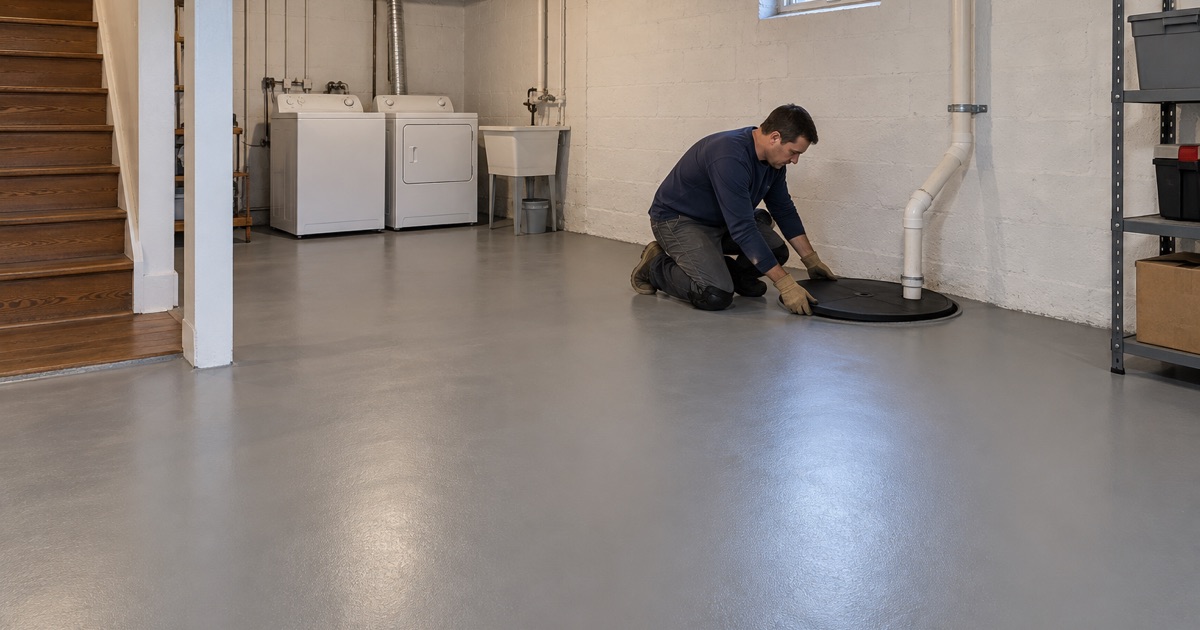
Sump pits and perimeter drain tile carry groundwater away from the slab, and they have to keep working after the floor is finished. We coat neatly up to the pit rim and around floor drains without sealing over any opening, so the system can still drain and a pump can still be lifted out for service.
Where the floor slopes toward a drain, we keep that slope rather than leveling it out. A coating should help water reach the drain, not hold it in a puddle against the wall.
Preparing an Old Basement Floor
Paint, Patching Compound and Tile Adhesive
Basement floors in older homes often carry several generations of floor paint, patching compound and black mastic from vinyl tile pulled up years ago. A new coating is only as strong as the weakest layer under it, so those layers are ground off down to sound concrete with a diamond grinder rather than coated over.
Black mastic from older tile is tested before any grinding, because some older adhesives contain asbestos. Where testing calls for abatement, that work is done by the right contractor first, and our grinding starts on a clean slab.
Cracks, Spalls and Uneven Patches
Basement slabs crack as they settle and dry, and older floors often have rough patches where pipes or posts were moved. We fill cracks and spalls with repair materials and grind high spots flush, so the coating sits on a smooth, continuous surface.
A crack that is actively leaking water gets sealed or injected as its own repair before coating. Coating over a wet crack only moves the leak to the edge of the coating, where it lifts the floor.
Dust Control in an Occupied House
Grinding a basement inside a lived-in home calls for dust control. Our grinders run with vacuums connected at the machine head, capturing dust where it is made rather than letting it drift up the stairs, and we close off the work area from the rest of the house.
None of the slurry or dust is rinsed toward the floor drain. Grinding residue goes into the vacuum and out of the house, which keeps the sewer line clear and keeps concrete fines out of the very drain you rely on in a storm.
Basement Rooms, Finishes and Costs
Laundry Rooms, Workshops and Home Gyms
A coated basement floor turns a damp, dusty slab into a surface that is easy to sweep, mop and keep dry. Laundry rooms get a textured topcoat near the washer, workshops get a thicker build and chemical resistance for oil and solvents, and home gyms get a coating that will not crack under dropped weights.
Flake broadcasts are popular in basements because they hide dust and small marks, and lighter blends help brighten rooms with small windows. A solid color is simpler and suits utility rooms and storage areas.
What Basement Floor Epoxy Costs
Price moves with floor area, the moisture test results, how many old layers must be ground off, crack repair and whether a mitigation primer is needed. Low ceilings, narrow stairs and furnishings that must be moved also add time, so we price after seeing the floor rather than quoting by the square foot over the phone.
Home jobs above the Illinois Home Repair and Remodeling Act threshold get a written contract and the Home Repair: Know Your Consumer Rights pamphlet before we begin. We also explain what the coating warranty excludes, and on a basement slab, moisture is always the first exclusion we name.
Why a Basement Coating Is Not Radon Mitigation
Sealing a basement floor can reduce some soil gas entry through the surface, but it is not radon mitigation. In Illinois, radon mitigation is licensed work regulated by IEMA, and a coating is never sold as radon reduction. If you are concerned about radon, a licensed professional should test the home and design a proper system, and we are happy to coat the floor once that work is finished.
- 20+ Years Coating Concrete
- Moisture Tested Before Pricing
- Free Written Estimates