Oak Lawn Epoxy Flooring has more than 20 years behind its epoxy-flooring in Bridgeview, and on every job the first question we ask is who will walk on the finished surface. For most owners the answer points toward durability, chemical resistance and easy cleaning. For a building that houses people living with dementia, the answer changes what color, pattern and sheen the floor should carry before anyone talks about thickness.
That question is the thread of this page. A coating can cure perfectly, bond perfectly and still be the wrong floor if the people using it read its surface as something it is not. We treat finish selection in those rooms as a design decision settled with the operator before a product is ordered, not a sample picked off a board on the last day.
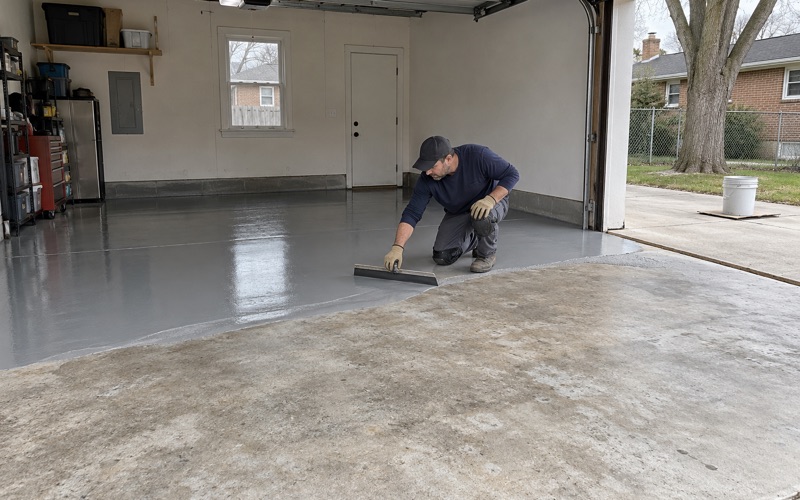
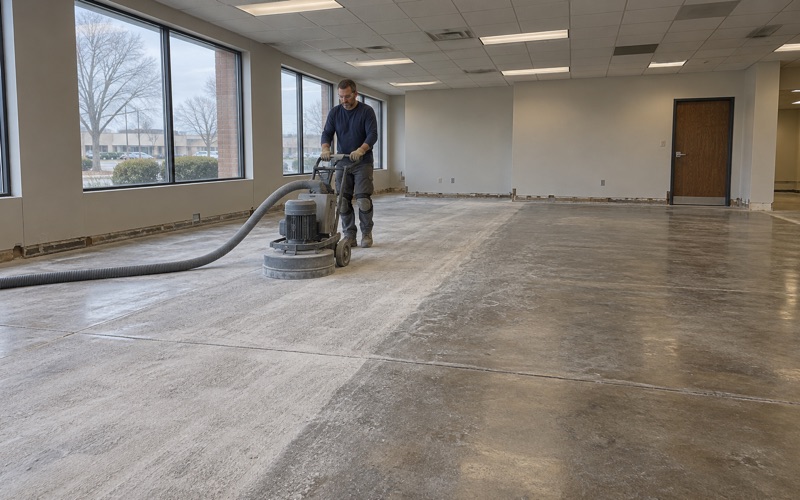
The groundwork stays the same as on any slab we coat. We open the concrete with a diamond grinder or shot blaster instead of an acid etch, write a moisture test into the scope before the price is final, and name the product line, the coat count and the finished thickness in the proposal so the floor can be checked against what was quoted.
Memory Care on Harlem Avenue
A care campus in Lyons Township
Midway Neurological & Rehabilitation Center sits at 8540 S. Harlem Avenue, an address that geocodes inside the Village of Bridgeview in Lyons Township, Cook County. Its own site describes short-term rehabilitation through long-term living and lists personalized memory care among its services, and Medicare lists the nursing home at that address. We name it because it shows the kind of building this page is about, not because it is a customer; we have not seen its floors, finishes or unit layout.
The same stretch of Harlem carries other senior-care buildings. Pavilion of Bridgeview is listed at 8100 S. Harlem for post-acute care, short-term rehabilitation and skilled nursing, and Moraine Court at 8080 South Harlem Avenue is a supportive living community for residents 65 and older. Neither publishes a memory-care unit, so the guidance below applies there only where an operator decides it fits the people they serve.
Perception comes before wear
In most commercial rooms we specify a floor around traffic: carts, cleaning chemicals, hot tire pickup in a garage, pallet jack wheels in a plant. In a memory-care hall the first test is what the floor looks like to a person whose brain is reinterpreting what the eyes report. A surface that survives ten years of traffic has still missed the point if residents read it as something other than a floor.
The guidance we work from comes from the Alzheimer Society of New Brunswick, written while it designed its own dementia-inclusive resource center. It is advice from a dementia organization, not an Illinois rule or a federal requirement, and we present it to owners exactly that way. For its own space, the society chose a neutral, pattern-free floor.
None of this asks a coating to do something it cannot. We make no claim that a finish changes how residents behave or what happens to them. Our job is narrower: keep the floor from adding a misleading signal on top of everything else a resident is already working to make sense of in a hallway.
Looking for epoxy-flooring closer to Palos Hills? See Palos Hills Epoxy-Flooring.
Shine, Dark Bands and Speckle: Three Ways a Floor Gets Misread
Shine that reads as water
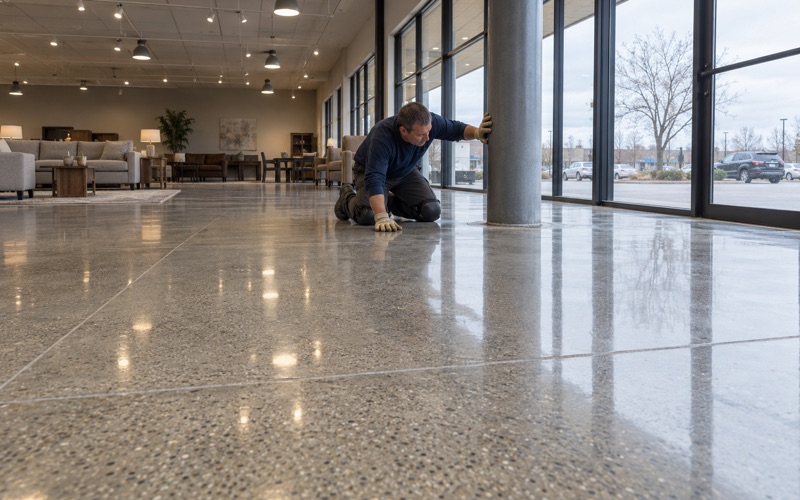
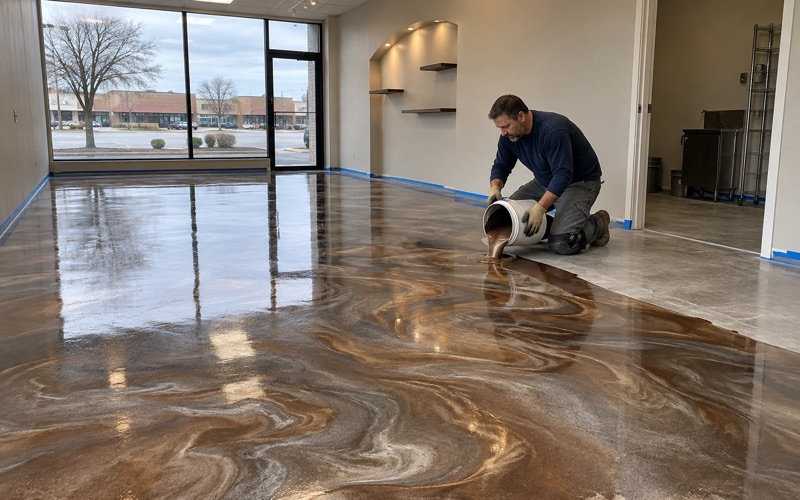
The society’s guidance says reflective or shiny flooring can be perceived as wet or look like water. A high-gloss clear topcoat is the most reflective surface we install, and under long rows of corridor lights it throws back bright patches the way a puddle does. On a garage floor that shine is the selling point; in a memory-care hall it is the problem.
Gloss is not a property of the epoxy body alone. The topcoat decides the sheen, so the same base system can finish glossy, satin or matte depending on what goes on last. That is why the sheen belongs in the written proposal next to the product line, rather than being left to whatever topcoat a crew happens to carry.
Dark areas that read as holes
The same guidance warns that dark flooring can look like a hole in the floor. On a coated floor the risk is rarely a whole dark room. It is usually a dark stripe: a contrasting border, a threshold band at a doorway, or a dark color used to mark where one zone ends and another begins.
Those bands exist for good reasons elsewhere, since a painted line in a warehouse tells a driver where an aisle stops. In a memory-care corridor the same band at a door can read as a gap. We plan doorway transitions so the color carries through at the same value, and where two pours must meet we keep the seam in a matching tone instead of a dark strip.
Speckles that read as dirt
Speckled or patterned flooring, the society notes, can look like there is dirt on the floor. A vinyl flake broadcast is speckle by design, and a blended quartz aggregate broadcast can read the same way. The pattern that hides tire marks and road grit in a garage hands a resident a floor that looks scattered with crumbs to pick up.
Why the Garage Finish Is Wrong Here, and What Replaces It
The flake-and-gloss default
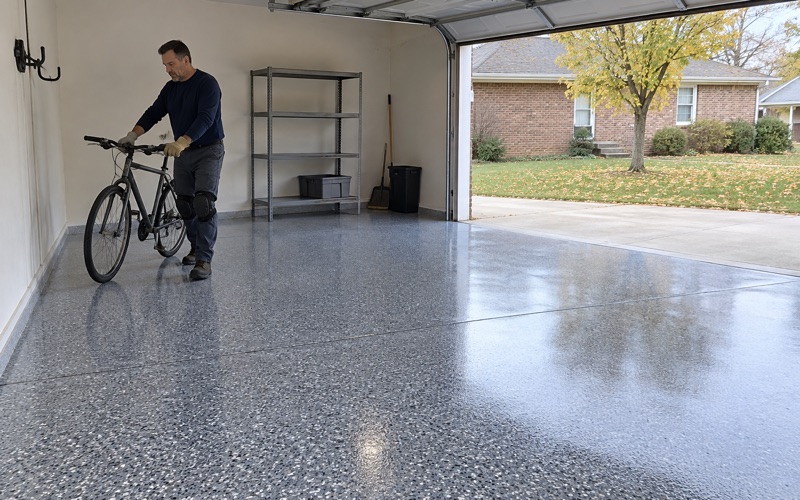
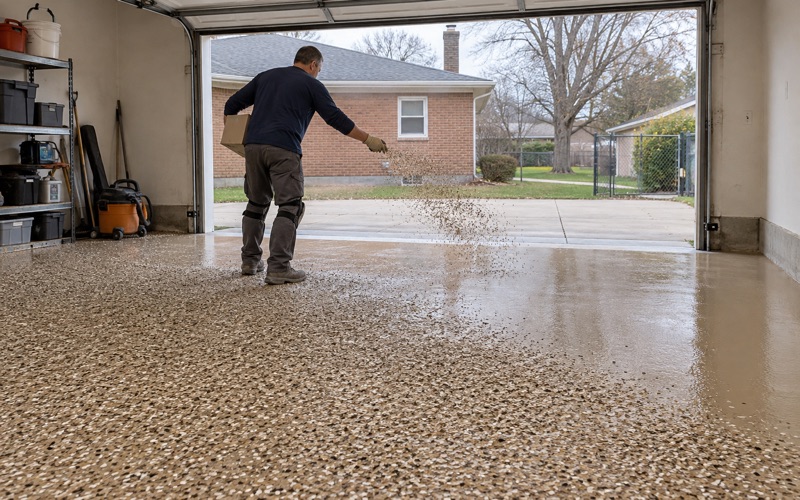
The system most homeowners ask us for is a 100% solids epoxy base, a dense multicolor vinyl flake broadcast and a clear polyaspartic topcoat at full gloss. We build it to stand up to the brine and rock salt that ride in on tires all winter, and the pattern hides dirt between cleanings. Every one of those strengths is a reason it does not belong in a memory-care hall.
The flake supplies the speckle, the gloss supplies the reflection, and owners often add a darker border for looks. Put together, the standard garage floor stacks all three warnings from the guidance into a single surface. We say so plainly when a care operator asks for the finish they have seen in a showroom.
Solid color, mid-tone, low contrast
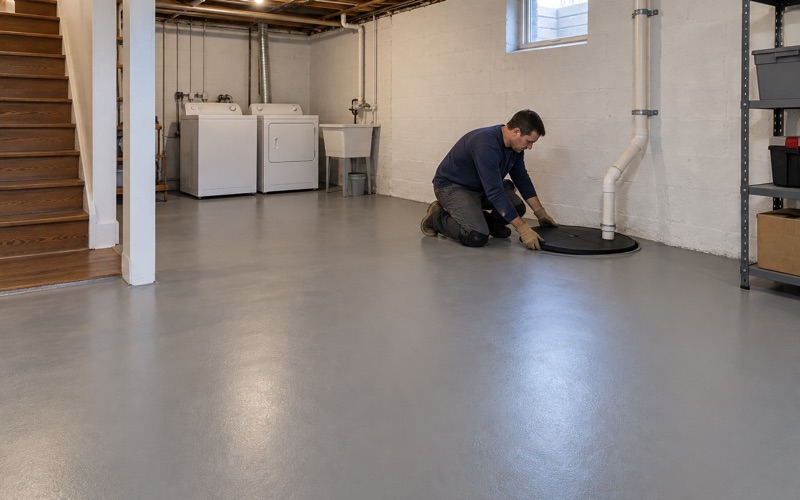
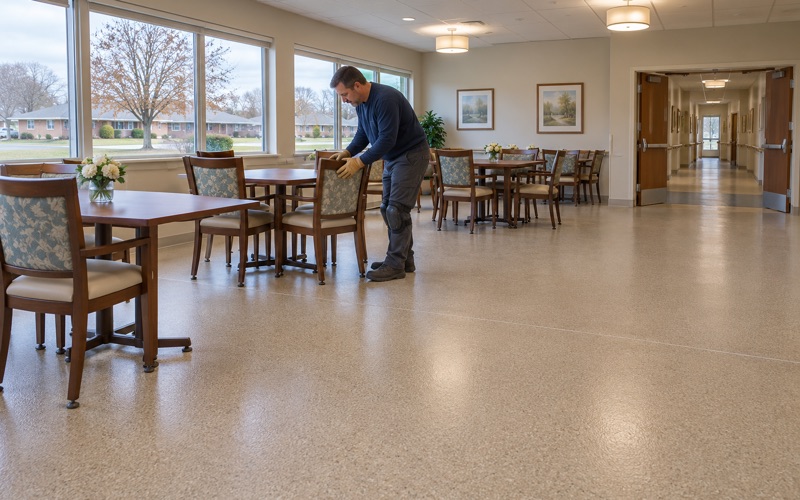
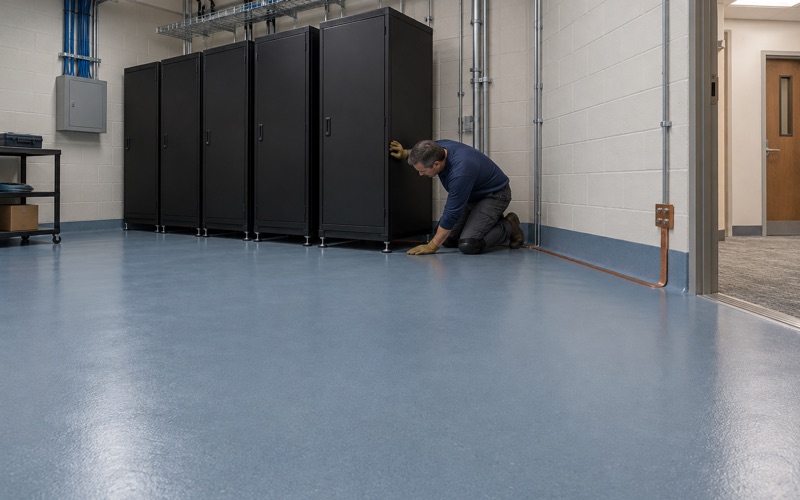
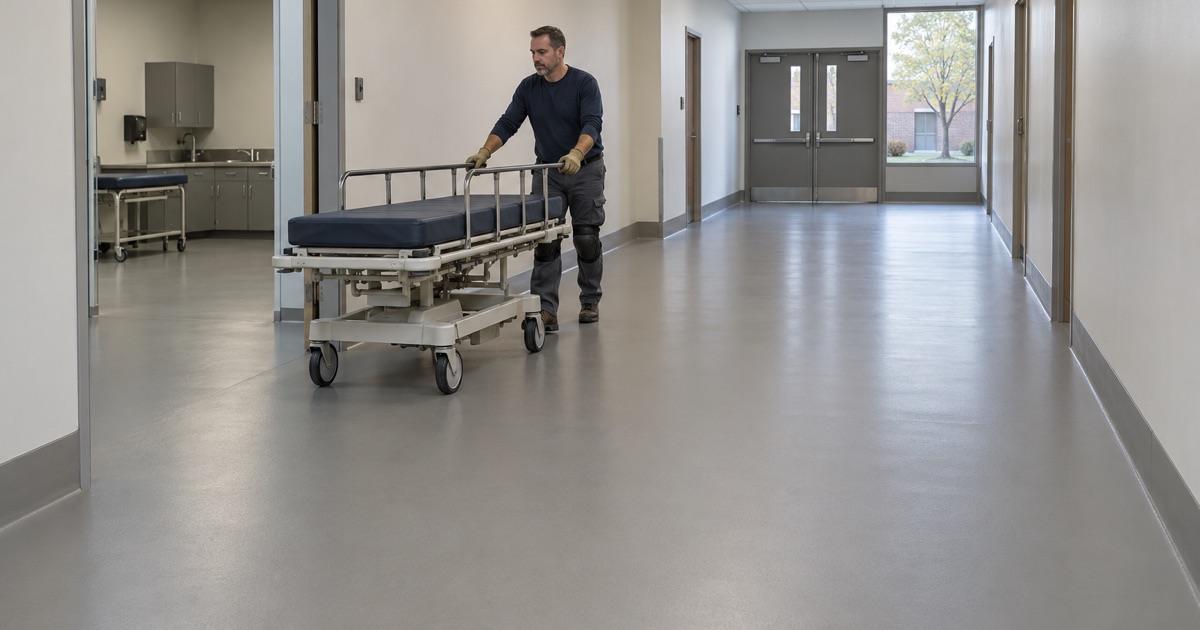
What answers the guidance is a solid pigmented color with no visible broadcast at the surface. Mid-tone matters: a very light floor can glare under bright fixtures, and a very dark one runs into the hole problem. We bring large samples into the building and look at them under its own lighting, because a chip under a showroom lamp says little about a corridor.
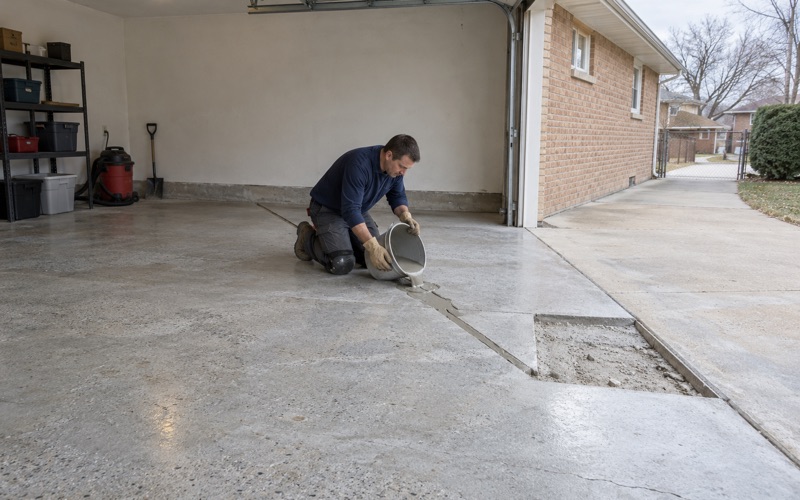
Low contrast applies inside the floor itself. Two adjoining rooms, a corridor and its alcoves, or an old coating patched against a new one should land close enough in tone that no line reads as a step. Where a repair section meets an existing floor, we match the color before the job is scheduled, not after.
A solid color does not have to mean a thin floor. The pigment runs through the epoxy body built to the thickness named in the proposal, so a scuff through the topcoat does not expose a different tone underneath. Where an owner wants a broadcast for texture, pigmented coats can bury it completely so nothing speckled shows at the surface.
A matte finish on top
A matte finish or satin topcoat throws back far less light than the gloss most crews default to, and both are available in polyaspartic and urethane lines. The trade is visual: a flat surface can show scuffs and cleaning residue differently than a shiny one. We talk through the cleaning routine with the operator before the sheen is chosen, so housekeeping is not surprised.
Working Inside an Occupied Care Building
Phasing around residents
A care building never closes, so we phase medical floors around its routine and offer overnight and weekend windows where a wing cannot be emptied. Work moves in sections the operator approves, and residents are routed by staff rather than by us. Grinding dust is captured at the machine with a vacuum instead of being rinsed toward a floor drain.
Before the first section is ground, we walk the route with facility staff and mark which doors stay in use, where wheelchairs and carts still need to pass, and where a temporary barrier can stand. That plan is written down, so the night shift inherits the same instructions the day manager approved instead of a crew’s memory of a conversation.
Cure schedules follow slab temperature and dew point, not the calendar. A section is reopened only when the coating is ready for traffic, which can mean an extra night of closure in a cool wing. We would rather explain that in the schedule than reopen a hallway early and leave footprints in the finish.
Products and the air inside
Bridgeview sits in the Chicago 2015 ozone nonattainment area, and the Illinois VOC limits for floor and industrial coatings under 35 Ill. Adm. Code Part 223 Subpart C bind whoever applies them. We pick products inside those limits for every job. In an occupied building we also weigh odor during application, since residents stay in the building while a section cures.
Permits, moisture and the written scope
The Village of Bridgeview Building Department at 7500 S. Oketo Avenue issues no permit without drawings, and applicants submit a contractor’s license, a $10,000 surety bond and a certificate of insurance. Illinois has no state flooring license, so that village registration is the credential that counts, and we confirm it before booking. Electrical work under the village’s adopted codes falls to City of Chicago licensed electricians, not to us.
Before pricing, we map cracks, spalls and old coatings and run moisture tests such as ASTM F2170 in-situ relative humidity probes or ASTM F1869 calcium chloride testing. If a slab needs repair or a moisture-mitigation primer, we say so in writing. What the coating warranty excludes is explained before anything is sold, and moisture is the first exclusion we name.
That written scope is where the finish decisions from this page end up. Color, sheen and the treatment at every doorway are listed alongside thickness and product line, so the operator can check the finished floor against the guidance it was chosen to meet.
- 20+ Years Coating Concrete
- Moisture Tested Before Pricing
- Free Written Estimates