Oak Lawn Epoxy Flooring has spent more than 20 years on epoxy-flooring in Burr Ridge and the suburbs around our home base, and the floors that need the most thought are in buildings changing what they are for. An office floor is judged on how it looks under a desk. A floor in a room full of toddlers is judged on whether it can be scrubbed every day and stay dry underfoot.
That shift from appearance to washability runs through this whole page. When a building moves from offices to licensed child care, the floor question stops being about finish and color and starts being about cleaning, moisture and comfort at floor level. We write coating scopes around those questions, beginning with whatever is actually under the existing carpet.
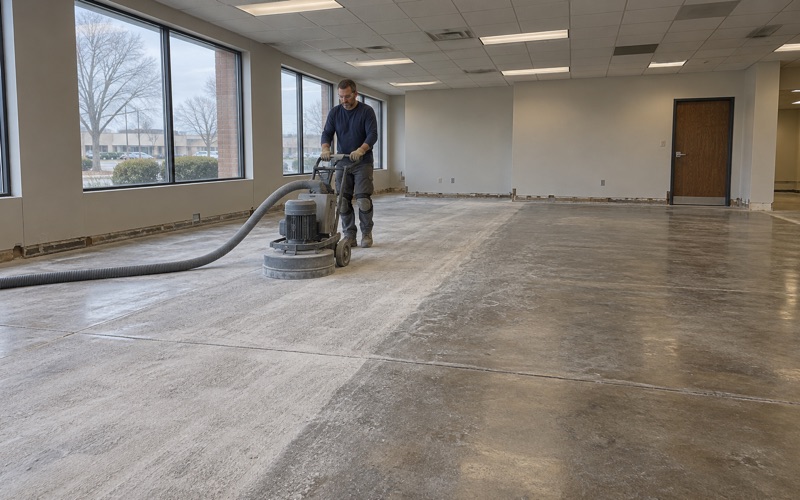
Every floor we take on is opened mechanically, with a diamond grinder or a shot blaster rather than acid, and every price we finalize carries a moisture test in the written scope. Those two habits matter most in a conversion, where a slab may have spent decades hidden under office carpet and nobody knows its condition until it is exposed.
From Village Hall to Preschool on County Line Road
A 40-year-old building changes hands
Burr Ridge, a village of 11,192 people at the 2020 census that sits in both Cook and DuPage counties, has decided to leave its own Village Hall. The building at 7660 S. County Line Road, in the DuPage County part of the village, is about 40 years old and needs roughly $6 million of work, with its mechanical systems described as being in a ‘disaster state.’
Rather than spend that, the village chose to build new offices as an addition to the neighboring police station, a building about 15 years old. The addition is estimated at $5.8 million, with construction from about June 2026 and occupancy targeted for May 2027. Bid packages for the work on the police department building were posted in August 2026.
As Patch reported on November 25, 2025, the old hall is being sold to Goddard School, a preschool chain, with closing expected in May 2026. Whether Goddard reuses the existing structure or replaces it was not stated in the reporting we read, and we make no assumption either way.
Three buyers, one use
The Goddard deal was not the first. In March 2025, Pleasantdale School District 107 looked at buying and renovating the building as a preschool for the 2027-28 school year, at about $12 million including renovation. In September 2025 the village board approved a $2.3 million sale to N Family Club, a daycare firm that planned to demolish the building.
Three different buyers came forward, and each one wanted the site for young children. That pattern is the useful part for anyone thinking about floors. A building that held village offices and board meetings has repeatedly drawn buyers whose rooms would be judged by the standards for a child care center rather than an office.
Looking for epoxy-flooring closer to Harvey? See Epoxy-Flooring Services in Harvey.
What Illinois’ Day Care Rule Asks of a Floor
Illinois licenses day care centers under 89 Ill. Adm. Code Part 407, and Section 407.370 covers the physical plant and indoor space. Subsection (e)(2) is a single sentence: ‘The floors and floor coverings shall be washable and free from drafts, splinters, and dampness.’ It reads as plain language, but it works as a short performance spec for anything laid on the slab.
Licensing is the state’s decision, made by DCFS, not ours. A floor coating does not make a center licensable, and we never describe one as approved for day care. What we can do is read each word of that sentence as a property a floor either has or lacks, and show an operator how a given system answers it.
Washable
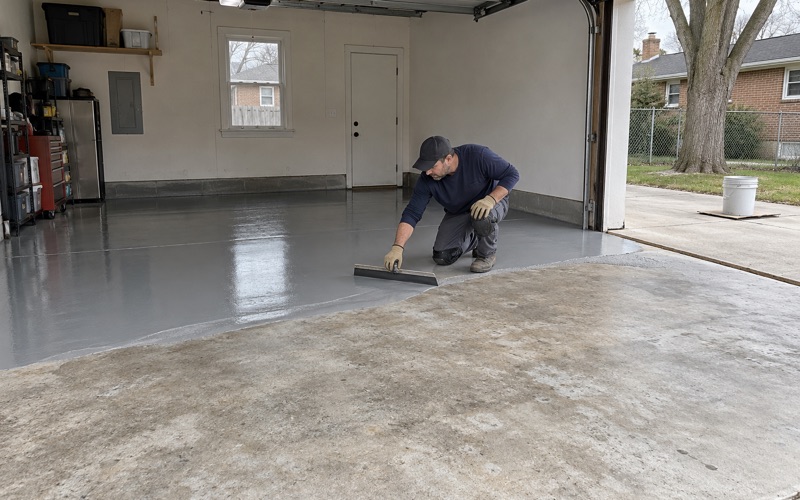
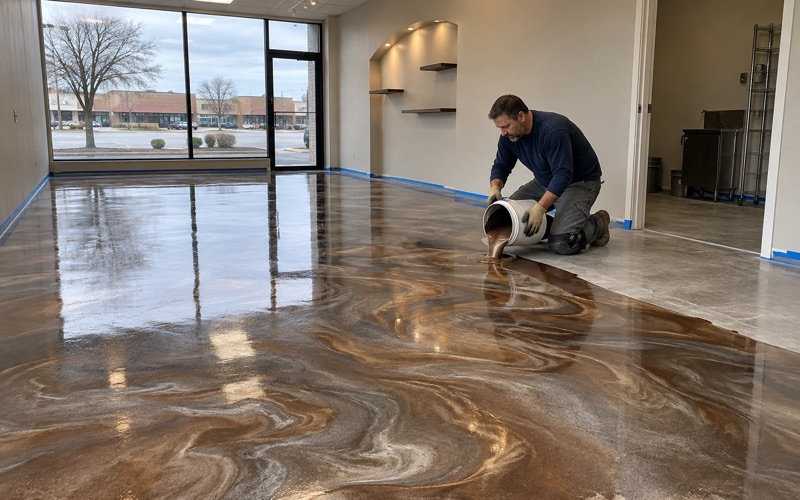
A washable floor survives daily wet mopping and disinfecting without absorbing what lands on it. Seamless epoxy or a urethane cement system has no grout lines or fibers to trap spills, and a coved base can carry the coating up the wall so the floor-to-wall corner is cleanable too. A polyaspartic or polyurea topcoat resists stains and cleaning chemicals better than a bare epoxy surface.
Carpet meets the word differently. It can be vacuumed and shampooed, but spills soak into the fibers and backing, so a rule asking for washable floor coverings is a harder fit for it than for a sealed, seamless surface. That gap is usually the first reason an office-to-classroom conversion looks at a resinous floor.
Drafts and splinters
Drafts are mostly a building question, governed by doors, the envelope and air handling, but the floor plays a part where a slab runs cold at an exterior wall. A coating does not insulate, so we say that plainly instead of selling it as a fix. Splinters are the easier word: a resinous floor has no wood grain to lift, and a properly profiled slab does not shed loose concrete.
Dampness
Dampness is the word we spend the most time on, because it is the one a coating can turn into a failure. Moisture moving up through a slab can blister and lift epoxy, and a floor that seemed dry under carpet may not behave the same once it is sealed. That is why moisture is the first exclusion we name when we explain a coating warranty, before any job is sold.
Dampness also covers what the occupants bring. A child care room sees mop water daily and spills constantly, so the surface has to shed water from the top as well as resist vapor from below. A sealed system handles the top side well; only testing tells us whether the slab can handle the bottom side.
Office Floors Versus Classroom Floors
What sits under office carpet
An office floor carries rolling chairs and foot traffic, and a worn patch under a desk is a cosmetic problem. A classroom floor carries cots, small tables, art supplies and daily disinfecting, and a worn patch there is a spot that no longer cleans properly. That change in what failure means is why we choose a classroom system differently from an office one.
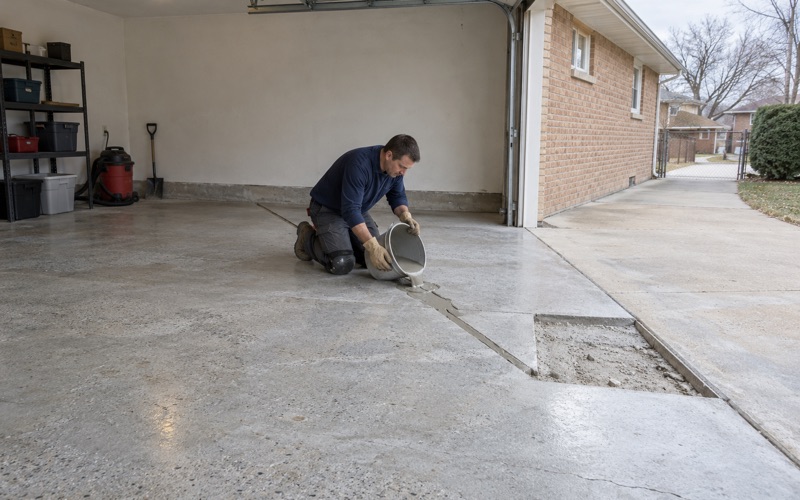
Old office space often has carpet or resilient tile over much of its slab, with adhesive residue beneath, and none of that belongs under a coating. Our first step is to map cracks, spalls, old adhesives and any previous coatings. We say directly when a section needs repair or replacement before it should be coated at all.
The village’s permit page exempts ‘finish work including painting, hardwood refinishing, tile replacement, and carpeting,’ while work that impacts foundations needs a permit. A change of use from offices to a preschool is a larger project, and its permits and certificate of occupancy belong to the owner and their design team. We stay inside the floor scope and leave those questions with them.
Testing the slab before choosing a system
A slab that has sat under carpet for decades has never been tested for what a sealed floor will face. We start with the ASTM D4263 plastic sheet test as a quick screen, then use ASTM F2170 in-situ relative humidity probes or ASTM F1869 calcium chloride testing to put a number on it. Those results are compared against ASTM F710 thresholds and the coating maker’s own limits.
Whether an older slab sits on an under-slab vapor retarder meeting ASTM E1745 is rarely written down anywhere we can check, so we test rather than assume. When readings come in high, a moisture-mitigation primer goes into the written scope as its own line, with its cost stated before the price is final.
Systems that suit a classroom
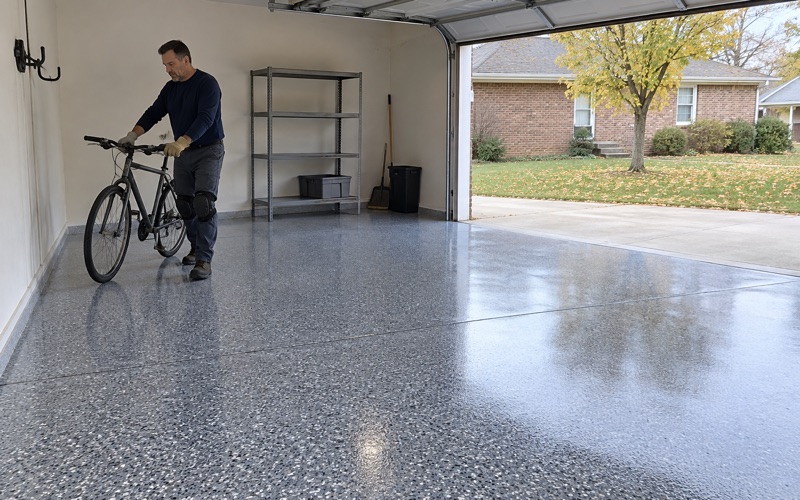
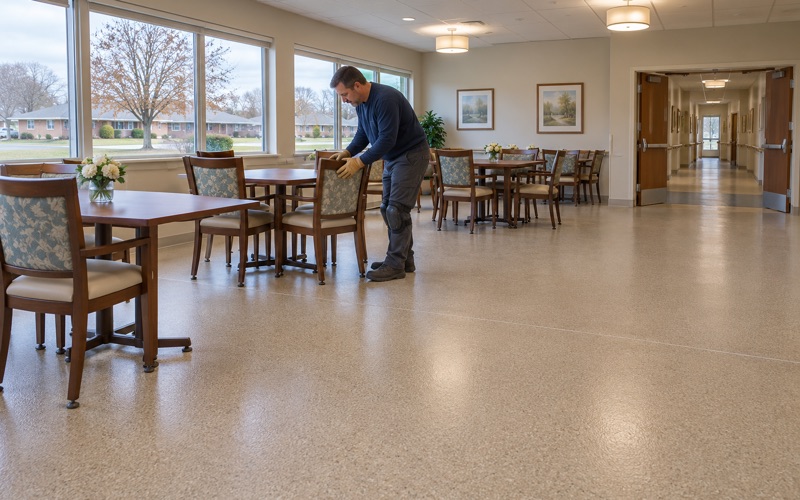
For classrooms and corridors, a 100% solids epoxy base with a quartz aggregate broadcast and a polyaspartic topcoat gives a seamless, washable surface with adjustable texture. Where bathrooms or a food-prep room need tougher heat and cleaning resistance, urethane cement is the stronger choice. Vinyl flake broadcast suits hallways, where a busier pattern helps hide everyday scuffs between cleanings.
Texture is a balance in a room where children sit and crawl. Too much grit is hard to mop and rough on knees, while too little leaves a wet floor slick. We set the broadcast and the topcoat together so the finished surface can be cleaned the way the operator actually cleans it.
How We Scope a Change-of-Use Floor
Grinding, dust and the written proposal
Every slab is profiled by diamond grinding or shot blasting to the ICRI CSP range the system calls for, never acid etched. Grinding dust is captured at the machine by vacuum instead of being rinsed toward a floor drain, which matters in a building that will soon hold children. The proposal names the product line, the number of coats and the finished thickness, so an owner can check the installed floor against the quote.
Cure, VOCs and timing
Cure schedules follow slab temperature and the dew point spread at the slab surface rather than a calendar date, which helps keep amine blush off epoxy coats. Products are picked within the Illinois VOC limits for floor and industrial coatings in 35 Ill. Adm. Code Part 223 Subpart C, which bind whoever applies them. Where a space has to stay in use or open on a fixed date, we phase the work into overnight and weekend windows.
Contractor rules in Burr Ridge
Illinois licenses no flooring or coatings contractor, so the village’s own rules are the ones that bind. Burr Ridge requires every contractor and subcontractor on a permitted job to hold a village license, post a $10,000 surety bond naming the village, and carry at least $1,000,000 in aggregate liability insurance listing the village as additional insured. We check those requirements before a job is booked.
What this page does not claim
We have no relationship with the village, Goddard School or any other buyer of the old hall, and nothing on this page describes work on that building. It is simply the clearest local example of a question an owner converting offices to child care space has to answer. If you are weighing that kind of conversion in Burr Ridge, we will test the slab, map its condition and put a washable, moisture-aware system in writing before anything is ground.
- 20+ Years Coating Concrete
- Moisture Tested Before Pricing
- Free Written Estimates