Oak Lawn Epoxy Flooring has spent more than 20 years on epoxy-flooring in Country Club Hills and across the south suburbs, and the work here usually begins at a joint rather than out in the open slab. A crack or saw-cut line that something rolls over every week is where a floor fails first, so we treat it as the starting point of the scope. Coating over it without filling it only hides the problem for a season.
Before a price is final, we open a test area, map every crack, spall and old coating, and run a moisture test that goes into the written scope. If a slab needs repair or replacement before it should be coated, we say so plainly. The proposal then names the product line, the number of coats and the finished thickness, so you can hold the finished floor up against the quote.
That approach is the same for a two-car garage and for a commercial floor that takes wheeled traffic all day. What changes is the load crossing each joint and how much of the floor sees it.
An Interstate City With No Railroad
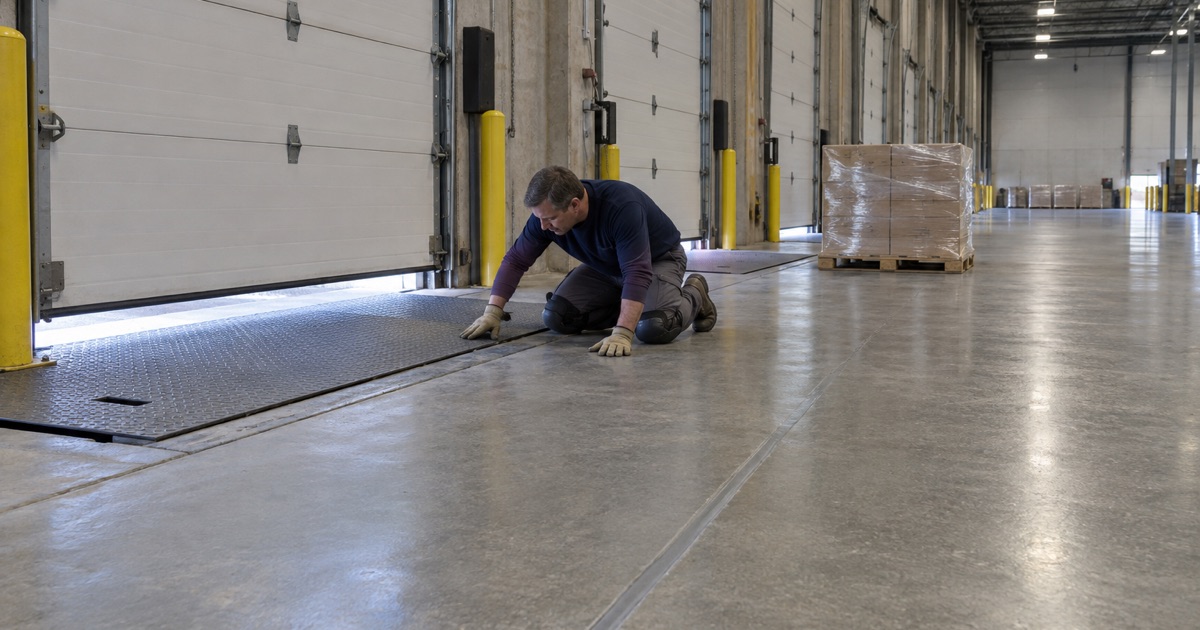
Country Club Hills is a city in Cook County, a suburb south of Chicago, and its 2024 hazard-mitigation annex describes it as one of the few Chicagoland communities with no railroads within its boundaries. Its industry arrived by interstate instead. I-57 and I-80 both pass through, and the newer warehouse buildings sit where trucks reach them straight off the highway.
The Cubes at I-57 and 183rd Street
The Cubes at Country Club Hills sits at the northeast corner of I-57 and 183rd Street, on a 70-acre site with 1,000 feet of interstate frontage. It is a 1,033,450-square-foot building with 40-foot clear heights, a cross-dock configuration and 128 exterior docks. A full-building lease there was executed in January 2023.
We have not worked inside that building, and we do not know which floor system it carries. We bring it up because it shows the kind of floor this city’s newer industry depends on, and the wear pattern that comes with that kind of floor.
LogiPark 57-80 and the Gatling Square Mile
LogiPark 57-80, owned by Logistics Property Co., adds 1.2 million square feet across three buildings and is now fully leased. In January 2024 a trucking and warehousing company took 140,000 square feet there to consolidate two locations into one.
The same annex points to the Gatling Square Mile, a 400-acre parcel it calls the largest undeveloped piece of land in Cook County. If buildings go up there, their floors will face the question the existing ones already do: what happens where wheels cross a joint thousands of times.
Looking for epoxy-flooring closer to Hinsdale? See Hinsdale Epoxy-Flooring.
A Cross-Dock Floor Is a Traffic Lane, Not a Storage Floor
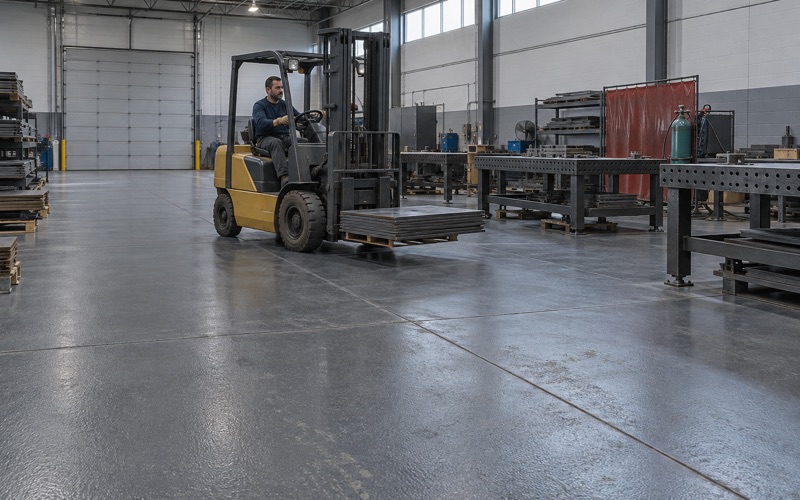
In a storage warehouse, much of the slab sits under racking and sees little movement. A cross-dock works the other way. Freight comes in one set of doors and leaves through the opposite set, so the open floor between them is a lane that forklifts cross all day.
That changes where a floor wears. Instead of spreading evenly, the damage concentrates at the dock-door zone and along the joints that run across the travel path. Hard, small forklift and pallet jack wheels carry heavy point loads, and every crossing strikes the same edges.
Dock plates and door thresholds
At every dock door in a cross-dock, a forklift leaves the trailer, rolls over a dock leveler, crosses the threshold and lands on the slab. Each of those transitions is a small impact, repeated thousands of times. The concrete just inside the door takes the hardest hits, and that is usually where a coating starts to chip first.
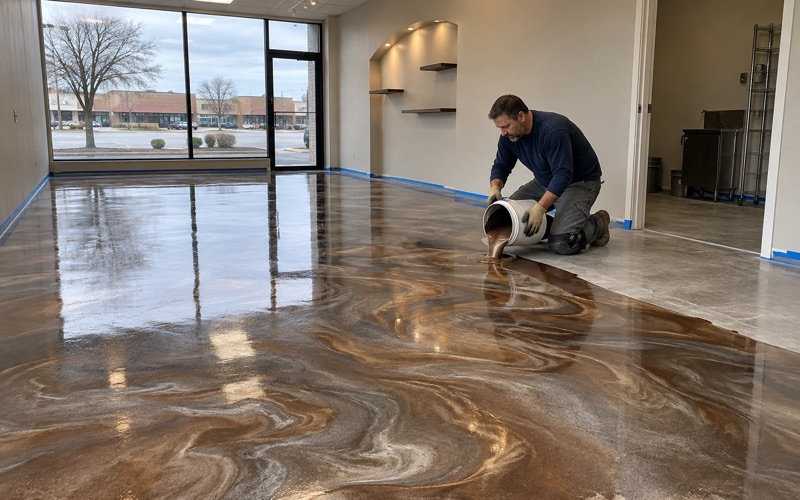
A floor program for that zone is about the wear surface far more than the color. In the lanes, an abrasion-resistant system with a quartz aggregate broadcast or a urethane cement holds up better than a thin decorative coat. On a building that size, the operator’s engineers decide the system, and that is how it should be.
Saw-cut joints and edge chipping
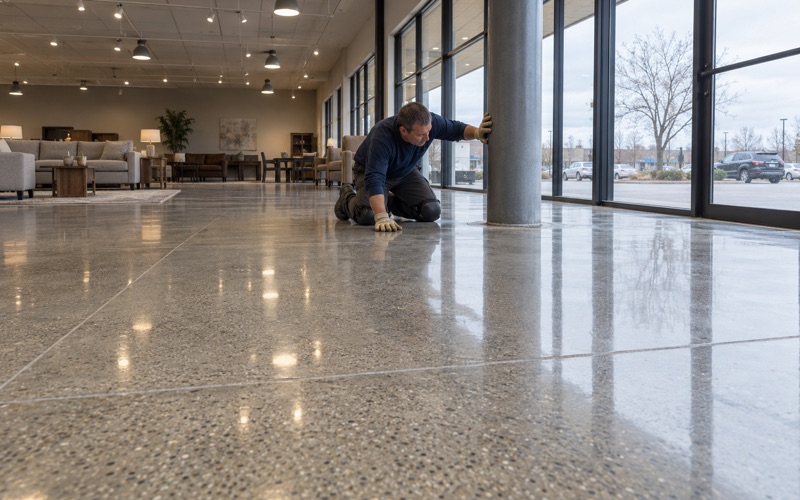
Concrete slabs are cut into panels to control cracking, and those saw-cut joints stay open grooves until something fills them. When a hard wheel drops into an unfilled joint, it strikes the far edge and knocks off small pieces of concrete. Over months the edge rounds over and widens, and each later wheel hits harder.
That is why floor work in a cross-dock starts with joint filling and edge repair, not with the coating itself. A semi-rigid filler supports both edges so the wheel rolls across instead of dropping in. Spalled edges are cut back and rebuilt first, and only then does the coating tie into a joint that can carry the load.
The Garage Version: Fill the Joint a Floor Jack Rolls Over
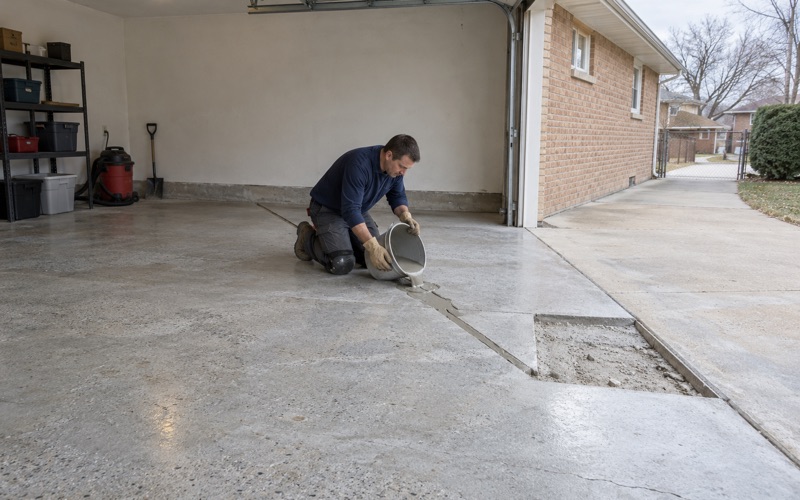
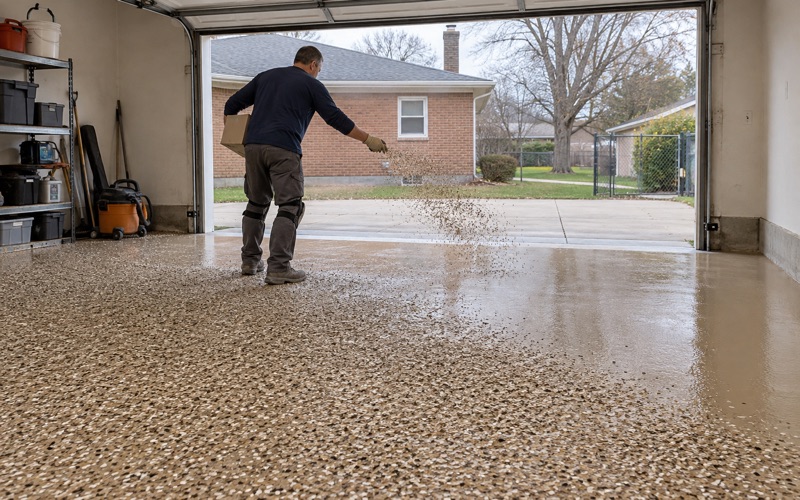
The same failure plays out on a smaller scale in a Country Club Hills garage. Many attached garage slabs have a control joint or a crack running across them, and a floor jack, a creeper or a heavy rolling tool cart crosses it every week. Those wheels are small and hard, much like forklift wheels, and the joint edge chips first.
Housing here puts a lot of those slabs in private hands. About 74.0 percent of occupied homes are owner-occupied, 74.1 percent of units are detached houses and 16.1 percent are single-family attached. The 1970s were the largest build decade, accounting for 30.2 percent of homes, so many slabs have had decades for joints to open and edges to wear.
Joint filling before the coating
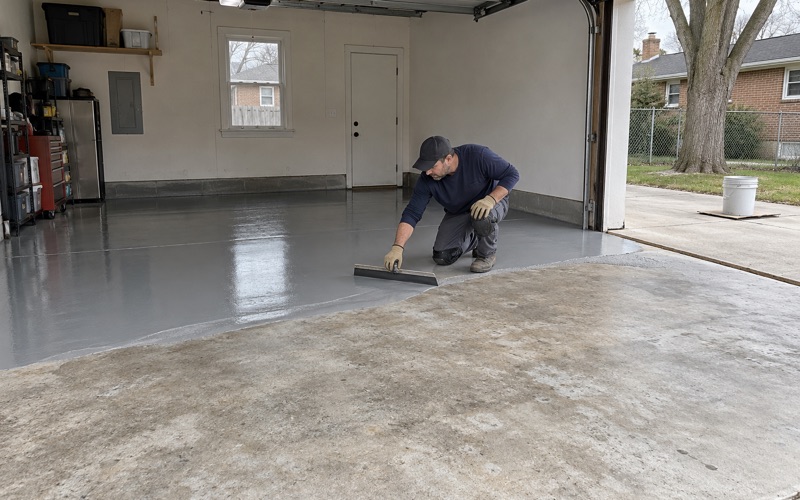
We do not roll a coating across an open joint and hope it bridges. We grind out loose material, rebuild chipped edges and fill the joint so it sits level with the slab. Then the coating goes over a continuous surface, and a jack wheel crosses the line without dropping into it.
Working control joints are a judgment call. Where a joint is still moving, we may cut it back through the finished coating rather than bury it, because a rigid fill over a moving joint will crack along the same line. We explain which joints we are treating each way before the job starts.
Grinding, moisture testing and the system we choose
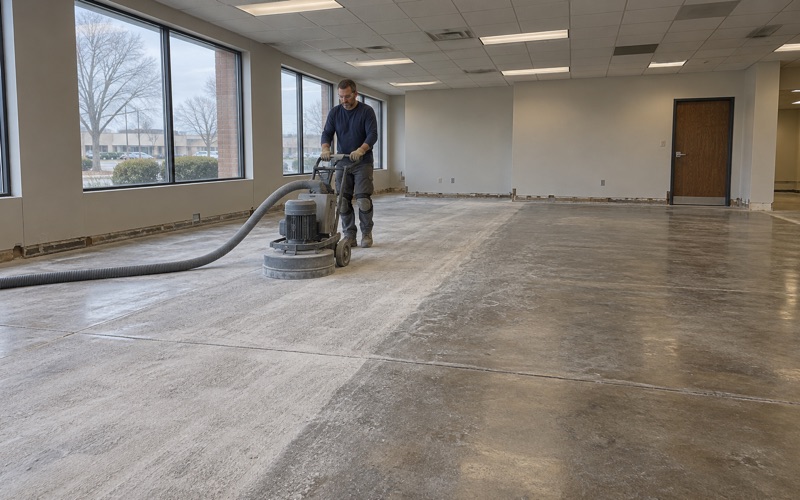
Every slab is opened with a diamond grinder or a shot blaster to a measured profile on the ICRI CSP scale. We never acid etch, because etching leaves a weak surface and no real profile for the coating to grip. Grinding dust is captured at the machine by vacuum instead of being rinsed toward a floor drain.
Moisture comes next. A plastic sheet test under ASTM D4263 gives a quick read, and where the result calls for it we use calcium chloride testing under ASTM F1869 or in-situ relative humidity probes under ASTM F2170. If readings run high, a moisture-mitigation primer goes into the scope, and we explain up front that moisture is the first exclusion in a coating warranty.
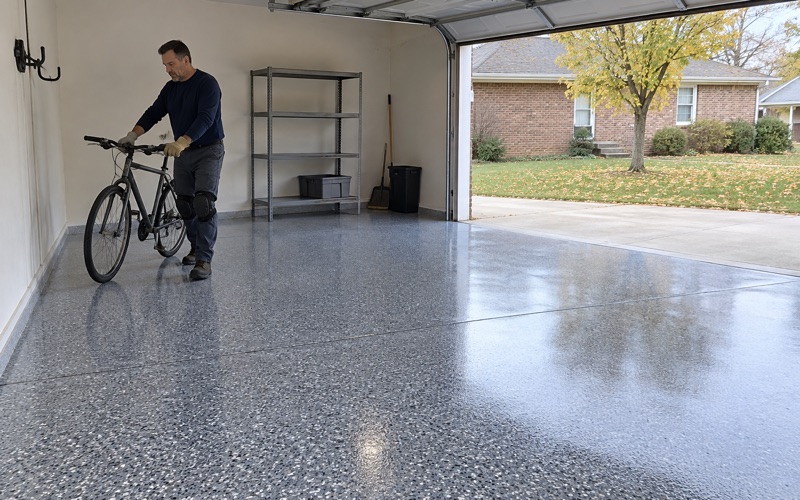
For most garages the build is a 100% solids epoxy base with a vinyl flake broadcast and a polyaspartic topcoat. That combination resists hot tire pickup and handles rolling loads better than a single thin coat. Cure schedules follow slab temperature and the dew point spread at the surface, not the calendar.
City License, $10,000 Bond and Permits at City Hall
Illinois licenses no general, flooring or coatings contractor, so the rules that matter are local. The City of Country Club Hills, incorporated in 1958 and a home-rule city, requires every contractor doing construction work there to carry its own Contractor’s License, a $10,000 surety bond and a certificate of insurance. The license fee is $150 for a general contractor or a subcontractor.
Those are the city’s requirements, and we check them for each job before it is booked rather than assuming another town’s rules carry over. Asking any contractor whether they have met them is a fair question before work starts.
Which work needs a permit
The Community Development and Building Department, under the Building Commissioner, issues all building permits in the city. Its handout says all new construction work, including additions, alterations and repairs, requires a permit, while normal maintenance and repairs do not.
Where a floor coating falls between those two lines has not been confirmed, so the right move is to ask the Building Commissioner before the job is scheduled. A garage coating that includes slab repair may read differently from a straight recoat, and the city makes that call, not the installer.
Filing the application at City Hall
Permit applications are handled at City Hall’s lower level, 4200 West 183rd Street, and the department’s number is 708-798-2616. The city does not accept emailed or faxed permits. Review takes about two weeks, while commercial review runs six to eight weeks.
Commercial review can involve the Zoning Administrator, the Fire Department and the electrical and plumbing commissioners, so a business floor project should allow for that window. We build those weeks into the schedule and phase retail, medical or restaurant floors around opening hours, with overnight or weekend windows when a space cannot close.
Home contracts and what a coating is not
On a home job above the state threshold, we provide a written contract and the Home Repair: Know Your Consumer Rights pamphlet before any grinding starts, as the Illinois Home Repair and Remodeling Act requires. Products are chosen within the Illinois VOC limits for floor coatings, limits that bind whoever applies them.
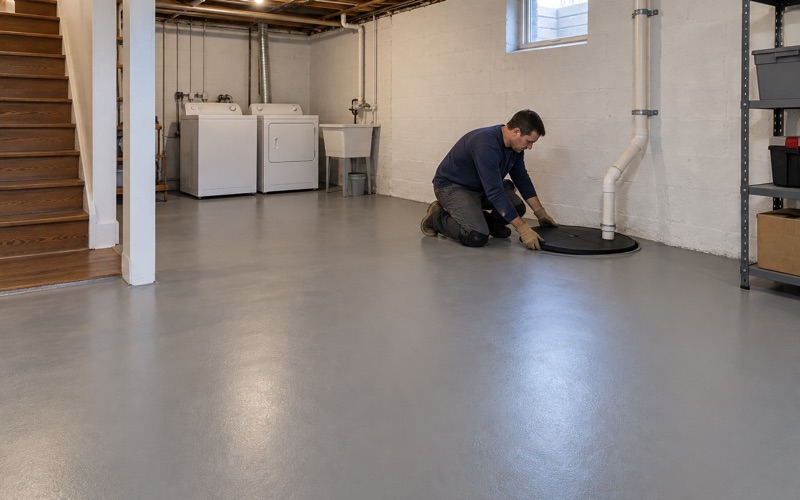
A floor coating also has limits worth stating. It is not flood protection or waterproofing, and we never sell it as radon reduction, because in Illinois that is licensed mitigation work. What it does well is give a sound, repaired slab a durable surface that wheels can cross for years.
- 20+ Years Coating Concrete
- Moisture Tested Before Pricing
- Free Written Estimates