Oak Lawn Epoxy Flooring approaches epoxy flooring in Crestwood the way we have for more than 20 years, starting from one question: what is going to walk across this floor every day? For a store that sells fuel, the honest answer is gasoline, diesel and the gray film that builds up around a pump island. A coating chosen for a dry showroom is the wrong tool for that, and we would rather say so before a quote than after a failure.
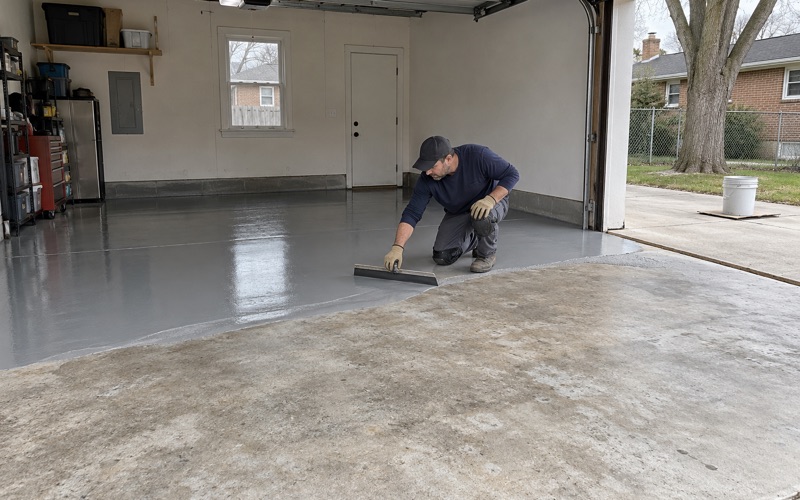
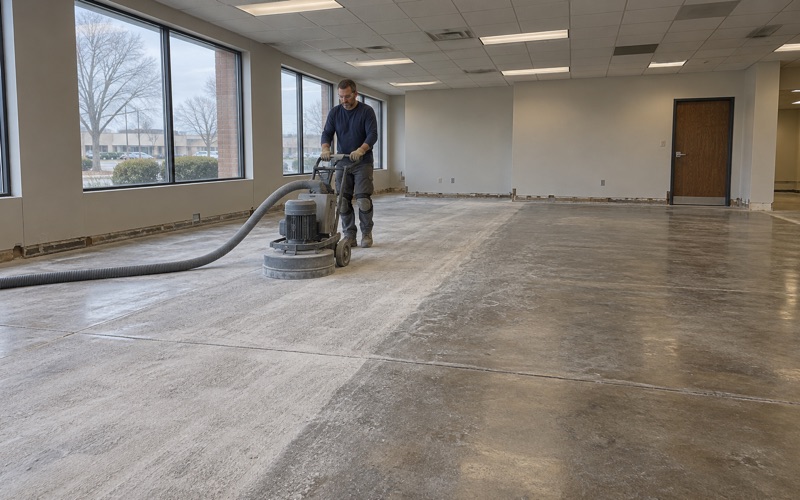
Every slab we coat is opened with a diamond grinder or a shot blaster rather than an acid etch, which leaves a real surface profile for the coating to lock into. Before a commercial price is final, a moisture test is written into the scope, and the proposal names the product line, the number of coats and the finished thickness. That way the owner can check the finished floor against the paper.
Retail floors rarely get to close for a week. We phase the work around opening hours and use overnight and weekend windows when a store has to keep selling, and we capture grinding dust at the machine with a vacuum instead of washing it toward a floor drain.
Crestwood’s Newest Corner and What Walks In From the Pump Island
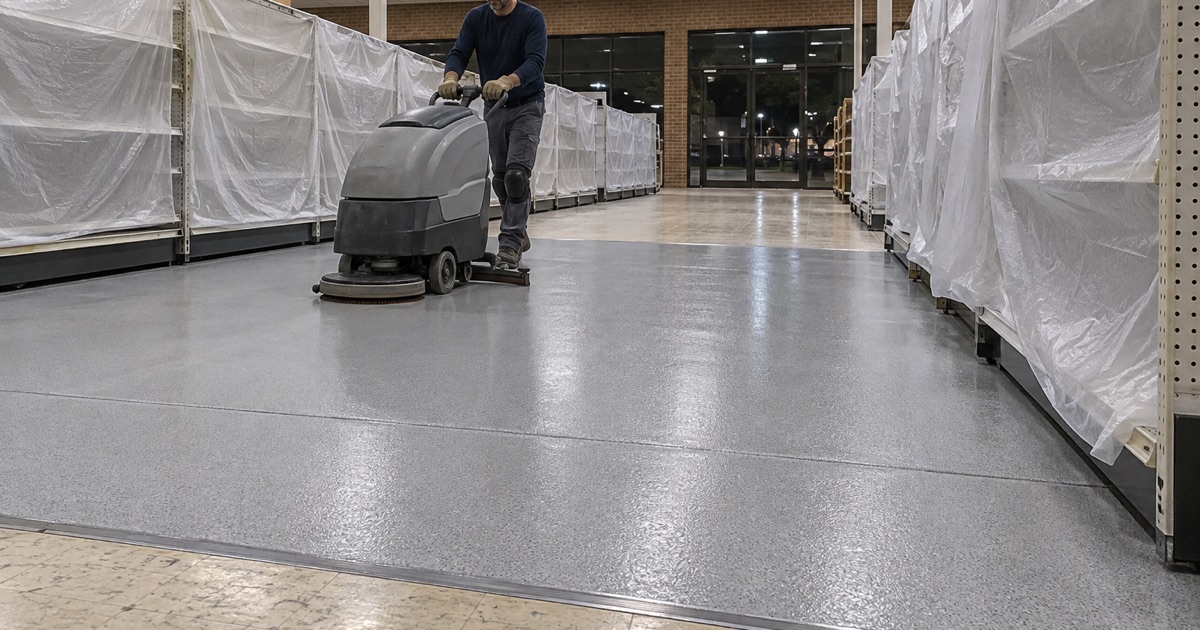
The building at 13960 S. Cicero Ave sits on the signalized corner of Cicero Avenue and the Midlothian Turnpike, and its broker listing calls it Crestwood’s newest retail development. The same listing puts traffic at the corner at over 67,000 vehicles per day and names Lindy’s Gas and Aviator Coffee as tenants of an 11,752-square-foot building on a 5.2-acre lot.
From footings to an open store
The village’s own Committee of the Whole minutes trace the project. In June 2025 the Village Services Director reported the building footings being poured, and in February 2026 the mayor’s report said Lindy’s was planning a February 25 grand opening. On March 17, 2026, the minutes recorded that the Lindy’s C-store was open and doing business as of early March.
The address geocodes inside Crestwood village in Bremen Township, Cook County, even though it carries a 60445 mailing ZIP. That ZIP also covers Midlothian, so we go by the village boundary rather than the ZIP when deciding whose building department a job answers to.
What a shoe carries in from the fuel island
We have not seen the floor inside Lindy’s, and we make no claim about its condition. What we can describe is the general mechanism at a fuel-and-convenience store: drips at the nozzle, diesel residue near the pumps and oily grime on the apron get picked up by shoe soles and walked straight to the register. On a corner carrying that much daily traffic, the trips across one threshold add up quickly.
Petroleum on a floor does two kinds of damage. Some coatings soften or stain under repeated contact with gasoline and diesel, and a film of oil on a smooth finish turns the first few feet inside the door into the slipperiest part of the store.
Why the entry takes the worst of it
Tracking is heaviest in the first stretch past the door and fades toward the back aisles as soles wipe themselves clean. That gradient matters for planning, because the entry zone and the path to the counter need the toughest build, while shelving areas can share the system without as much texture. We map traffic lanes during the walkthrough so the scope reflects how the store is actually used.
Looking for epoxy-flooring closer to Summit? See Epoxy-Flooring Services in Summit.
A Light, Fuel-Resistant, Textured Floor
Three properties carry most of the weight on a store floor that takes fuel tracking: chemical resistance, slip texture and a color that shows dirt. We specify each one in writing so the owner knows which product is doing which job.
Resistance to gasoline, diesel and solvents
A 100% solids epoxy base gives the system its build and adhesion, but the topcoat is what meets the fuel. Polyaspartic and polyurea topcoats are common choices where solvent and chemical resistance matter, and urethane cement systems are built for harsher chemical and hot-water exposure. We match the topcoat to the exposure its product data supports, and we name that line in the proposal instead of calling it industrial grade.
Thickness matters as much as chemistry. A thin roll-on paint film can wear through at a busy door, while a broadcast system builds enough material that wear shows up as dulling long before it reaches the concrete.
Slip texture where shoes arrive wet
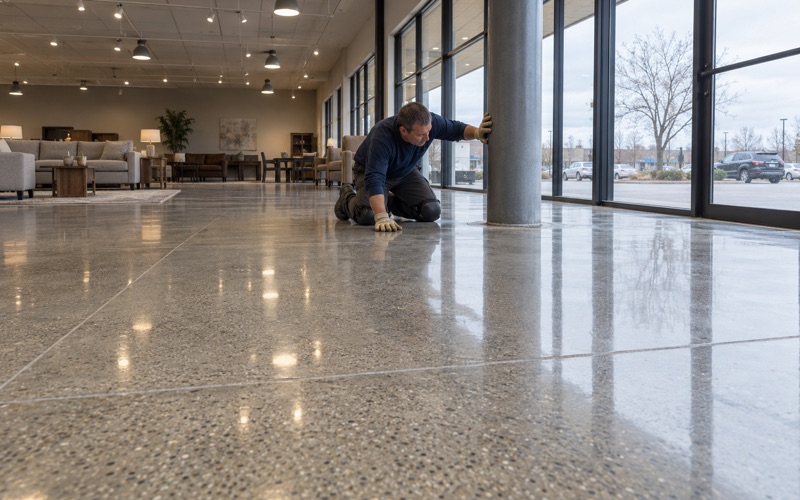
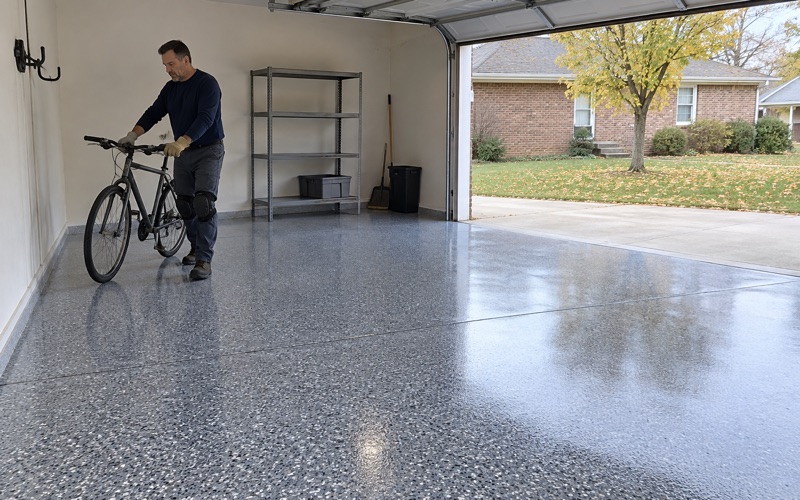
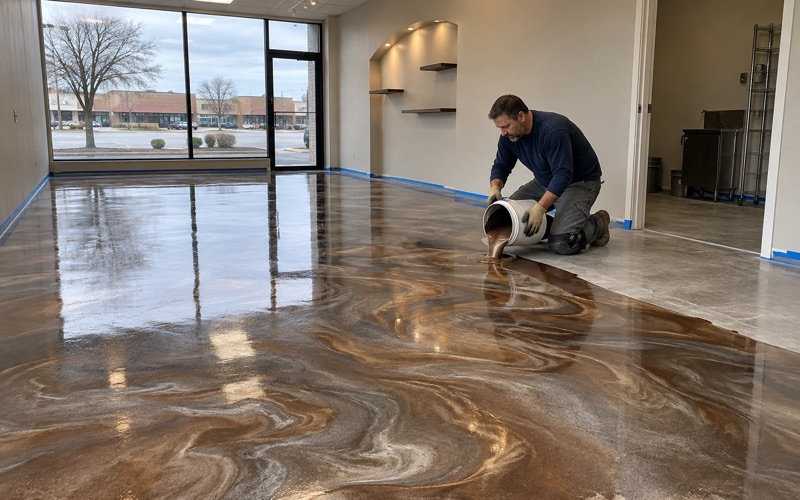
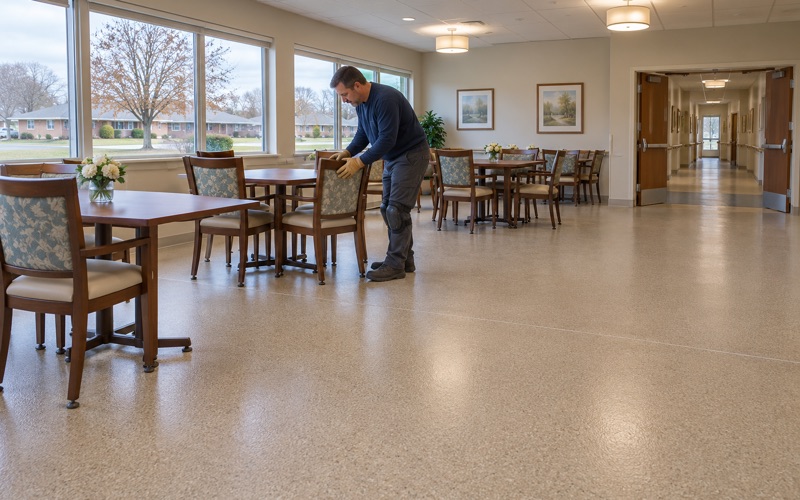
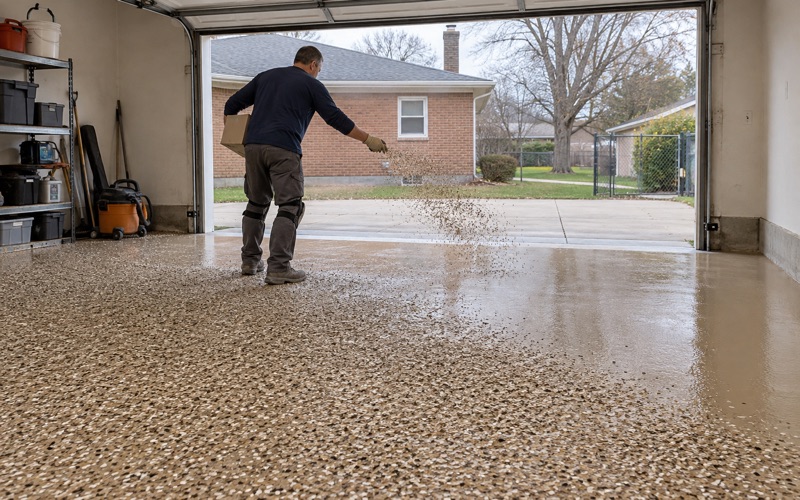
A glossy finish looks good on day one and turns treacherous under a film of oil or melted snow. We build texture into the entry with a quartz aggregate broadcast or a vinyl flake broadcast locked under the topcoat, and we can add a fine grit to the final coat. The trade-off is cleanability, so we set the texture coarser at the door and finer deeper into the store.
Texture is a decision an owner should make with a sample in hand. We bring test boards so a manager can wipe them, scrub them and feel how a mop drags across each profile before the choice is final.
A light color that shows the spill
Dark floors hide tracked-in grime, which sounds like an advantage until nobody notices a slick patch near the door. A light gray field makes oily footprints visible, so staff can mop them before a customer finds them. Light floors also bounce more of the store’s lighting back up toward the shelves.
Light color does ask more of the topcoat. Some epoxies amber under ultraviolet light coming through glass storefronts, so we keep a UV-stable topcoat over a light base wherever sunlight reaches the floor.
A 2025 Slab and the Moisture Test Before Any Coating
The building at this corner went from footings in June 2025 to an open store in early March 2026. A slab placed in that window can still be releasing water from its mix, and moisture moving up through concrete is one of the most common reasons a coating lifts.
Why a new building is not a dry floor
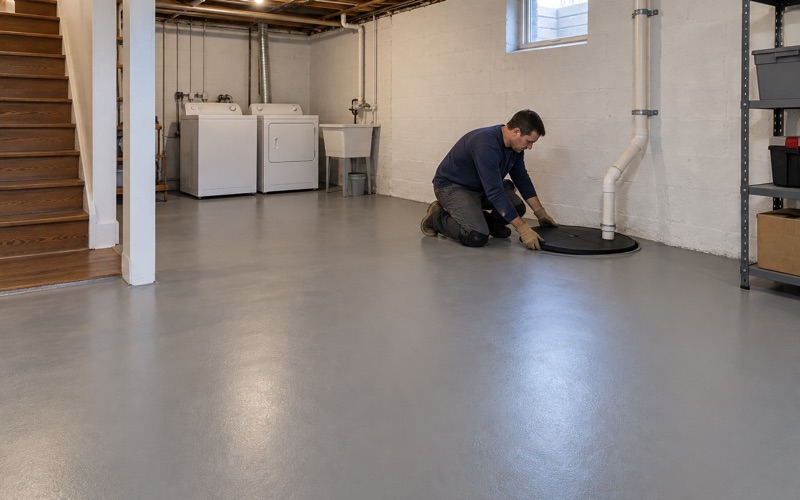
Concrete gives up water slowly, and a store that has been heated, cooled and occupied is not the same thing as a dry slab. Vapor pushing up from below can collect under a coating until it blisters or loses its bond, often in patches that show up months after the job. Our warranty discussion names moisture as the first exclusion, which is exactly why we test before we price rather than after.
The tests we run
On a commercial slab we lean on ASTM F2170 in-situ relative humidity probes, which read moisture inside the concrete rather than at its surface. ASTM F1869 calcium chloride testing measures the moisture vapor emission rate across the surface, and an ASTM D4263 plastic sheet test is a quick screen that flags trouble but does not clear a slab on its own. We compare results against the coating maker’s published limits, not a rule of thumb.
When readings come back high, the answer is usually a moisture-mitigation primer under the system rather than a delay with no end date. We put the numbers, the recommendation and any added cost in writing before grinding starts.
Profile, cracks and cure conditions
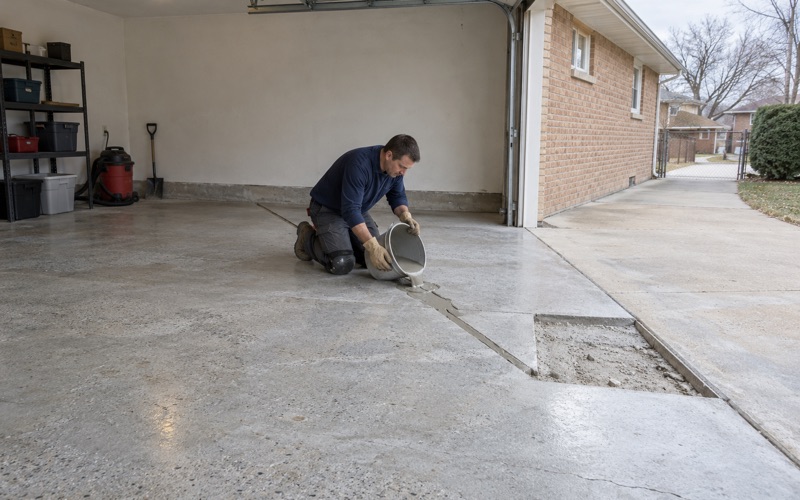
Once moisture is settled, we open the slab with a diamond grinder or shot blaster to an ICRI concrete surface profile matched to the thickness of the system. Cracks, saw cuts and any spalls are mapped and filled at this stage, and we say so plainly if a section needs repair first. Cure timing follows slab temperature and the dew point spread at the surface, which helps keep amine blush off fresh epoxy.
The Coffee Counter, the Open Unit and Village Paperwork
The listing for this corner describes more than a fuel store. Aviator Coffee is named as a tenant, and 1,926 square feet of retail, medical or office space was marketed as available, so the building’s floors serve more than one kind of business.
The coffee side of the building
A coffee counter shares the same parking lot, and with it some of the same tracked-in grime at its own door. Behind the bar the floor has a different job, taking frequent wet mopping and dropped cups. We would treat the entry and the work area as separate zones with their own texture rather than run one finish across the whole space.
We have no relationship with any tenant or owner at this address, and we have not inspected these floors. These are the questions we would raise with anyone planning floor work in a building like this one.
The vacant 1,926-square-foot unit
An empty unit is the easiest time to get a floor right. With no shelving or equipment in place we can grind wall to wall, test the slab and finish the coating before a build-out closes in. Whether that space becomes a shop, a clinic or an office decides the system, since a medical waiting room and a retail floor call for different textures and cleaning routines.
A tenant planning a build-out should raise the flooring question before walls and fixtures go up. Coating around a finished counter is harder and costlier than coating first and setting the counter on top.
Registering with the Village of Crestwood
Illinois licenses no general, flooring or coatings contractor, so local rules are the ones that count. The Village of Crestwood requires every contractor to register, at $100 for a general contractor and $25 for a sub-contractor, with a certificate of insurance naming the village as additional insured. We file that registration before a Crestwood job is booked.
The village’s Building and Zoning Department at 13800 S. Cicero Ave lists painting and carpeting as permit-exempt but does not name floor coatings either way. We ask the department directly rather than assume, and we choose products inside the Illinois VOC limits for floor coatings, which bind whoever applies them.
If you own or lease space near Cicero Avenue and the Midlothian Turnpike and your floor takes traffic from the fuel lanes, we start with a walkthrough, a moisture test and a written scope. The price follows the readings, not the other way around.
- 20+ Years Coating Concrete
- Moisture Tested Before Pricing
- Free Written Estimates