Oak Lawn Epoxy Flooring has spent more than 20 years on epoxy flooring in Harvey and the surrounding south suburbs, and the Harvey floor we get asked about most is the one that never fully dries. In a machine shop or fabrication bay, that means coolant and forming lubricant on the concrete through every shift. Our job is to choose a system that keeps working under that film, not one that only looks good on the day it cures.
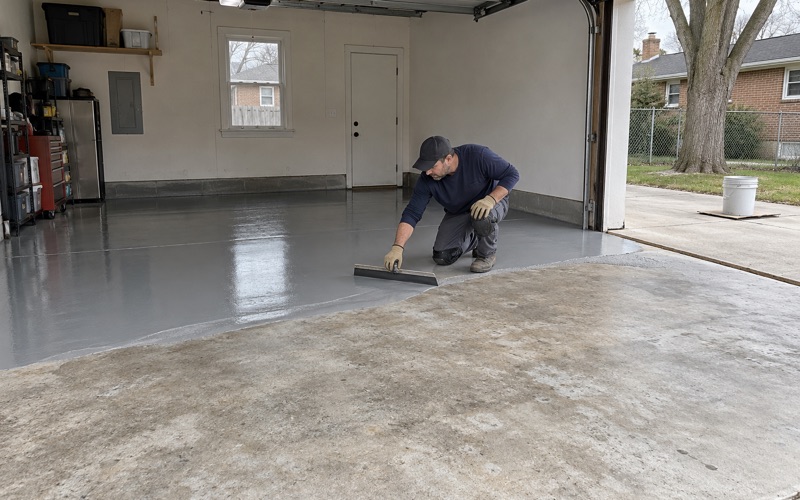
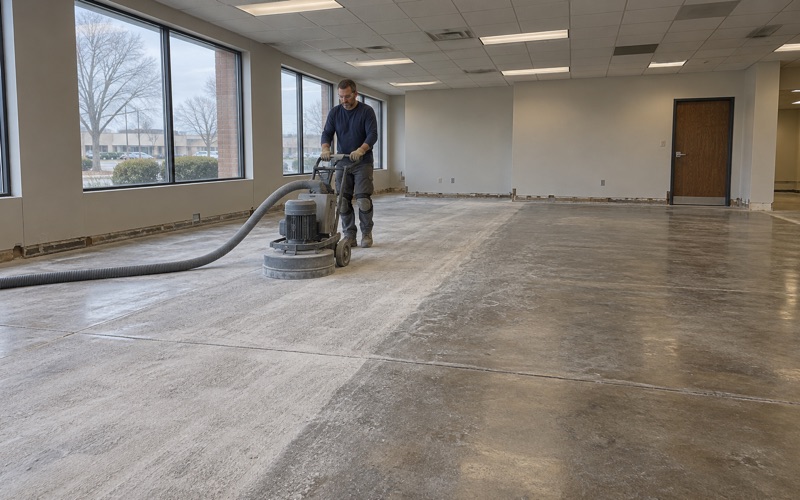
Every Harvey slab we coat is opened with a diamond grinder or a shot blaster, never an acid etch, because a coating on a wet-working floor lives or dies by its bond. Before the price is final, a moisture test goes into the written scope. The proposal then names the product line, the coat count and the finished thickness, so a shop owner or a homeowner can hold the floor to the paper.
We also say plainly when a floor should not be coated yet. Cracks, spalls and old coatings get mapped first, and an owner whose slab needs repair or replacement hears that from us before hearing a price.
A Steel-Tube and Conduit Mill on Lathrop Avenue
Allied Tube & Conduit and a factory-town start
Harvey was laid out as an industrial suburb. In 1889 Turlington Harvey, a Chicago lumberman and banker, organized a real-estate syndicate to promote it, and by 1900 the town counted 5,395 residents, a bank and 11 industries. The city’s own 2024 hazard-mitigation annex says Harvey used to be a large manufacturing center, and that factories have since closed and businesses have left.
One maker still running is Allied Tube & Conduit at 16100 S. Lathrop Avenue, an address that geocodes inside Harvey city limits in Thornton Township. The plant makes galvanized steel tube, pipe and electrical conduit, along with metal framing systems and building components. The same address is the corporate headquarters of Atkore, the company Allied is now part of.
Allied is known for an in-line galvanizing technique called Flo-Coat, which applies zinc as the tube and pipe are formed. We bring the mill up because it shows what kind of town Harvey still is, not because we have worked there. Allied is not our customer, we have never seen its floors, and a plant of that size has its own engineering and safety staff deciding what goes on its concrete.
Coolant emulsions: why a metalworking floor stays damp
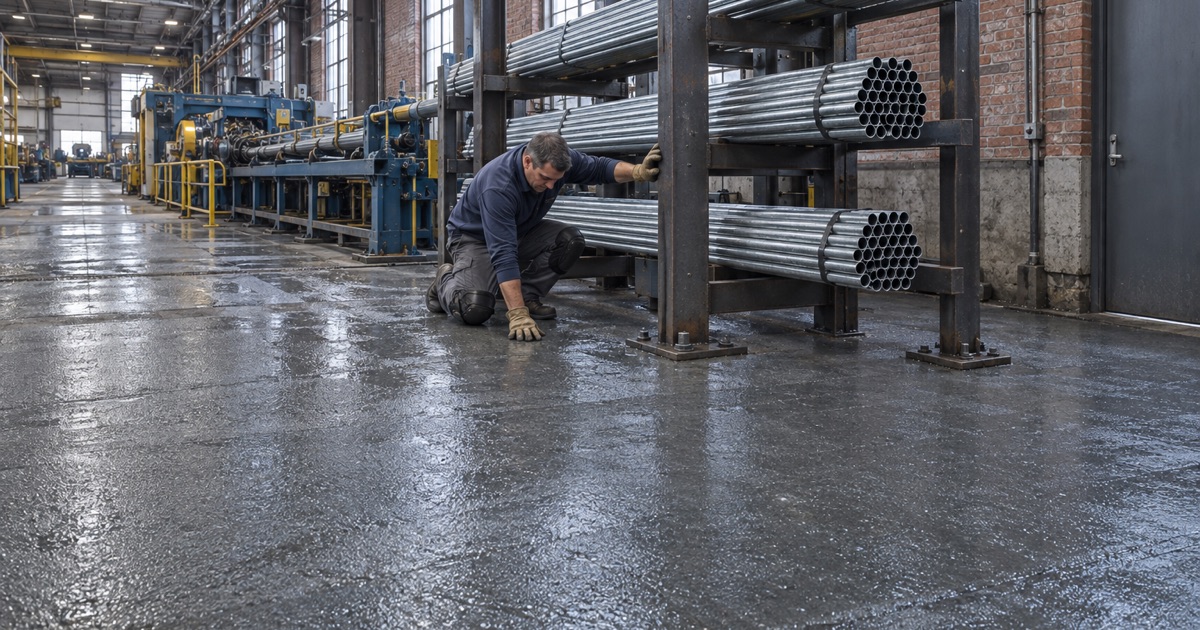
Metal forming and cutting across the trade generally run on water-mixed coolant emulsions and forming lubricants. That is a general description of metalworking, not a report about any one Harvey plant. What it does to a floor is consistent, though: the concrete near the machines stays damp and filmed through the shift, which is a different problem from an occasional drip of motor oil in a garage.
A water-mixed emulsion carries both water and oil onto the surface. Bare concrete soaks it up, darkens and becomes hard to clean, and over the years the contamination works down into the pores. A coating on that floor has to tolerate constant wetting without softening or lifting at its edges, and it has to be bonded to concrete that was properly cleaned and profiled first.
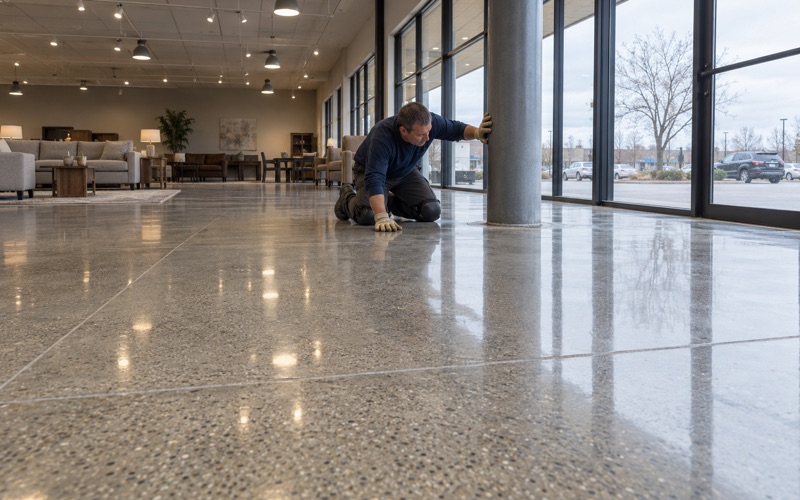
That is why our prep is something we can measure. Grinding or shot blasting to a defined ICRI concrete surface profile opens the slab, and a contaminated floor is degreased and checked again before any primer goes down. Where fluid has soaked deep into an older slab, we tell the owner whether the concrete can be cleaned well enough to hold a bond or whether that section needs to be cut out and replaced.
Looking for epoxy-flooring closer to La Grange? See La Grange Epoxy-Flooring.
Grip When the Floor Is Filmed
Texture that still works wet
A smooth, glossy epoxy is the wrong floor beside a lathe or a press. Once a coolant film covers it, a slick finish loses much of its grip, and the people working that station are the ones who pay for it. Slip resistance on a wet or oily industrial floor comes from texture built into the system, not from a coating left as smooth as glass.
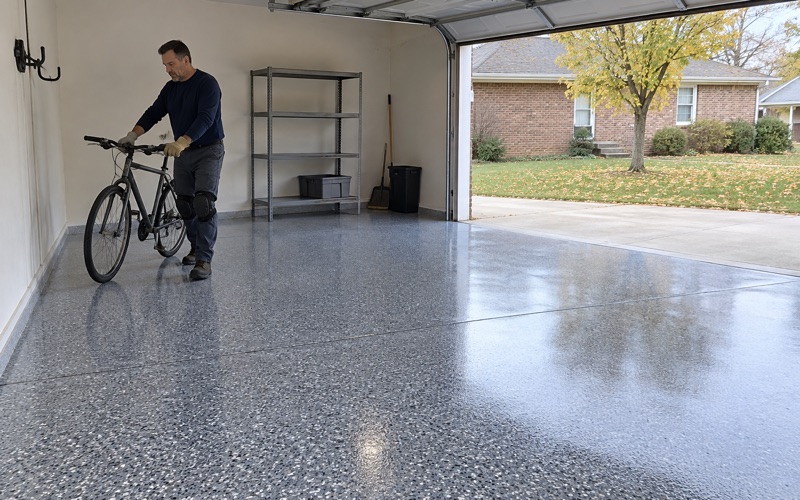
We usually broadcast quartz aggregate into the body coat and lock it in with the topcoat, sized so the peaks still stand above a thin film of fluid. In the wettest zones a urethane cement system is often the better base, because it is built to tolerate water and heat in ways a standard epoxy is not. A 100% solids epoxy with a lighter broadcast suits the drier aisles and storage areas.
Cleanability is the other half
Texture that grips can also trap grime, so the profile has to be one a crew can actually clean. Too coarse and a mop shreds on it while residue builds in the low points; too fine and the grip disappears once the floor is filmed. We match the aggregate size to how the floor is cleaned now, whether that is an auto-scrubber, a squeegee or a mop and bucket.
A polyaspartic or polyurea topcoat over the broadcast gives a tight, chemical-resistant surface that releases residue more readily than bare concrete. Before the job is sold, we also walk through what the coating warranty leaves out. Moisture is the first exclusion we name, and on a floor that sees fluid every day, the owner should know exactly where those limits sit.
Where forklifts and carts run
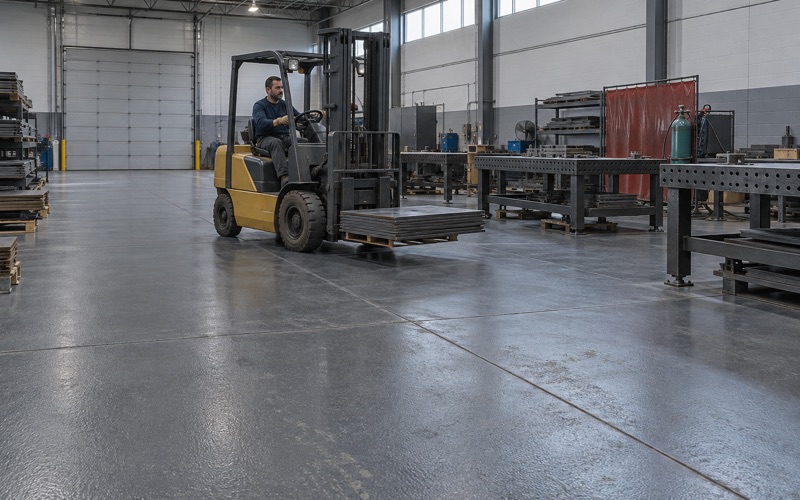
Fabrication bays often move pallet jacks and forklifts across the same floor that carries the coolant film. Those wheel loads concentrate on a small contact patch and grind loose grit into the surface. The finished thickness written into our proposal reflects that traffic, so a forklift aisle may get a heavier build than the benches and walls beside it.
Harvey’s Older Industrial Blocks: Shops, Bays and Truck Garages
The coolant question does not only belong to a plant the size of a tube mill. It applies at the scale where a local contractor actually works: the small machine shops, fabrication bays and trade buildings left in Harvey’s older industrial blocks. Many of these run a few machines on one open slab, with a bench area, a parts room and an overhead door.
Machine shops and fabrication bays
In a working shop the floor is rarely uniform. The ground under and around each machine sees coolant and chips, the welding corner sees spatter and heat, and the aisle sees carts. We map those zones before quoting, because one system across the whole room either overspends on the dry corners or underbuilds where fluid sits.
Work in a running shop is phased so production does not stop. We can coat in sections around the machines, using overnight and weekend windows when a bay cannot close. Grinding dust is captured at the machine with a vacuum instead of being rinsed toward a floor drain or a storm inlet.
Truck garages and service bays
Truck garages face a winter problem as well as a shop one. Brine and rock salt ride in on tires all season and pool around parked vehicles, then dry into a crust that eats through weak coatings. We choose garage systems that hold up to those deicers, and we plan around hot tire pickup where heavy tires park on the finished floor.
Cure schedules follow slab temperature and the dew point spread at the surface, not the calendar. An unheated bay in deep winter is told to wait, because coating a cold slab close to its dew point invites amine blush and a weak bond. Waiting a few weeks costs far less than grinding off a failed floor in spring.
Products and permits
Every product we specify falls inside the Illinois VOC limits for floor and industrial coatings, which bind the person applying them. Illinois licenses no flooring or coatings contractor, so local rules carry the weight. Harvey requires a contractor to be registered and licensed with the city before any work starts, and we check those terms for every job before it is booked.
The city lists all work requiring the pouring of concrete among jobs that need a permit, applied for in person at the Planning Department, 15320 Broadway Avenue, with 7 to 10 days to process. A coating over existing concrete is not on that list as the city states it. We confirm the scope with Planning, Building and Inspectional Services, and any slab replacement we recommend is planned around that permit.
Reopening a Vacant Building: Down to Sound Concrete First
A good share of Harvey’s building stock has stood empty for a time. In the census estimate, 23.8 percent of housing units were unoccupied, and the city’s annex notes that Harvey has many abandoned buildings. When a house, garage or small shop comes back into use after a vacancy, the history of its floor is usually unknown.
Unknown prior coatings
An empty building often carries paint, sealer or an old epoxy that nobody on hand can name. Some of it is well bonded and some is barely hanging on, and a new coating is only as strong as the layer under it. In most cases we take the old material off entirely, because a new floor bonded to an unknown one inherits its weaknesses.
Shot blasting or diamond grinding takes the slab down to sound concrete and leaves a profile the primer can grab. That pass also exposes what the old coating was hiding: cracks, spalls, patched trenches from removed equipment and soft spots. Each one gets mapped and priced as repair, and a slab that is too far gone is called a replacement job rather than a coating job.
Moisture before anything new goes on
A building that sat closed without heat or ventilation may hold more moisture in its slab than one in daily use. We test before the price is final, using ASTM F2170 in-situ relative humidity probes or ASTM F1869 calcium chloride testing depending on the slab, with an ASTM D4263 plastic sheet test as a quick first read. If the readings run high, a moisture-mitigation primer goes into the scope instead of appearing as a surprise later.
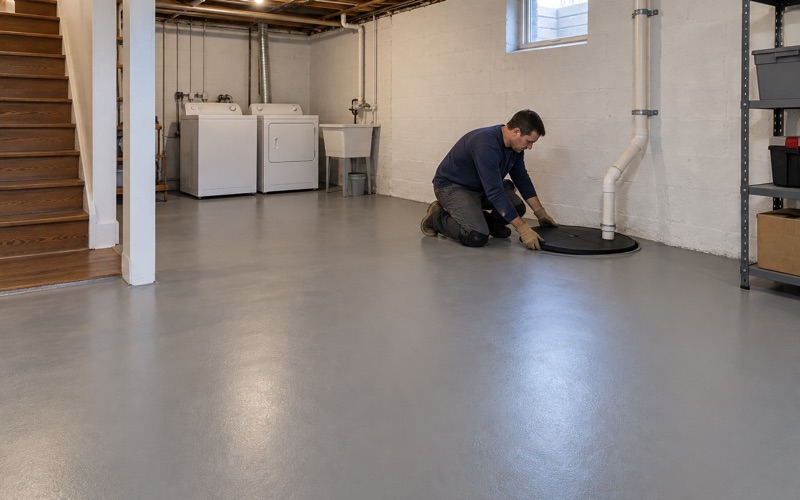
A coating is not a fix for water arriving from outside the slab. If a basement takes water from seepage or a sewer backup, that source has to be dealt with first. We never sell an epoxy floor as waterproofing, and never as radon reduction, which in Illinois is licensed mitigation work.
Homes coming back after vacancy
Houses bought out of vacancy bring the same questions to a basement or garage floor. Home jobs over the state threshold get a written contract and the Home Repair: Know Your Consumer Rights pamphlet before any grinding begins. Mobile homes make up part of Harvey’s housing, and their floors are not concrete slabs, so we tell those owners up front that theirs is not an epoxy job.
Whatever the building, the first visit is the same. We look at what runs across the floor, what lands on it, how it gets cleaned and what was on it before. The system we propose comes from those answers, written down with its product line, coat count and thickness so the finished floor can be checked against the quote.
- 20+ Years Coating Concrete
- Moisture Tested Before Pricing
- Free Written Estimates