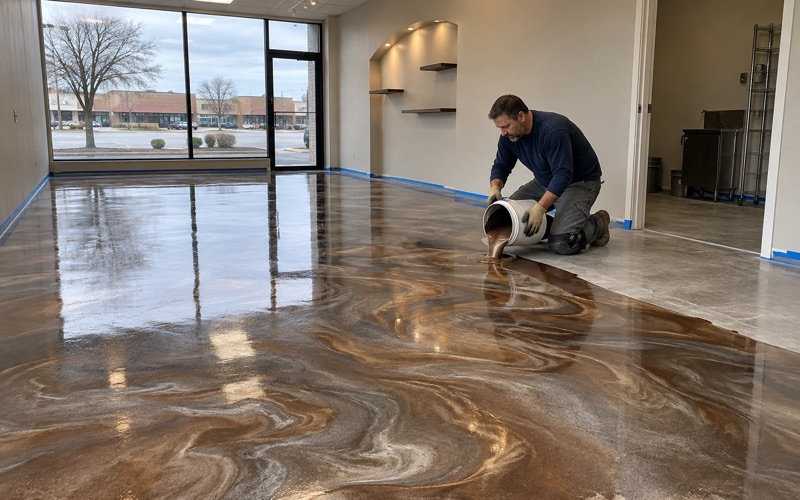
Oak Lawn Epoxy Flooring has spent more than 20 years on epoxy-flooring in Hazel Crest and the south suburbs, and the first question we ask on a job here is where the hot work happens. A welder, an angle grinder or a cutting torch changes which parts of a floor should carry resin at all. We would rather plan that boundary with you on paper than repair it after the first spark lands.
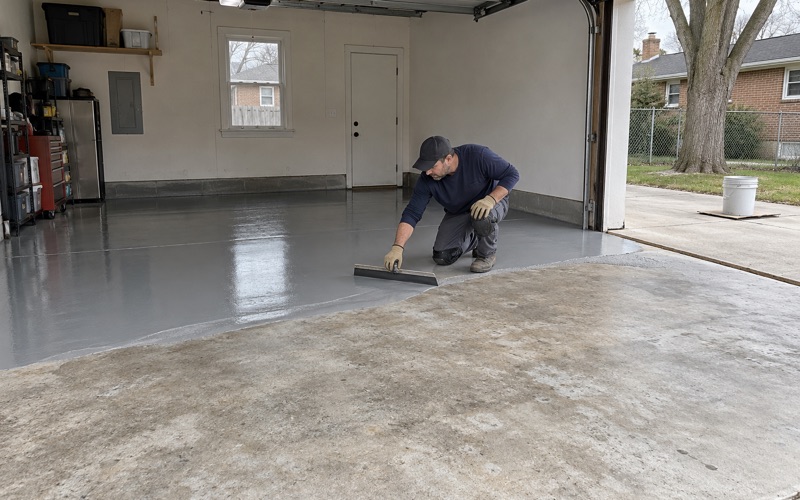
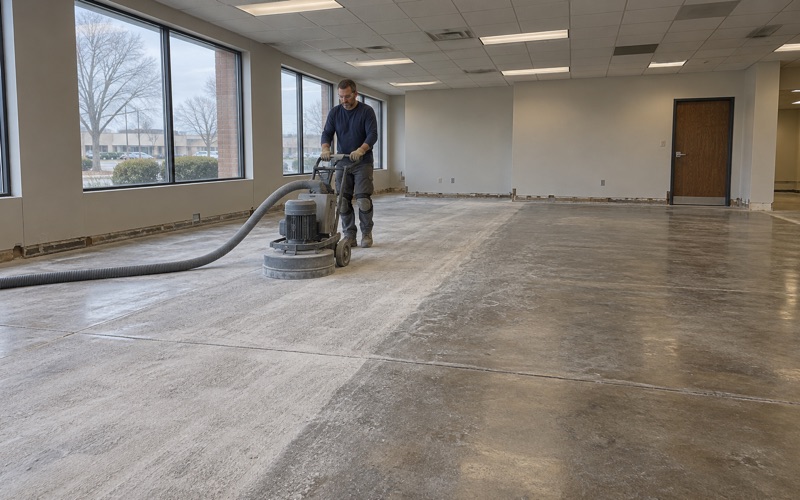
Every slab we coat is opened mechanically with a diamond grinder or a shot blaster, never an acid etch, so the primer bites into real profile instead of a smooth, sealed surface. Before the price is final, the written scope includes a moisture test, and the proposal names the product line, the coat count and the finished thickness so you can hold the floor up against the paper.
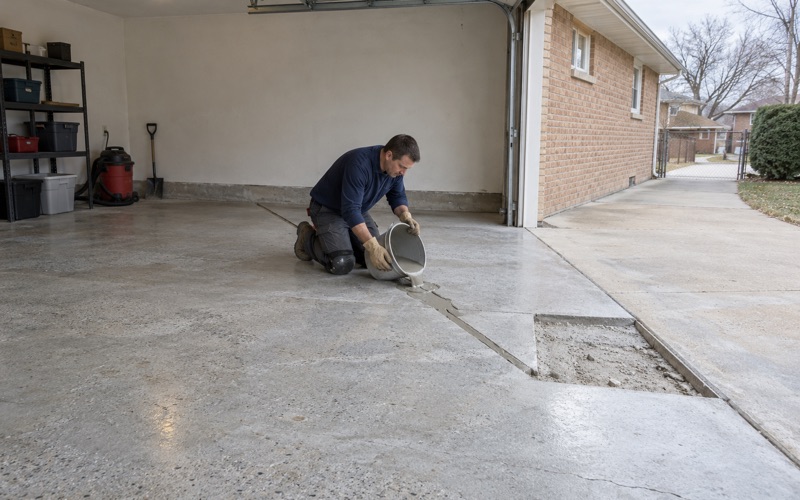
That discipline is the same whether the floor belongs to a fabrication bay or a two-car garage with a welder parked against the back wall. The scale changes and the loads change, but the question of where the coating should stop is the one that decides whether the floor still looks right in five years.
A Crane Builder on 167th Street, and What Hot Work Does to Resin
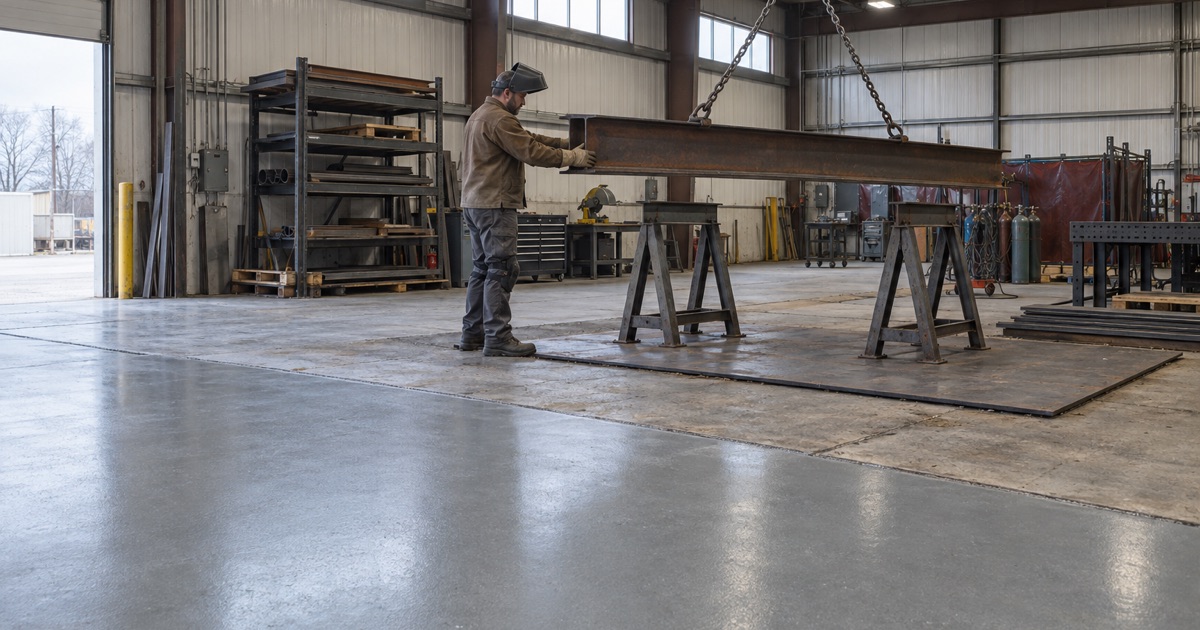
Hazel Crest’s industry fits on a short stretch of road. The village’s 2024 hazard-mitigation annex says industrial development is ‘very limited and mostly confined to the south side of 167th Street east of Kedzie Avenue,’ and the anchor there is Mi-Jack Products at 3111 W. 167th Street, in the Bremen Township part of the village.
Mi-Jack Products and its move toward welding and fabrication
Mi-Jack has built material handling equipment since 1954, including the Travelift and Translift rubber-tired gantry cranes it says are used on six continents. In a February 16, 2026 release, the company said a new 200,000-square-foot plant in Monee would handle all assembly, while ‘the Hazel Crest location will focus on increased welding and fabrication capacity.’
We have never worked for Mi-Jack and have not seen its floors. We mention the shift because it puts the floor problem that welding creates in plain view on 167th Street, and because the same problem shows up, in smaller doses, in garages and small shops across the village.
Spatter and grinding sparks on a coated floor
A weld throws molten droplets, and a grinder throws a stream of hot steel particles. When either lands on an epoxy or polyaspartic film, it can pit the surface, scorch it brown or leave a small crater with a bead of metal fused into it. No resin system we install is immune to that, and we will not describe one as if it were.
Thicker, harder systems hold up better than thin roll-on garage paint, and a quartz aggregate broadcast gives the surface more body than a bare clear coat. Still, repeated spatter in one spot wears through any of them over time. The honest plan is to keep the hottest work off the coating rather than hope the coating shrugs it off.
Slag, steel plate and heavy fabrications
Chipped slag is sharp and often still hot, and it gets ground into a floor under boots and casters. Steel plate dragged across a coated slab gouges it, and a heavy fabrication set down on one edge concentrates its weight on a line no wider than a pencil. Those are impact and abrasion loads, and they call for different decisions than a floor that only carries parked cars.
Looking for epoxy-flooring closer to Country Club Hills? See Epoxy-Flooring Services in Country Club Hills.
Where the Coating Stops: Zoning a Floor Around Hot Work
In welding and fabrication spaces, the floor around the welding stations is commonly left as bare or hardened concrete, or covered with protection, and the coating goes where the hot work does not. We draw that line on a floor plan before we price anything. Coating less floor well is usually cheaper over the years than coating all of it and patching scorch marks.
Bare, densified or protected concrete at the weld stations
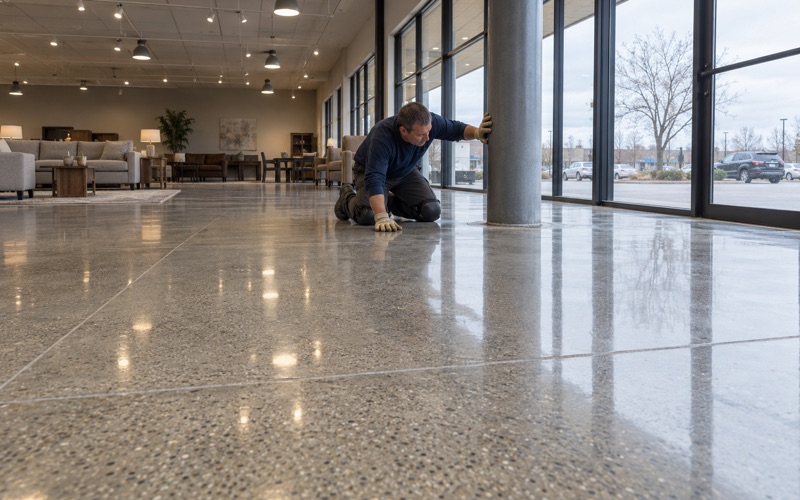
Where welding happens day after day, a lithium silicate densifier hardens the top of the slab and cuts dusting without putting a resin film in the path of spatter. Some owners prefer a removable cover, such as steel plate or welding blankets laid over the slab at each station. Either way, the edge of the coated area should be a clean, deliberate line rather than a ragged boundary where traffic wore through.
Coated aisles, benches and storage
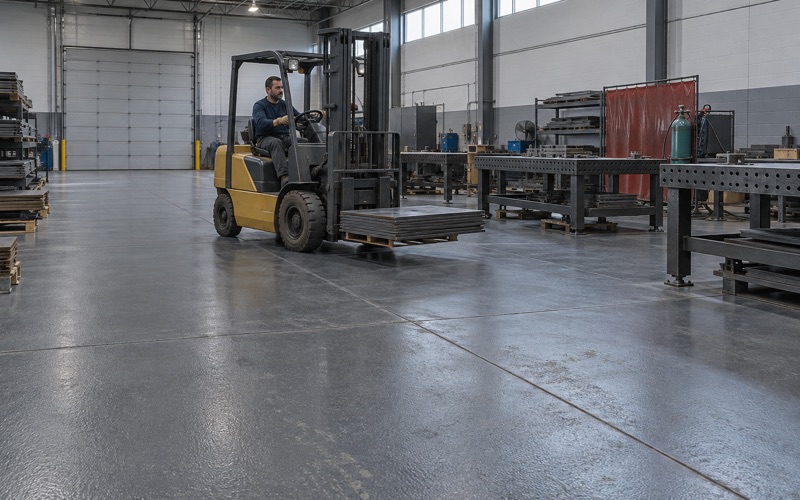
Aisles, parts storage, finishing benches and break areas are where a resin system earns its cost. A 100% solids epoxy body coat with a broadcast and a polyaspartic or polyurea topcoat resists the oil, coolant and tire traffic those zones carry, and it cleans quickly. Forklift and pallet jack wheel loads factor into that choice, since hard, small-diameter wheels punish thin films.
If a space runs hot water washdowns or sees thermal shock near ovens, urethane cement is worth discussing for those zones instead of standard epoxy. We lay out the options side by side so the decision rests on how each area is actually used.
Mapping the slab before the line is drawn
Cracks, spalls and old coatings are mapped first, and when a section of slab needs repair or replacement before it should be coated, we say so in writing. Grinding dust is captured at the machine by vacuum, never rinsed toward a floor drain or a storm inlet. Products are selected inside the Illinois VOC limits for floor and industrial coatings, which bind whoever applies them.
The Home or Trade Garage Where Someone Welds or Grinds
The same hot-work question belongs in a house garage. A homeowner with a MIG welder for trailer repairs, a hobbyist building furniture frames, or a tradesperson grinding parts on weekends all put sparks on the floor, just less often than a production shop does.
Leave a welding corner, coat the parking side
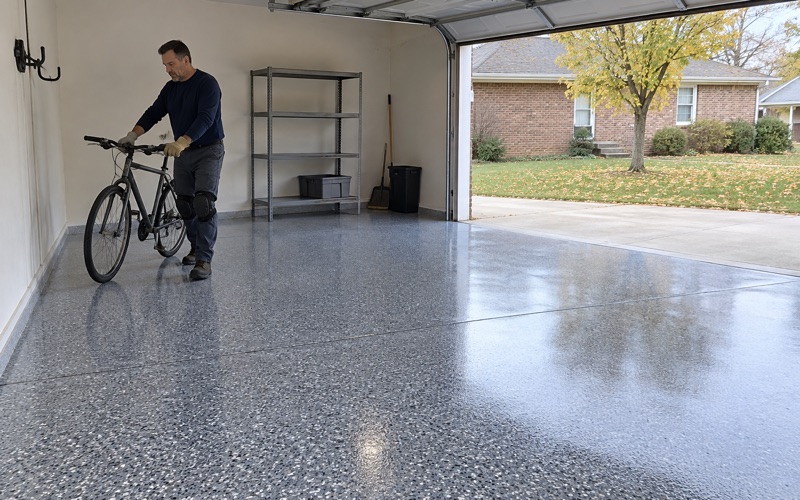
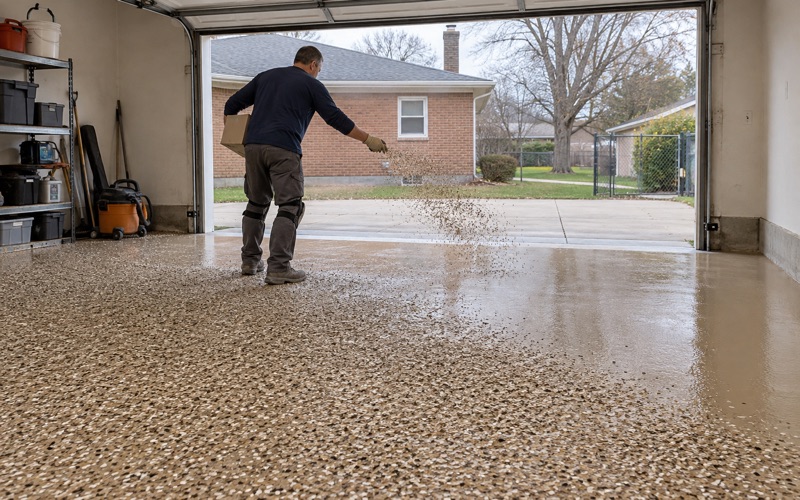
In most of these garages we suggest leaving a defined corner or bench zone uncoated or densified only, and coating the parking side with a full vinyl flake or quartz system. A welding mat or a steel sheet under the bench protects the transition. Your cars get a floor that resists hot tire pickup, and your welder gets a surface it cannot ruin.
What to tell us at the estimate
Tell us what you weld, how often you grind, and where the bench sits now or might sit later. Moving a welding station onto a finished coating a year from now is one of the surest ways a good garage floor gets scarred. If the layout is still open, we can leave a larger uncoated area or plan a protected zone in advance.
Salt, cold and cure schedules
A garage that parks a car through a Chicago-area winter takes brine and rock salt in on its tires, so the parking side gets a system chosen to stand up to calcium chloride deicers. Cure times follow slab temperature and the dew point spread at the surface, not the calendar. An unheated garage in deep winter is told to wait until a proper cure is possible.
Hazel Crest’s 1960s-1980s Subdivisions and Their Garages
Most of the village is owner-occupied houses. Census figures show 3,622 of 4,828 households own their homes, and 4,218 of the housing units are single-family detached. The annex describes the larger part of Hazel Crest, south of I-80, as mostly 1960s, 1970s and 1980s subdivisions, and the housing count backs that up, with 1,314 units built in the 1970s alone.
Slabs with a few decades of traffic
A garage slab poured in those decades has usually seen salt, oil, patching and sometimes an old coat of paint. We start with an ASTM D4263 plastic sheet test as a first look, then use ASTM F2170 in-situ relative humidity probes or ASTM F1869 calcium chloride testing when a slab needs a firmer number. Old paint and loose patches come off in the grind so the new system bonds to sound concrete.
Where a slab shows efflorescence or a test reads high, a moisture-mitigation primer goes into the scope before the body coat. Amine blush is checked and cleaned between coats in cold, damp conditions, because a blushed surface is a weak bond waiting to peel.
Basements are a water question first
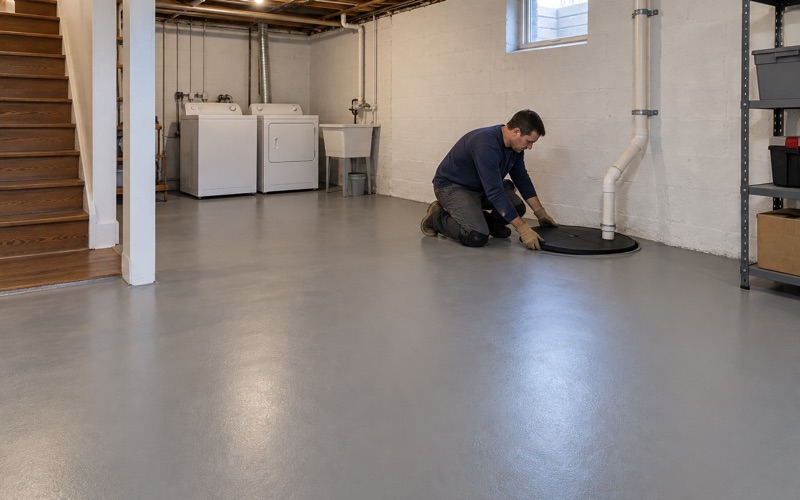
Some homes in the village, especially in Pottawatomie Hills near Mahoney Creek, have a documented history of basement flooding over clay soil that sheds water. A floor coating does nothing about that water. Seepage and overflow have to be handled first, and we coat a basement slab only once it is dry and sound, with moisture named as the first warranty exclusion we discuss.
The Building Department and your contract
Hazel Crest extends its flood building-protection rules into the 500-year floodplain and counts alterations cumulatively from April 1, 1990. Whether a floor job in your house falls under that is the Hazel Crest Building Department’s call, not ours, so we ask before we schedule. Illinois has no state flooring license, so we also check the village’s own registration, bond and insurance terms before booking.
On home jobs above the state threshold, you receive a written contract and the Home Repair: Know Your Consumer Rights pamphlet under the Illinois Home Repair and Remodeling Act before any grinding starts. With the scope, the zoning plan and the pamphlet in hand, you can check every part of the job before you sign.
- 20+ Years Coating Concrete
- Moisture Tested Before Pricing
- Free Written Estimates