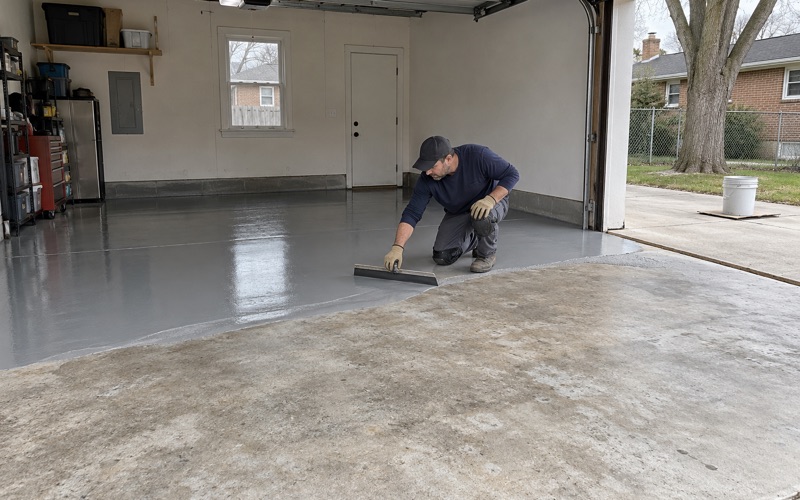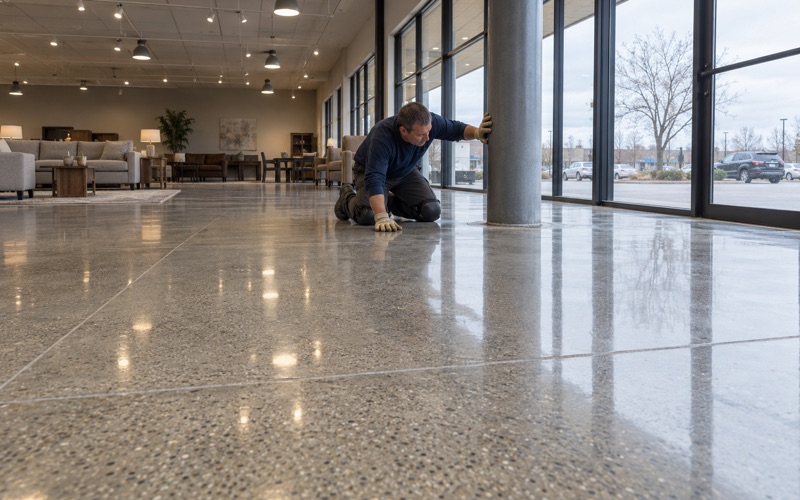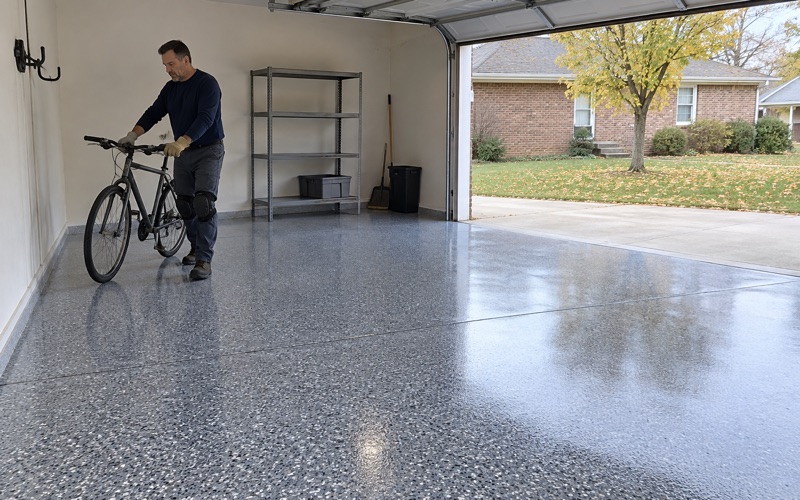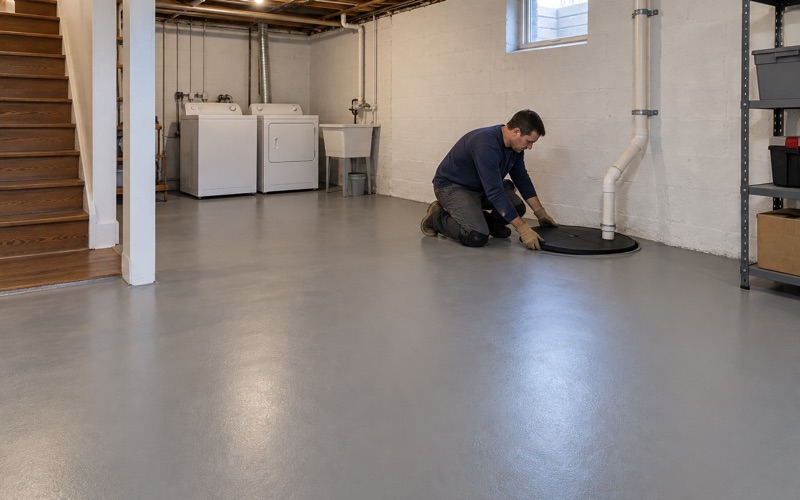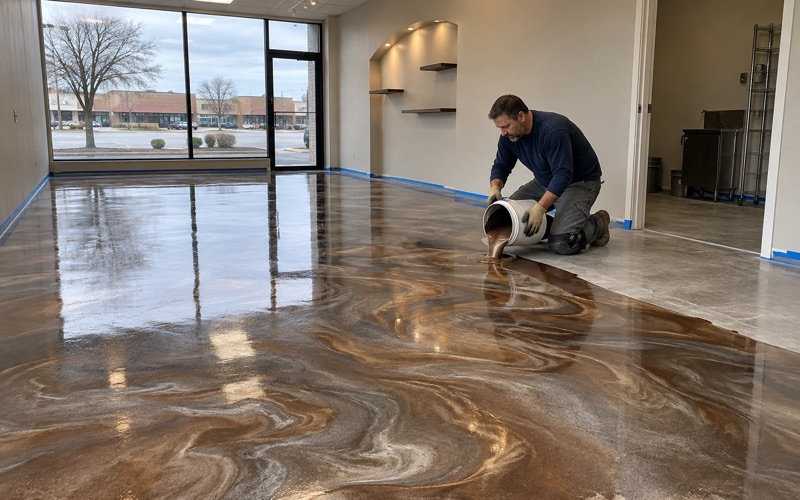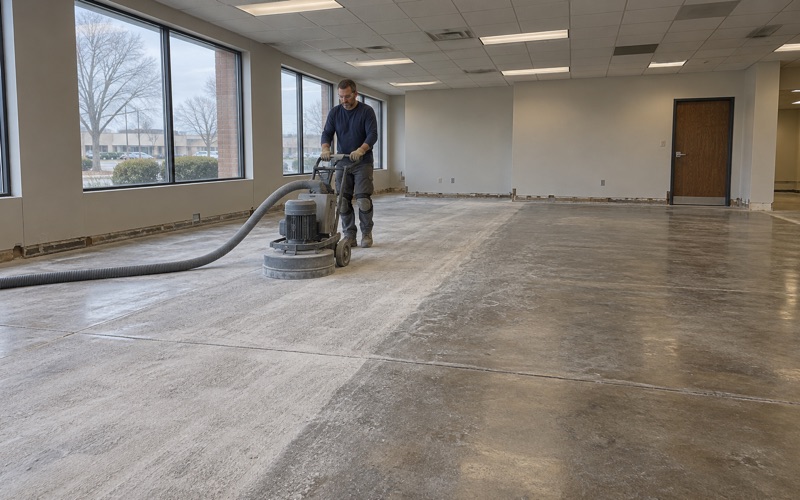
Oak Lawn Epoxy Flooring has spent more than 20 years on epoxy flooring in La Grange Park and across Cook County, and on every job the order of work is settled long before any resin is mixed. We open each slab mechanically with a diamond grinder or a shot blaster, never an acid etch, because a coating holds only as well as the profile under it. That preparation step is also where most of the risk on an older commercial floor sits.
Our proposals spell out the product line, the number of coats and the finished thickness, so an owner can measure the floor against the paper once it is done. A moisture test is written into the scope before the price is final. We map cracks, spalls and old coatings first, and we say plainly when a slab needs repair or replacement instead of a coating.
Some floors carry a history that changes the first question entirely. When a slab once sat under a firing range or another lead source, the first decisions are about testing and dust control, and the coating comes after both. This page walks through why, using one well-documented public building in the village as the example.
A 1953 Village Garage With a Firing Range in Its Basement
La Grange Park, a village of 13,475 people about 13 miles west-southwest of Chicago, keeps its Public Works facility at 937 Barnsdale Road. The oldest part of that building dates to 1953, and the village’s 2012 State of the Village Address described the facility as nearly 60 years old and in need of structural and mechanical improvements. After new construction was found not to be financially feasible, the village released a request for proposals to renovate the existing building instead.
The scope in that RFP is what makes the building worth studying for anyone thinking about floors. Alongside replacing windows, upgrading mechanical systems and stabilizing the facade, it listed removing all hazardous materials from the building and cleaning up the former gun range in the basement. Few garages carry a line like that in their records, and it changes what grinding a basement slab there would mean.
What the 2013 renovation cleaned up
The Fall 2013 Rose Clippings newsletter reported the project finished. Its scope included hazardous waste abatement for lead and asbestos, major masonry repairs, a new roof, new windows, air conditioning, a first-floor locker room, ADA compliant bathrooms and a sprinkler system throughout the facility. The total came to $1,053,938, of which $600,000 came from grants and $453,938 from village reserves.
The village had weighed tearing down the 1953 portion and building roughly 4,000 square feet of garage bays and 2,300 square feet of office and support space, but the projected cost was too high for the space created. Investing in the current building won out, and a ribbon cutting followed on October 14, 2013. Residents know the same site today as the home of the village’s E-Waste Recycling Day.
What the record does not say
The newsletter names no floor or slab work, and nothing we have read describes the condition the basement concrete was left in. That gap is the whole point. Nobody can tell from the paperwork whether that slab holds lead today, and a contractor who claims to know either way is guessing.
Looking for epoxy-flooring closer to Hazel Crest? See Epoxy-Flooring in Hazel Crest.
Why Grinding an Old Range Floor Is a Lead-Exposure Job
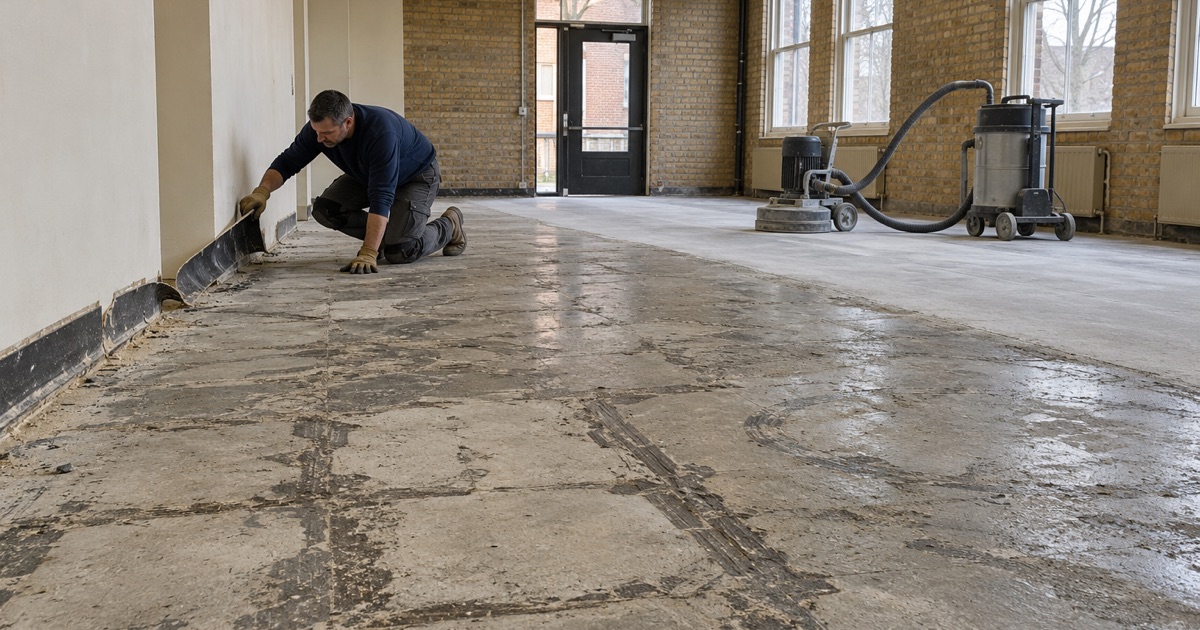
Lead is the reason a former range earns a second look, since ammunition is a lead source and a range is where it was used. A coating job on a slab like that is never only a coating job, because the first step of every system we install is mechanical surface preparation. Diamond grinding and shot blasting remove the top skin of the concrete to reach a proper ICRI CSP profile, and on a floor with a lead history that skin is exactly the material in question.
The two methods work differently but share the same problem. A shot blaster throws steel shot at the surface and recovers it along with the broken-off concrete, while a diamond grinder abrades the surface with rotating segments. Both turn the top of the slab into fine dust, and both can run with full vacuum capture or, run carelessly, put that dust into the air.
OSHA 1926.62 reaches surface preparation
OSHA’s lead standard for construction, 29 CFR 1926.62, applies to all construction work where an employee may be occupationally exposed to lead. Its coverage includes alteration, repair and renovation of structures where lead is present, along with lead contamination and emergency cleanup. Grinding a slab is renovation work, so the standard is in the picture the moment a grinder touches a floor that may hold lead.
The standard sets a permissible exposure limit of 50 micrograms of lead per cubic meter of air, averaged over eight hours. That is a limit on what workers breathe, and surface preparation is the step most able to lift fine concrete dust into the air. The crew doing the preparation, not the finished floor, is who the rule protects first.
Dust leaves the room if it is allowed to
Grinding dust that is swept, blown or rinsed does not stay on the slab. It drifts into adjoining rooms, settles on vehicles and stored equipment, and runs toward floor drains. On an ordinary garage that is a housekeeping nuisance, but on a slab with a lead history it spreads the very material the testing was meant to find.
Test First, Then Choose Dust-Controlled Preparation
Our order of operations on a floor like this does not change. Testing comes first, through wipe or bulk sampling by a qualified party, before any grinder or blaster is scheduled. The result decides how preparation is run, and in some cases whether a lead professional needs to handle the slab before a coating contractor is involved at all.
We do not perform lead work ourselves, and we say so at the first visit. Our role starts once the owner has the results and any work they call for is done. That keeps the decision about the concrete with the people qualified to make it, and keeps our proposal honest about where it begins.
What testing settles before a price
A sample tells everyone involved what they are working with instead of what they suspect. If lead is found, the owner brings in the right professional and that work happens first. If it is not, the job proceeds as ordinary preparation, still with the same dust controls, because one sample is never a reason to relax the method.
Testing also folds into the moisture work every scope already carries. A basement slab gets an ASTM F2170 in-situ relative humidity probe or an ASTM F1869 calcium chloride test before we commit to a system. When the readings call for it, a moisture-mitigation primer is priced into the job rather than added later.
Vacuum first, never compressed air
The OSHA standard’s housekeeping rules prefer vacuuming or other methods that keep lead from becoming airborne. Compressed air may not be used to remove lead from a surface unless it is paired with a ventilation system that captures the dust. That matches how we already work, with a vacuum attached at the grinder or blaster so dust is captured at the head rather than swept up afterward.
Final cleanup before the primer goes down follows the same rule. We vacuum the slab, the edges and the corners instead of blowing them off, and we never rinse grinding residue toward a floor drain. On a basement floor with a range in its past, that one habit decides whether the dust ends up in a sealed bag or across the building.
Keeping the work zone contained
When preparation goes ahead on a slab with a lead history, the room is closed off from the rest of the building and the work stays inside it. Doors and openings are sealed, and nobody walks dust out on their boots. Vacuum waste is bagged and handled according to what the test results showed, not tossed in with ordinary jobsite debris.
What a Coating Does After the Cleanup, and What It Is Not
Once testing has answered the lead question and preparation is finished under dust control, the slab is a candidate for a coating like any other. A 100% solids epoxy base with a quartz aggregate broadcast suits a working floor, and a polyaspartic or polyurea topcoat adds abrasion and chemical resistance where carts and equipment roll. Products are chosen inside the Illinois VOC limits in 35 Ill. Adm. Code Part 223, which bind the applicator and matter in an enclosed basement.
Basement slabs run cool, and a cool slab in humid weather can sit close to the dew point. We check the dew point spread at the slab surface before each coat, because condensation on fresh epoxy invites amine blush and weak adhesion between layers. Cure schedules follow slab temperature, not the calendar.
A coating is not lead work
A floor coating is never lead abatement, and we do not describe it as a way to deal with a hazard in the concrete. Whatever is or is not in a slab is settled by testing and, where needed, by qualified lead professionals before we arrive. The coating is a wear surface over prepared concrete, nothing more, and an honest proposal says that in writing.
Our warranty conversation works the same way. We explain what a coating warranty leaves out before the job is sold, with moisture named first, and a slab’s unresolved history goes on that list rather than being hidden under a glossy finish.
Permits and who signs off locally
La Grange Park is a non-home-rule village, and its Department of Building and Inspectional Services runs building code review through a contracted consultant rather than an in-house plans examiner. The village’s interior remodel packet requires a permit for most interior remodeling, excluding painting, carpeting, tiling and paneling, and neither that packet nor the garage packet names floor coatings. We ask the Building Department what a coating scope requires before quoting a schedule.
Illinois has no state flooring license, so we confirm the village’s own registration, bond and insurance requirements before booking. For homeowners, jobs above the state threshold get a written contract and the Home Repair: Know Your Consumer Rights pamphlet before any grinding begins.
What this means for other floors in the village
Most slabs in La Grange Park have no range in their past, and we do not treat every floor as suspect. The lesson of the Barnsdale Road record is narrower: when a building’s own history names a lead source over a floor, that floor is tested before it is ground. If you know of a range or a similar use in a building’s past, tell us at the first walk-through and we will build the order of work around it.
- 20+ Years Coating Concrete
- Moisture Tested Before Pricing
- Free Written Estimates