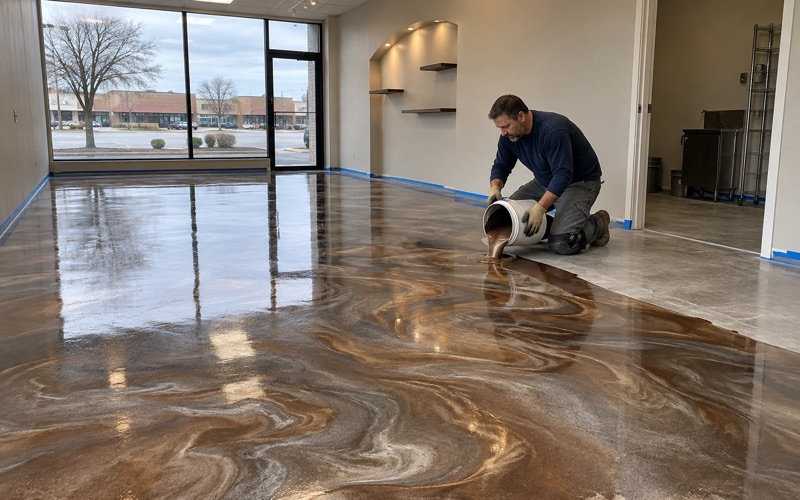
Oak Lawn Epoxy Flooring has spent more than 20 years on epoxy-flooring in Lemont and across the southwest suburbs, and the floors that teach the most are the ones that meet automotive fluids. Coolant and brake fluid are both glycol-based, both slippery, and both easy to ignore when they drip slowly. On a coated slab, how long they sit matters as much as which coating went down.
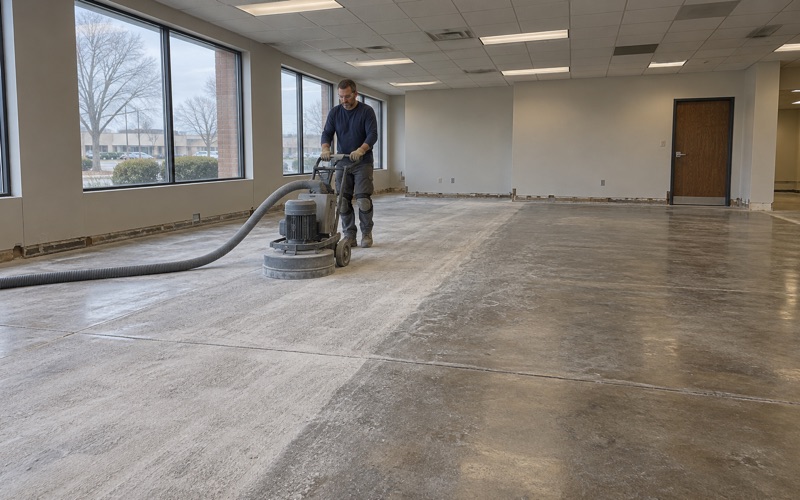
That timing question shapes how we plan a Lemont floor. We grind or shot blast every slab instead of acid etching it, test for moisture before the price is final, and write the product line, coat count and finished thickness into the proposal. None of that helps if a spill is left to stand for weeks, so we also talk through the cleanup habit a floor needs.
The guidance here comes from one epoxy maker’s published resistance sheet, read as trade-level data rather than a rating of any particular floor. It separates splashes cleaned the same day from exposure that repeats or lingers, and that split is the most useful thing a homeowner or plant manager can take from it.
A Coolant and Brake-Fluid Plant on Canal Bank Road
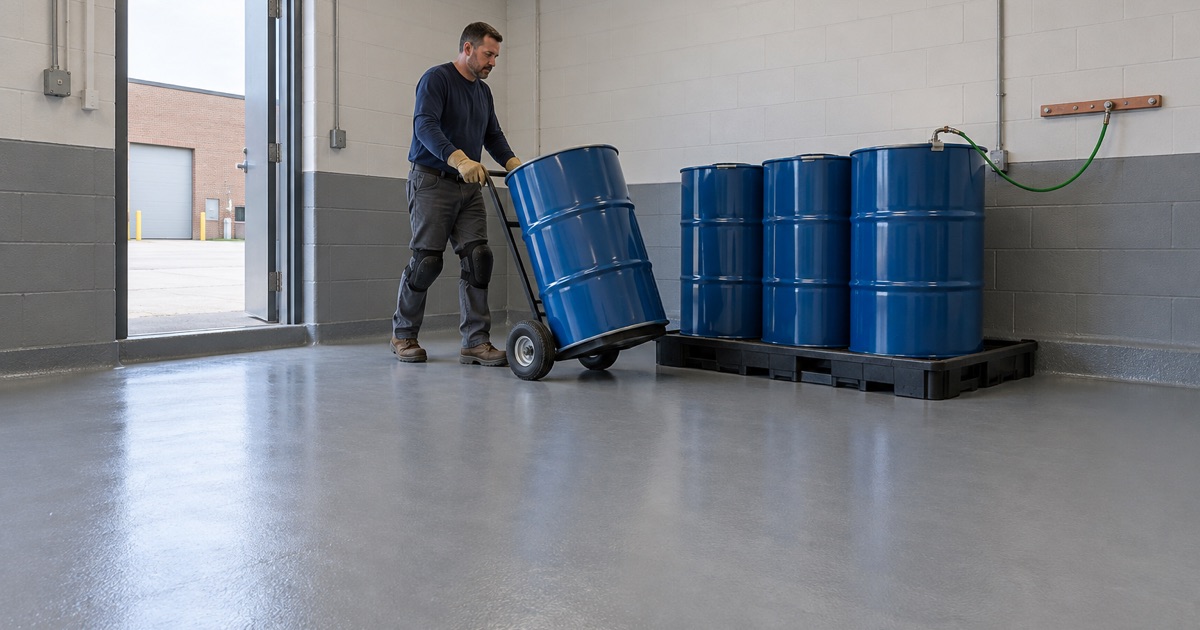
Lemont has a manufacturer whose products are the very spills we are describing. CCI Manufacturing IL Corporation is listed at 15550 Canal Bank Road with a Lemont address, and it is the Illinois plant of Japan-based CCI Corporation, founded in 1949. Directory and press sources describe it making pre-diluted engine coolants and brake fluid that meets DOT 3 and DOT 4.
For a coating contractor, that product list is the interesting part. Most industrial floor talk drifts toward aggressive solvents, but coolant and brake fluid behave differently: gentle on a good epoxy for a day, harder on its finish over weeks. The difference sits almost entirely in how long the liquid stays on the surface.
Lemont itself spans Cook, DuPage and Will counties, and Canal Bank Road has mapped segments in both Cook and DuPage. The plant’s street address did not resolve to a single building in the Census geocoder, so we describe it only as sitting on Canal Bank Road with a Lemont address. For a floor owner, that detail matters less than knowing which county and village offices answer for the site.
What the plant has shipped
A February 27, 2020 report said CCI’s factory in Lemont would supply fluids to Mazda Toyota, naming engine coolant and brake fluid among them, until the company’s Lawrence County, Alabama plant was running in 2023. That arrangement was described as interim. We have not read the plant’s current output, and we make no claim about its staffing or size.
What a fluids floor has to survive
We have no relationship with CCI and have never seen its floors. What a plant like that illustrates is a floor whose main chemical load is glycol, the base of most antifreeze and of the common brake fluids. Fill lines, drum stations and packaging areas tend to see small, frequent drips, and that pattern is exactly what the resistance data speaks to.
Looking for epoxy-flooring closer to River Forest? See Epoxy-Flooring Services in River Forest.
Glycol on the Floor: Rinsed the Same Day or Left to Stand
The sheet we lean on is the TEKNOFLOOR 500F chemical-resistance table published by Teknos, dated June 10, 2004, and tested at 23 degrees C. It lists antifreeze and brake fluid separately and rates each one twice, once for short-term contact and once for long-term contact. Both fluids score the same way, which makes the lesson unusually clean.
What short term means
Short term on that sheet means temporary splashes on a floor, provided the splashes are rinsed off during the same day. Under that condition both antifreeze and brake fluid earn the top mark, defined as resisting the chemical well with no or only minor changes in color or gloss. In plain terms, a drip wiped up before the shift ends or before bed is a nonevent.
That rating assumes a cured, intact film. A pinhole, a chip at a saw cut or a thin spot over a patched crack lets liquid reach the concrete, where the coating’s rating no longer applies. We map cracks, spalls and old coatings before quoting, and we say plainly when a slab needs repair before it should be coated.
What long term means
Long term covers splashes that occur repeatedly and are directed to one spot, or a continuous exposure lasting no more than three months. Here both fluids drop one grade. The sheet says the coating’s mechanical properties do not change at that grade, but changes in color and gloss occur. So the floor keeps doing its job; it just stops looking like the floor you paid for.
Reading the sheet honestly
This is one manufacturer’s product tested in a lab, not a promise about every epoxy and not a rating of any floor in Lemont. Other resins, topcoats and film thicknesses will behave differently, which is why our proposals name the exact product line. When a fluids area is in scope, we look for that product’s own resistance data on glycol before pricing the job.
Color and Gloss: The Early Warning and the Cleanup Routine
Because the long-term grade shows up as a change in color and gloss before anything structural, a dull or tinted patch is useful information. It marks where fluid has been landing repeatedly or sitting longer than a day. Caught at that stage, the fix is a change in habit, not a change in floor.
Gloss loss is also easy to confuse with ordinary wear. Traffic lanes dull evenly along a path, while a fluid stain tends to sit in a ring or teardrop where the drip lands. Telling the two apart decides whether the answer is a recoat or a cleanup schedule.
Where the dull patches show up
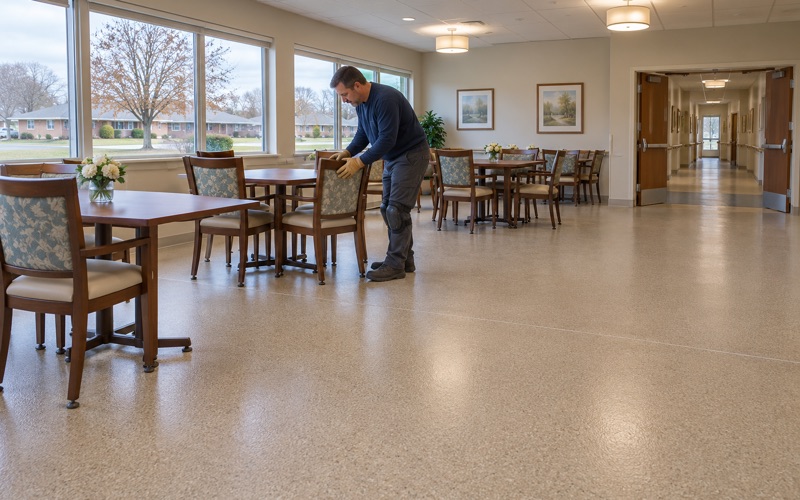
On a working floor the pattern tends to repeat: under a hose coupling, beside a drum pump, at the end of a line where caps are seated. Glossy, light-colored topcoats tend to reveal the change more readily than a busy flake blend, which can be an argument for a color that tells you the truth. We walk those spots with the owner before settling on a finish.
Within the sheet’s long-term window, a patch at that grade has changed in looks, not in mechanical properties. The usual repair is cosmetic: clean, abrade and recoat the affected area with a compatible topcoat. What prevents a repeat is moving or catching the drip, not thickening the film.
Fill lines, drums and a written routine
On an industrial floor, the same-day rinse is a staffing question as much as a coating one. A routine that works names who checks the fill and drum areas, what they use to pick up glycol, and when the floor is rinsed. Picking up with absorbent first and rinsing with water second keeps the liquid from spreading across a wider area.
Where a spot cannot be kept dry, such as under a valve that weeps, a drip tray or a sacrificial mat does more than a thicker coat would. Commercial floors are phased around operating hours, with overnight and weekend windows when a space cannot close. Grinding dust is captured at the machine by vacuum, never washed toward a floor drain.
The Same Drips in a Lemont Home Garage
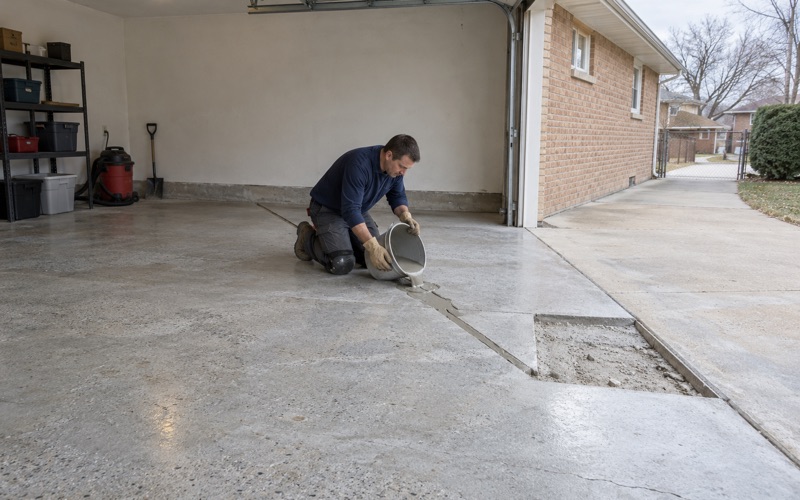
Far more Lemont floors are garages than fluid plants, and the glycol math is the same at home. A radiator hose that weeps, a coolant top-off that overflows, a brake job started on the driveway and finished inside: each leaves a small puddle that is easy to miss for a week. A week is well past the same-day window on that resistance sheet.
The housing figures point the same way. Census estimates count 5,617 owner-occupied homes in the village, and 4,739 of those owners live in detached single-family houses, with another 839 in attached ones. That is a large pool of household slabs, and the cars parked on garage floors tend to drip something eventually.
Choosing a garage system with glycol in mind
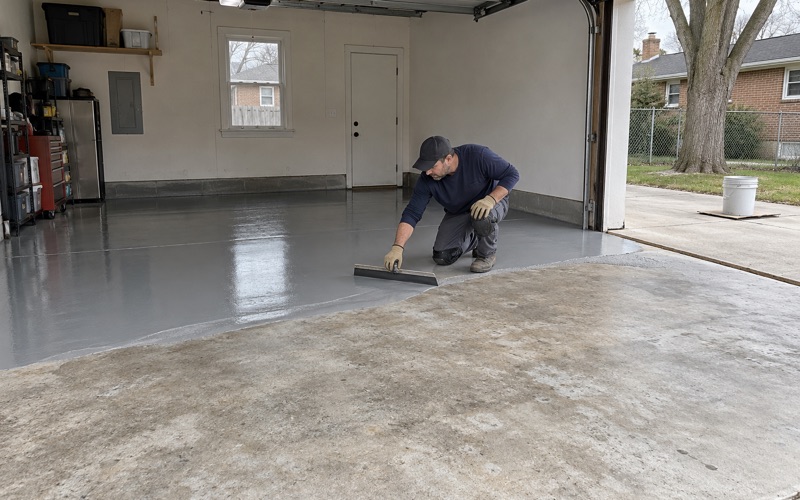
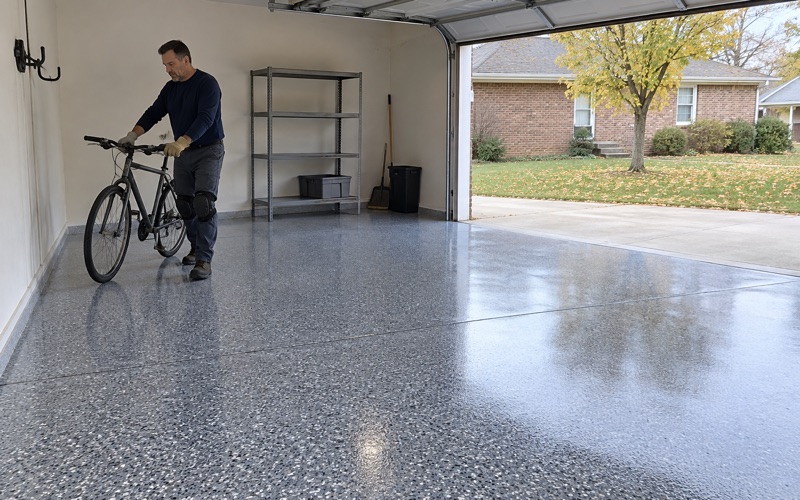
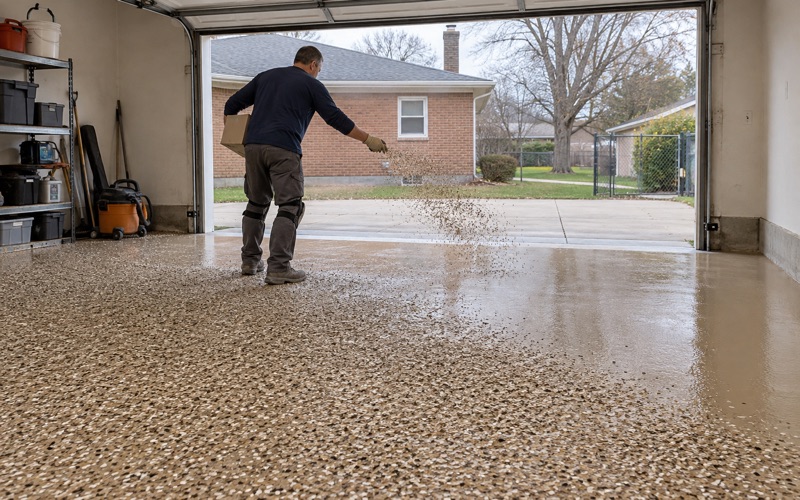
For a garage, we usually build a 100% solids epoxy base broadcast with vinyl flake or quartz aggregate, sealed under a polyaspartic or polyurea topcoat. The topcoat is the surface the coolant actually touches, so its own chemical data matters as much as the base coat’s. Hot tire pickup is the other failure we design around, since a car parked straight after a drive is often when a fresh drip lands too.
Prep and moisture before any coat
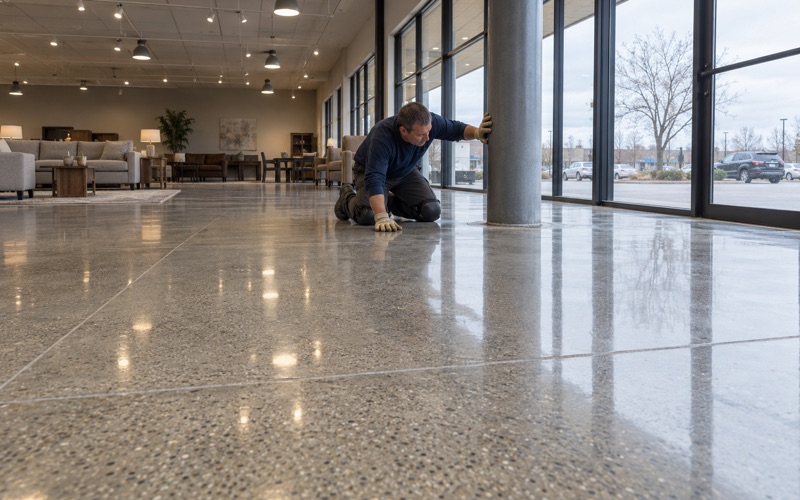
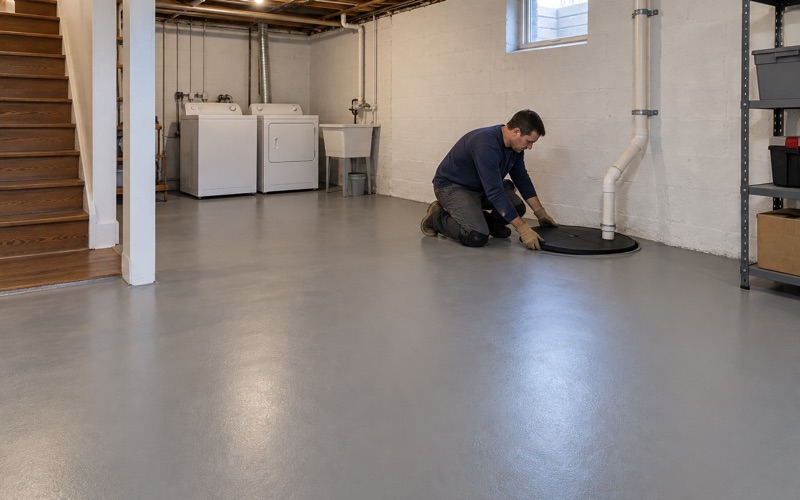
Glycol resistance only counts if the coating stays bonded. Every garage slab we take on is opened with a diamond grinder or shot blaster to a real ICRI surface profile, never an acid etch. Before the price is final we run a moisture test, using an ASTM F2170 relative humidity probe or an ASTM F1869 calcium chloride test depending on the slab.
The proposal then names the product line, the number of coats and the finished thickness, so you can check the floor against the quote. We also explain what the coating warranty leaves out before you sign, and moisture is the first exclusion we name. Discoloration from fluids left to stand belongs in that same conversation.
Keeping glycol off a home floor
The household version of the cleanup routine is short. Keep an absorbent and a bucket near the workbench, slide a drip tray under any car known to weep, and rinse a coolant or brake fluid spot the day you see it. Antifreeze is also sweet-tasting and toxic to pets, which is one more reason never to let a puddle sit.
Paperwork and the village
Illinois does not license general, flooring or coatings contractors, so the local rules carry the weight. The Village of Lemont Building Department works under a building code with the 2021 I-codes adopted, and we check its registration, bond and insurance requirements before a job is booked. Because current registration terms are not posted where we could read them, we confirm them with the department directly.
For a home job over the state threshold, you get a written contract and the Home Repair: Know Your Consumer Rights pamphlet before any grinding starts. On a garage or a fill line, the coating is only half the plan; the other half is a rag, a hose and the habit of using them the same day.
- 20+ Years Coating Concrete
- Moisture Tested Before Pricing
- Free Written Estimates