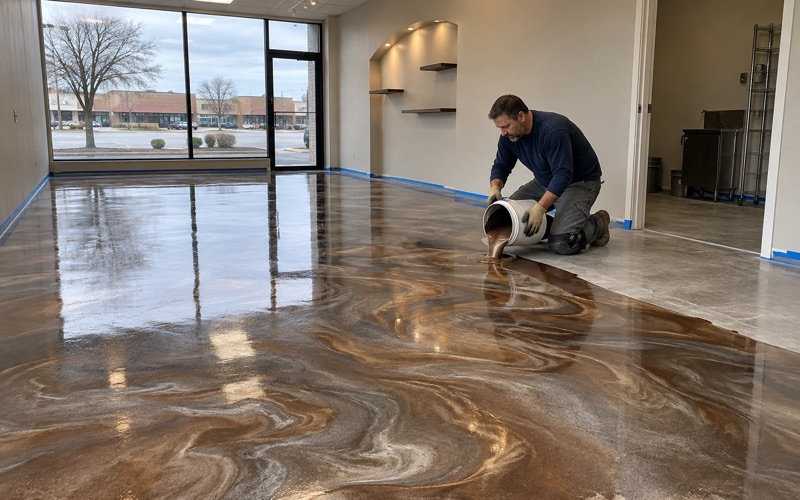
Oak Lawn Epoxy Flooring has handled epoxy flooring in Markham for more than 20 years, and the work here splits cleanly between homes and working buildings. Most of what we coat is a homeowner’s garage or basement slab. The rest is industrial: warehouse aisles, truck bays and shop floors that cannot stop moving while a coating goes down.
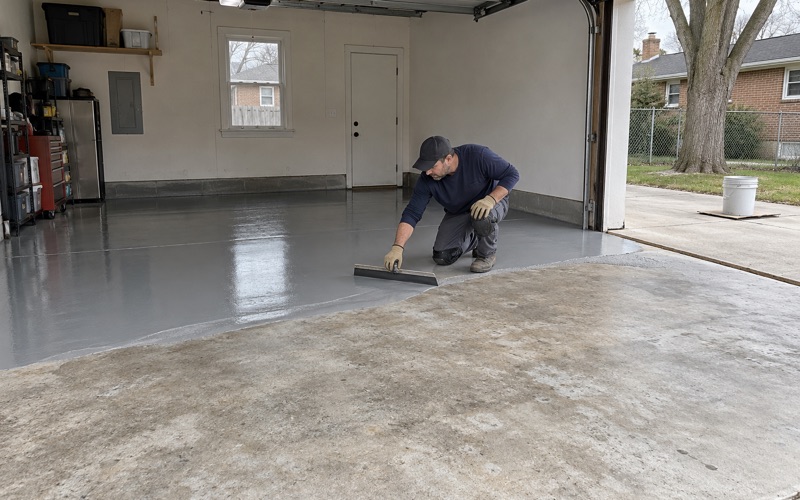
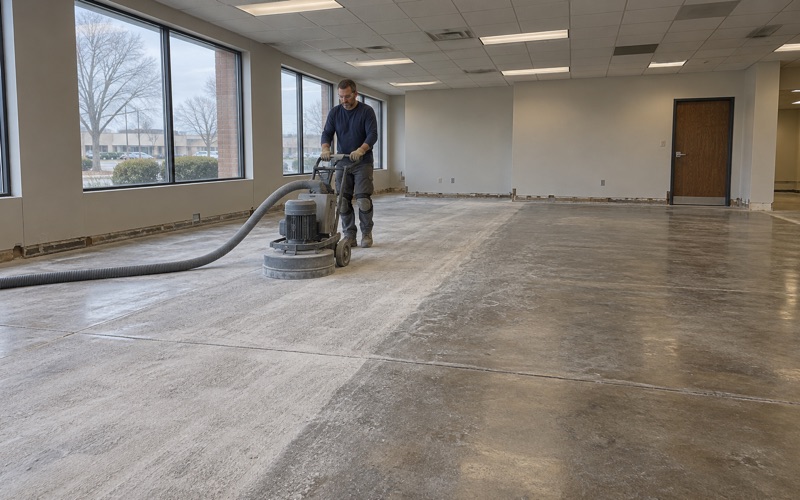
Every job starts with the slab opened by a diamond grinder or a shot blaster, never an acid wash. That mechanical profile is what a 100% solids epoxy or a polyaspartic topcoat actually bonds to. Before the price is final, a moisture test is written into the scope, because moisture is the one failure a coating cannot fix after the fact.
Our proposals spell out the product line, the coat count and the finished thickness, so you can hold the floor up against the paper when we leave. If the slab is cracked, spalled or carrying an old coating, we map it first and tell you plainly whether it needs repair, or outright replacement, before anything is coated.
When the Floor Is a Map: The Robotics Building on 159th Street
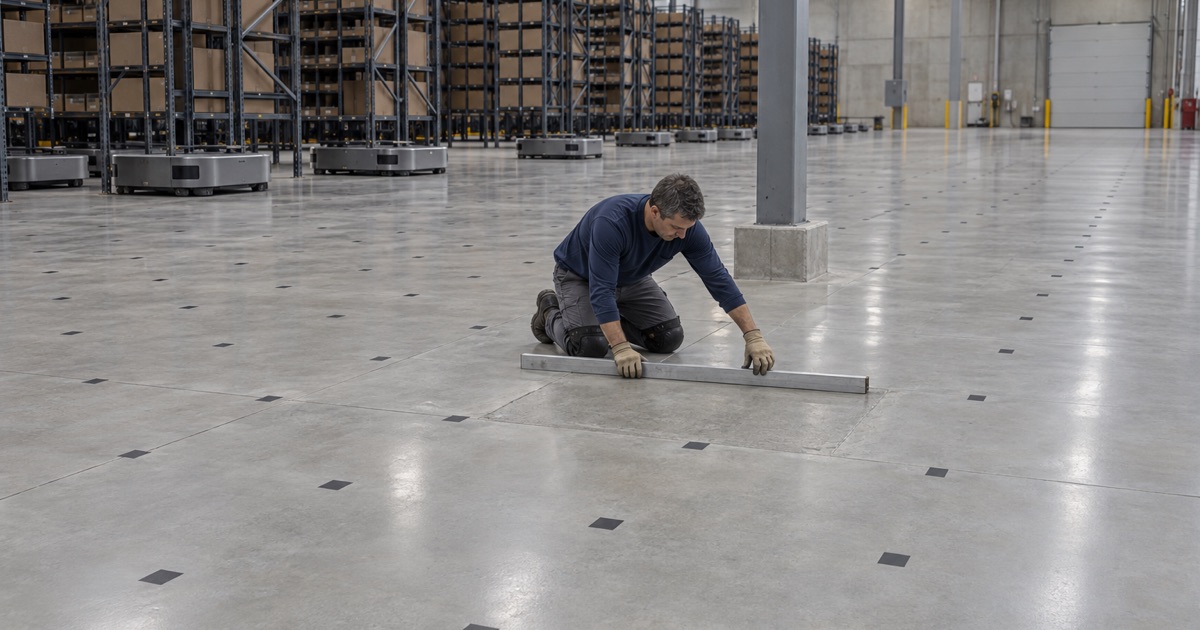
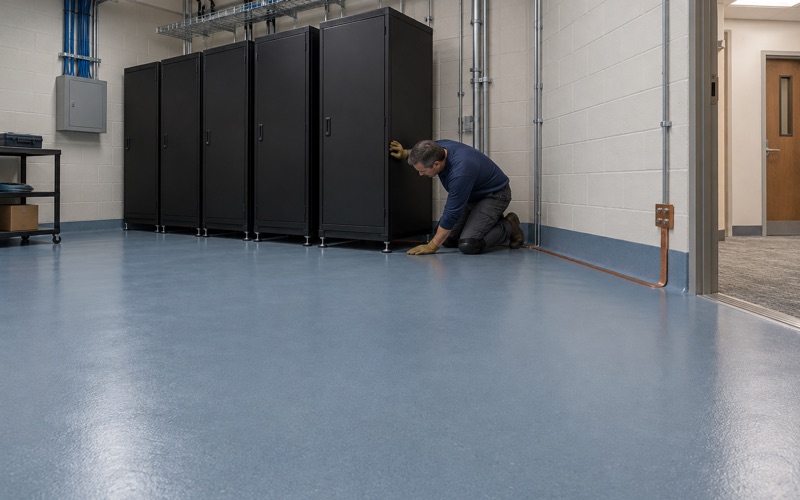
The largest floor in Markham sits at 2201 W. 159th Street, inside city limits in Thornton Township. It is Amazon’s IGQ1 robotics fulfillment center, a building of about 850,000 square feet that the city’s own 2024 hazard-mitigation plan lists among its future major assets. When CBS Chicago reported the project in June 2020, it described the Markham and Matteson buildings as 855,000-square-foot warehouses using the newest generation of Amazon robots. We have never worked there and Amazon is not a customer, but the building explains something every warehouse owner along this corridor should understand.
How drive units read a slab
Amazon’s patents describe drive units that find their way by capturing images of fiducial markers, small coded targets pressed, rolled or stamped onto the floor in a two-dimensional grid. The robot reads one marker, travels to the next and checks its position again. In a building run that way, the slab is a navigation surface first and a finish second.
We have not seen IGQ1’s floor finish, its marker system or its flatness specification, so we describe the mechanism only in general terms. What holds across automated buildings is that the operator’s engineering staff set the rules for the floor. The coating crew works inside those rules, not around them.
What a coating must not cover
Anything laid over a marked floor has to leave every marker readable. A glossy topcoat that throws glare, a flake broadcast that blurs a code, or a striping line run straight across a target can confuse a machine that a person would walk past without noticing. The surface also has to stay flat and even, because a loaded drive unit does not forgive a ridge at a patch edge.
That is why we treat any automated or semi-automated space as a design question before a product question. We ask who owns the marker layout, what tolerance the floor has to hold and whether a matte finish is required. Only then do we quote a single coat.
Repairs in a marked building raise the same issue. A patch poured over a marker means that marker has to be replaced at its exact position, and that is the operator’s decision, not ours. Our role in a space like that is to deliver a flat, clean, low-glare surface and leave the marker work to the people who own the map.
Looking for epoxy-flooring closer to Burr Ridge? See Epoxy-Flooring in Burr Ridge.
Smaller Warehouses and Trade Buildings Between I-294 and Dixie Highway
Markham’s 2014 Comprehensive Plan describes a strong industrial and cargo-oriented development base between I-294 and Dixie Highway, with the 159th Street segment anchored by the I-57 and I-294 interchanges. That band, not the Amazon building, is where a local coating contractor’s realistic work sits. It holds smaller warehouses, truck buildings and trade shops, the kind of space where Kelly Pipe Co. acquired a 92,000-square-foot industrial building in the city.
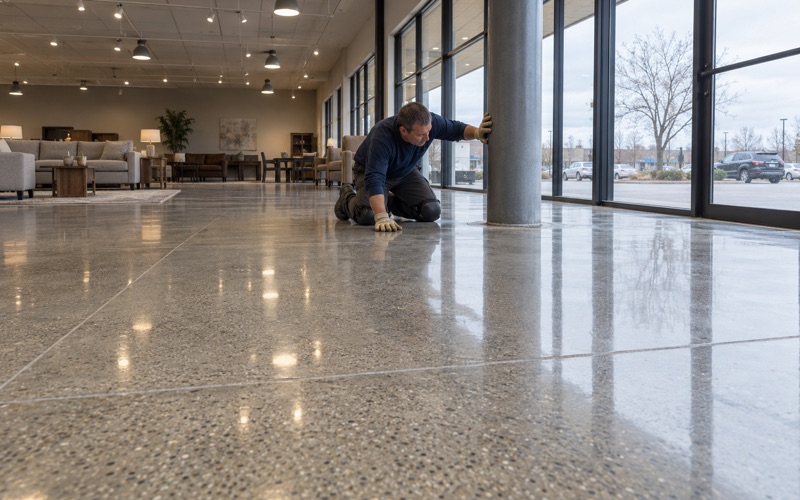
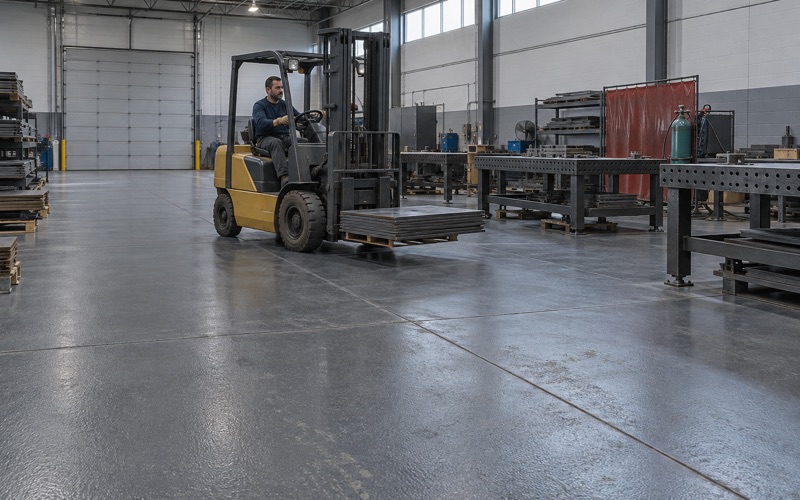
These floors carry forklift and pallet jack wheel loads all day, and few of them can close for a week. A coating here is chosen for impact and abrasion resistance first, with appearance a distant second. Most often that means a 100% solids epoxy body coat, sometimes with a quartz aggregate broadcast for traction where wet boots or spilled oil meet a ramp.
Coating a building that keeps shipping
A working building usually gets coated in zones rather than all at once. We grind and coat one area while racking and traffic shift to another, then swap, so the business never fully stops. Overnight and weekend windows go into the schedule when a dock or an aisle cannot go dark during the day.
Fresh coating needs time before a forklift rolls onto it. We give separate cure windows for foot traffic, light carts and full wheel loads, so a manager can plan which aisle reopens first. Polyaspartic topcoats shorten that wait, which is often why a busy dock ends up with one.
When epoxy is not the answer
Not every warehouse floor needs a film coating. Where traffic is heavy and looks do not matter, a ground slab treated with a lithium silicate densifier can outlast a thin coating that would wear through in the aisles. Where a space sees hot washdowns or chemical spills, urethane cement is often the better system, and we say so even when it costs more.
Patches first, stripes last
Repair comes before color. Spalled joints and gouged aisles are cut back, filled and ground flush, because a patch that stands proud of the slab becomes a bump every loaded wheel strikes. Striping goes down last on a cured surface, laid out with the owner so aisle lines match the racking plan instead of fighting it.
Dust and solvent limits
The Chicago region sits in the 2015 ozone nonattainment area, and the Illinois VOC limits for floor and industrial coatings bind the person who applies them, not only the manufacturer. We choose products inside those limits. Grinding dust is captured at the machine with a vacuum instead of being rinsed toward a floor drain or a storm inlet.
Markham’s Garages: A City of Owner-Occupied Detached Houses
Step off the industrial corridor and Markham is almost entirely single-family. Census figures put 94.6 percent of housing units in detached houses, and 74.9 percent of households own their home. Even among renters, 92.1 percent live in a detached house, so the ordinary job in this city is a garage or basement floor at somebody’s own address.
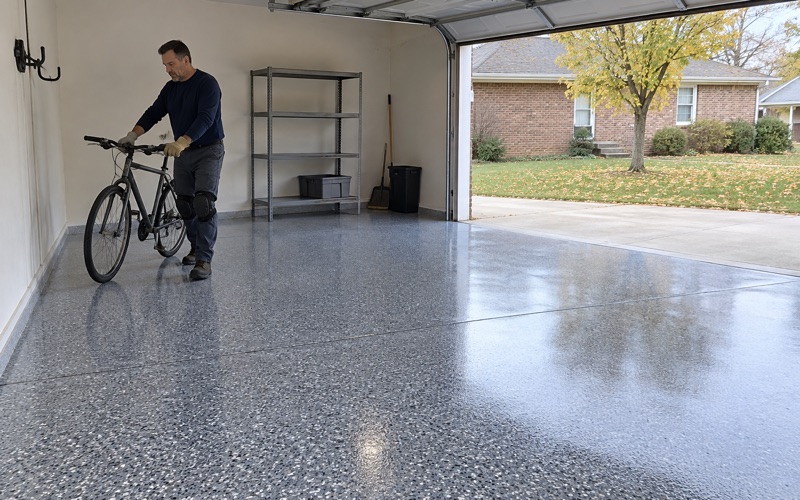
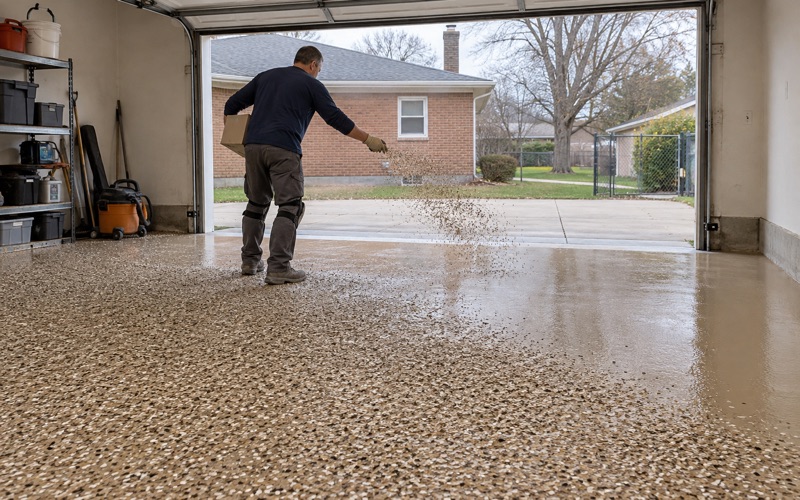
That makes the attached or detached garage our most common Markham project. A homeowner usually wants a floor that cleans easily, hides dust and holds up to a car parked on it every night. We build that with a ground profile, an epoxy or polyaspartic base, a vinyl flake broadcast and a polyaspartic or polyurea topcoat chosen to resist hot tire pickup.
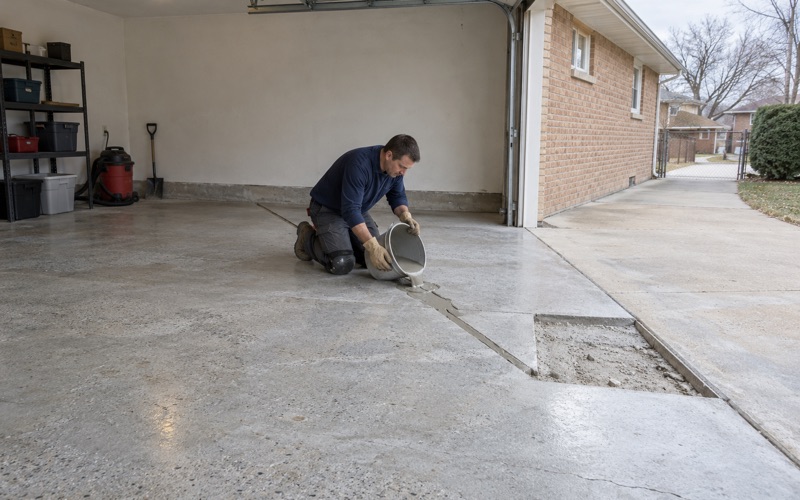
Cracks get the same scrutiny in a garage as in a warehouse. We map them before quoting, fill the ones that are stable and tell you when a heaved or broken section should be replaced instead of coated over. A coating can bridge a hairline shrinkage crack, but it will not hold a moving slab together.
A garage slab without a vapor barrier
The residential code lets a garage slab skip the vapor retarder required under a heated living space, through the IRC R506.2.3 exception. So moisture rising from below is a real possibility in a garage, not a theoretical one. We start with an ASTM D4263 plastic sheet test and move to ASTM F1869 calcium chloride readings or ASTM F2170 in-situ relative humidity probes when the first result raises a question.
High numbers do not end the conversation; they change the system. A moisture-mitigation primer under the coating is the usual answer, and we put that choice in writing with the reason behind it. Our warranty discussion names moisture as the first exclusion before you sign, so nobody learns about it after a blister appears.
Cure on the slab’s schedule
Cure times follow slab temperature and the dew point spread at the surface, not the date on the calendar. An unheated garage in deep winter is told to wait, because a coating laid on a cold slab near its dew point can stay soft or lose its bond. We would rather move a start date than come back to grind off amine blush.
Basements, Flood-Prone Blocks and the Paperwork Before Grinding
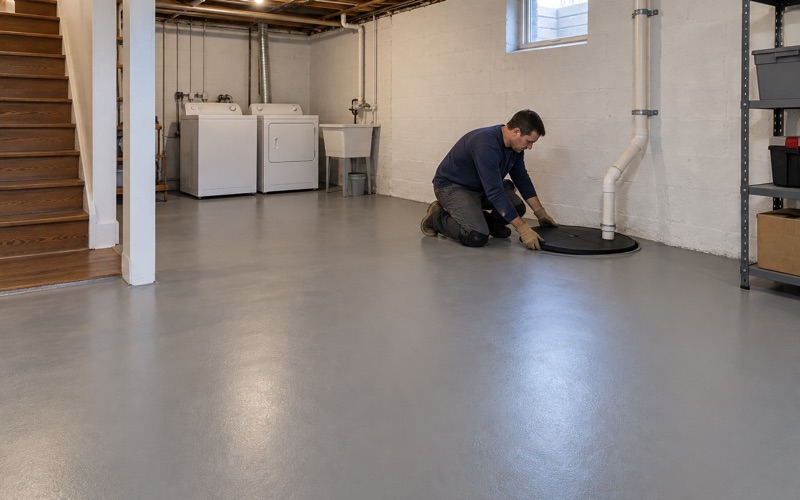
Basement work in Markham comes with its own questions, and some of them belong to the city rather than to us. The answers decide whether a floor gets coated now, later or not at all.
Bel Aire and Country Aire
The city’s hazard-mitigation plan names the Bel Aire Subdivision and the Country Aire neighborhood as vulnerable to flooding. Country Aire’s sanitary sewers are being assessed and rehabilitated with a $500,000 MWRD award, and Bel Aire has an MWRD-funded planning study for its flooding. A basement floor in either neighborhood is coated after the water source has been dealt with, never in place of that work.
A coating is a wear surface, not waterproofing or flood protection, and we say so in the proposal. Markham’s flood ordinance also counts improvements cumulatively against a 50 percent of market value line and treats the first alteration of a floor as the start of a substantial improvement. Whether a basement coating counts is the Building and Housing Department’s call, so we raise it with the department before work starts in a home that has taken water.
Contracts, bonds and who signs off
For a home job over the state threshold, the Illinois Home Repair and Remodeling Act calls for a written contract, and we hand over the Home Repair: Know Your Consumer Rights pamphlet before any grinding begins. Illinois issues no flooring or coatings license, so the local rules carry the weight. Surety-bond sellers report that Markham Code of Ordinances 120.18 has contractor applicants file a $10,000 license and permit bond with the Building and Housing Department.
That report comes secondhand, so we confirm the bond, insurance and any registration directly with the department before quoting a Markham job. The same office houses the Director of Building and Housing, who serves as the city’s floodplain enforcement official. One call usually settles both questions.
- 20+ Years Coating Concrete
- Moisture Tested Before Pricing
- Free Written Estimates