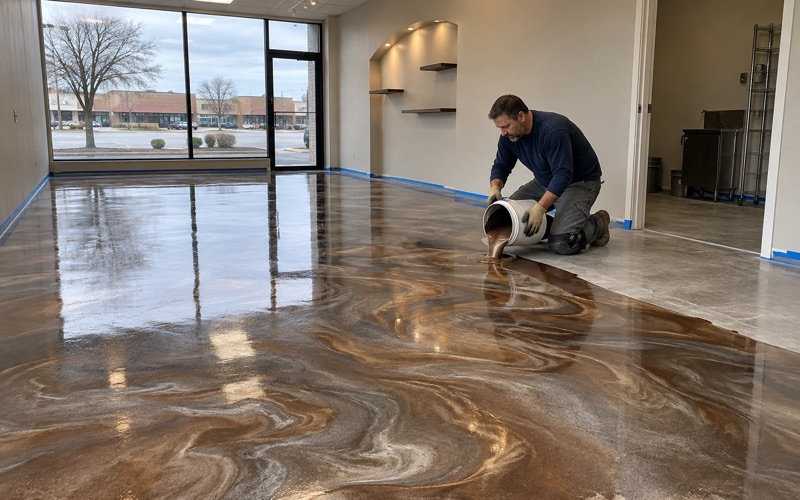
Oak Lawn Epoxy Flooring has spent more than 20 years installing epoxy flooring in Matteson garages, shops and wash spaces, and the floors that work hardest here are the ones that rarely get a chance to dry. Soap, degreaser and tire dressing all end up on the concrete sooner or later, and a coating has to keep both its grip and its bond through every one of them. We build each floor around that daily load rather than around a showroom photo.
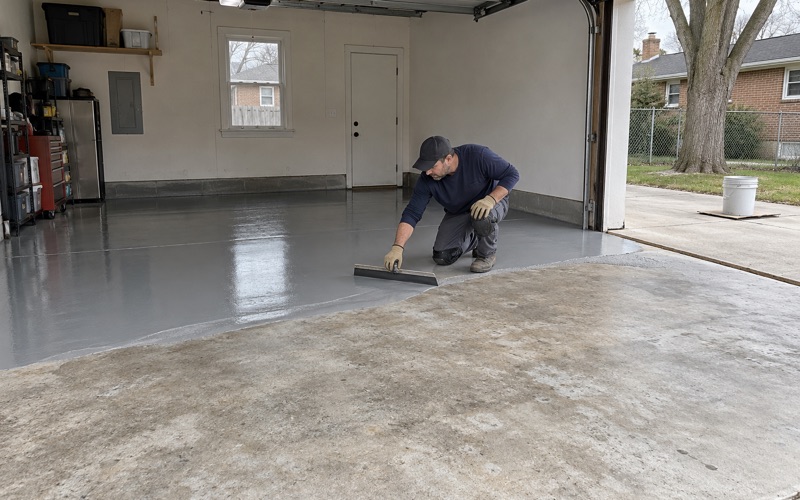
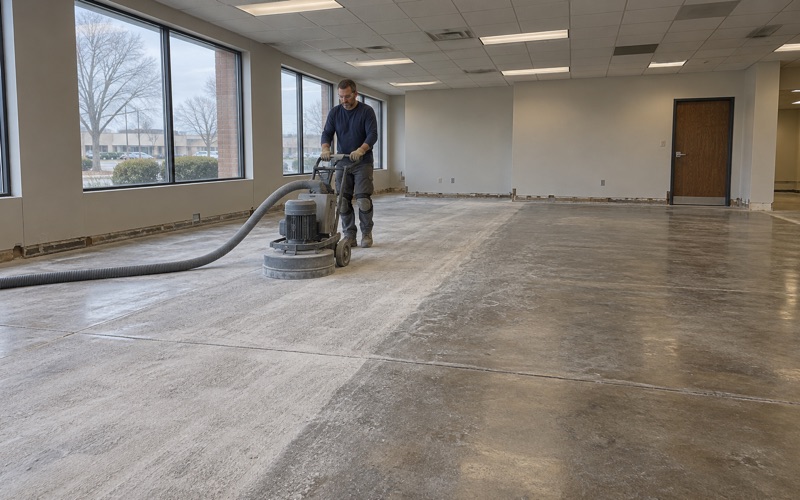
Every job starts with the slab itself. We open the surface with a diamond grinder or a shot blaster instead of an acid etch, map the cracks, spalls and old coatings, and tell you plainly when the concrete needs repair before anything should go on it. A moisture test is written into the scope before the price is final.
The proposal you sign names the product line, the number of coats and the finished thickness. That gives you a yardstick for the floor once it is down, and it leaves no room to quietly thin a system out halfway through the job.
An Auction That Reconditions Cars Inside the Village
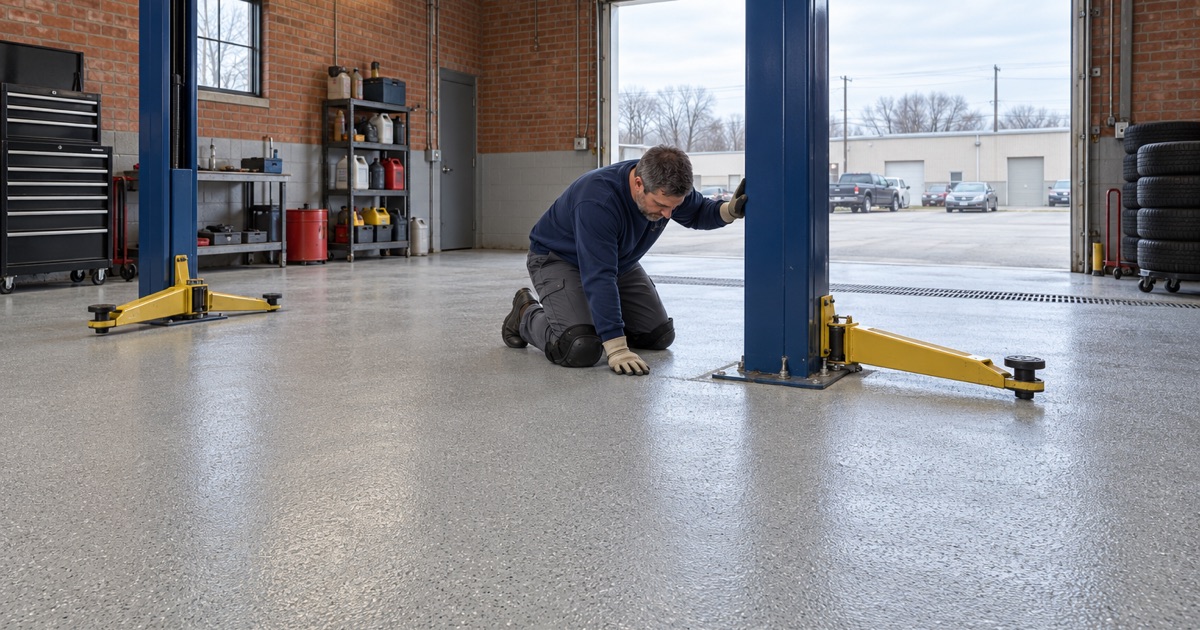
Matteson’s car economy is unusually concentrated, and much of it involves water on concrete. Two operations set the tone, and between them they explain why a wet-process floor deserves its own specification here.
Manheim Chicago on Cox Avenue
Manheim Chicago sits at 20401 Cox Avenue, inside the village and within Rich Township. The Village of Matteson’s FY2025 financial report lists the auction as a 400-employee major employer, and Mannheim Remarketing/Services Co ranks as the village’s third-largest taxpayer in the same report. It is a wholesale operation, so cars arrive needing work and leave ready to sell.
A 2016 site-visit account described a detail shop there cleaning about 450 cars a day and a body shop painting about 70, figures best read as approximate and a decade old. Manheim’s own October 2016 release recorded a new Retail Advantage reconditioning facility built to service 180 to 240 vehicles a week. We have never worked in those buildings and have not seen what their floors are made of, but the work described there sets out what a reconditioning floor has to survive.
The Matteson Auto Mall next door
The village’s financial report describes the Matteson Auto Mall, established in 2001, as spanning 110 acres between Interstate 57 and US Route 30. A 2019 hazard-mitigation annex called it the largest agglomeration of automobile dealerships in Illinois. Put an auction that reconditions cars beside a cluster that size, and washing and detailing become steady working trades in the village.
What a detail bay puts on its floor
A detail shop floor is wet for most of the working day. Wash water carries road film and brake dust, wheel cleaners and engine degreasers run off the cars in sheets, and tire dressing overspray settles as a thin silicone film. Each of those attacks a coating in a different way, and a floor chosen for looks alone tends to fail on one of them.
Strong degreasers and wheel cleaners test the chemical resistance of the topcoat, while standing water tests the bond underneath it. Silicone dressing is the quieter problem, because it never really dries on a smooth surface. That is why we treat a detail space as a wet-process floor first and a good-looking floor second.
Looking for epoxy-flooring closer to Mokena? See Epoxy-Flooring Services in Mokena.
Grip Under Tire Dressing: Texture Over Gloss
A high-gloss epoxy floor looks its best on the day it is finished and its worst the first time someone crosses it with dressing on their shoe soles. Silicone sits on a smooth coating as a slick layer that ordinary soap does not fully lift. In a bay where people move around wet cars all day, that is a safety question, not a cosmetic one.
Broadcast texture that stays put
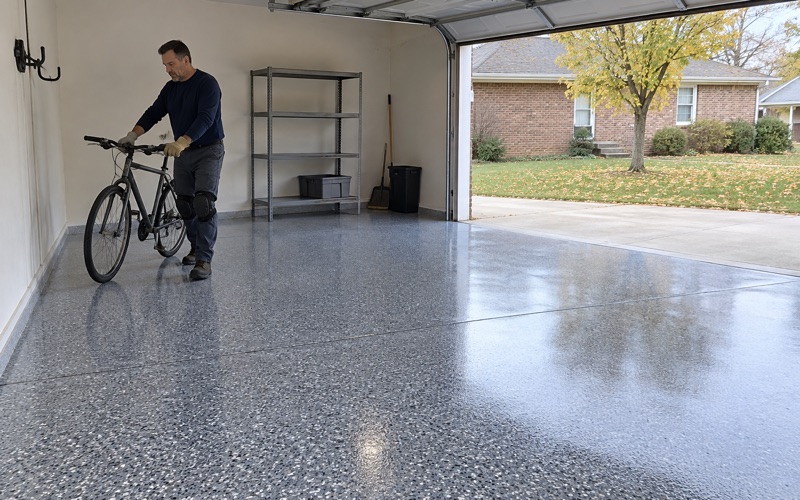
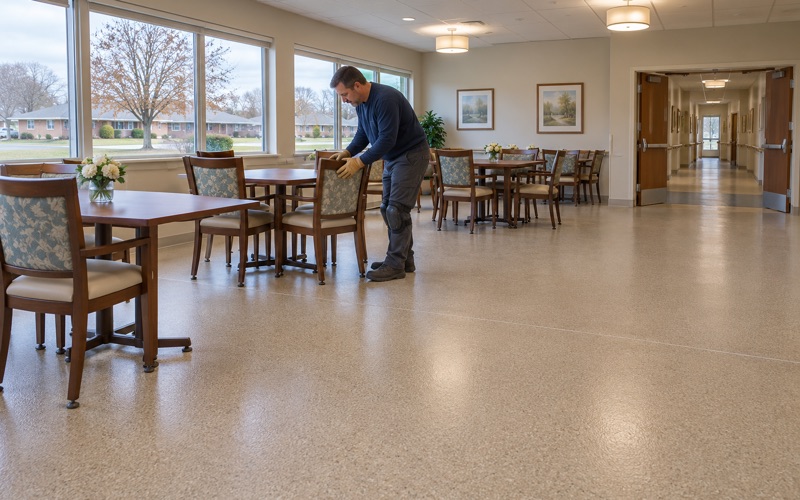
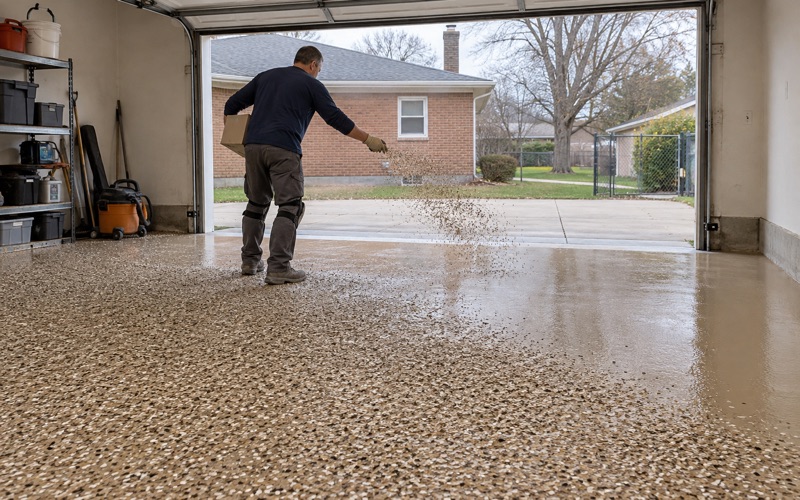
For wet detail spaces we lean toward a quartz aggregate broadcast locked under the topcoat, which leaves a sanded profile that still reads as grip when the floor is wet and oily. A vinyl flake broadcast gives a finer texture and hides spotting well, and it suits lighter traffic. In both cases the texture is sealed into the system rather than sitting loose on the surface, where a squeegee would drag it off.
Choosing the topcoat
Polyaspartic and polyurea topcoats cure quickly and stand up well to car-care chemicals, which makes them a common choice over a 100% solids epoxy base coat. Where a space takes hot water and heavy chemical washdown, urethane cement is another option worth pricing. A properly cured polyaspartic topcoat also resists hot tire pickup far better than a thin, single-coat epoxy paint, which matters when cars roll in straight off the road.
Keeping texture cleanable
Texture that is too aggressive traps dressing and grime and becomes hard to rinse. We sample the broadcast density with the owner before the job, so the floor balances grip against how often it actually gets squeegeed. A slightly finer profile along walkways and a heavier one where cars are washed is a common split.
Slope, Drains and Chemical Resistance in a Wash Space
Water that sits on a floor is water that finds every weak spot in a coating. In a wash-and-detail space, the slab’s slope decides whether rinse water runs to the drain or pools along the walls and under parked cars. A coating follows the concrete beneath it, so we check the fall before we grind, not after the floor is down.
Reading the slab before coating it
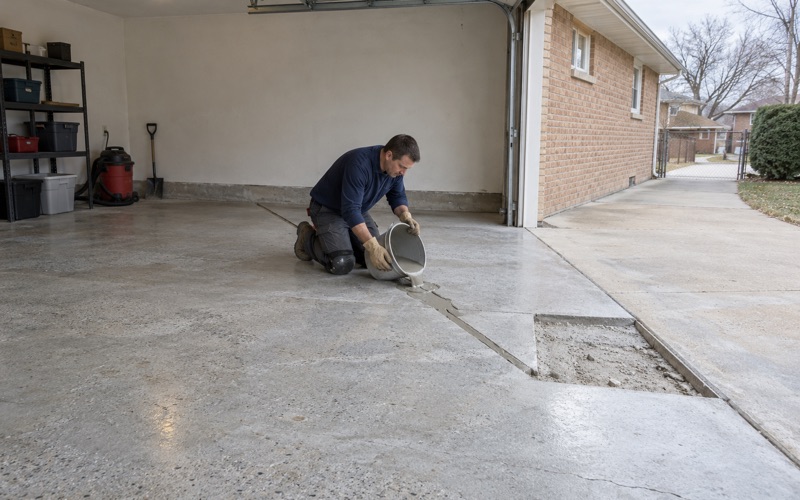
We map low spots, cracks and spalls, and we flag areas where the existing slope runs away from the drain. Some of that can be corrected with a patching mortar or a sloped topping, while some of it means the concrete needs work a coating cannot fix. We say which is which before the quote is final.
Moisture and the bond underneath
A slab that looks dry can still push moisture up from below, and a wet-process floor adds plenty more from above. We run an ASTM F1869 calcium chloride test or ASTM F2170 in-situ relative humidity probes as part of the written scope, and a moisture-mitigation primer goes into the system when the readings call for it. Moisture is also the first exclusion we explain in any coating warranty, before the job is sold.
Grinding dust and the drain
A wash bay drains into a public system, and Matteson Public Works maintains 81.40 miles of sanitary sewer and 86.43 miles of storm sewer across the village. We capture grinding dust at the machine with a vacuum instead of rinsing it toward a floor drain or a storm inlet. The floor goes down clean, and the drains do not inherit our prep work.
Scheduling around a working shop
A detail operation that cannot close gets phased work, with overnight and weekend windows the way we handle retail and restaurant floors. Cure schedules follow slab temperature and dew point rather than a calendar date, so we never reopen a bay on a guess. Permit questions for commercial work go to Matteson Community Development, Building Services, before the job is booked.
Detailing at Home in a 2000s Matteson Garage
The habits of a detail shop show up in driveways and garages, too. A homeowner who washes and dresses cars at home puts the same cleaners and silicone dressing on the garage floor, just at a smaller scale. For that owner, a textured topcoat makes more sense than a smooth gloss, however tempting the showroom finish looks.
A village of 2000s houses
Matteson grew quickly in the 2000s. Census figures put 31.8 percent of the village’s housing units in the 2000-2009 build years and 45.2 percent at 2000 or later, while a 2019 village annex recorded population rising 32.5 percent between 2000 and 2010. Owner-occupied single-family attached homes number 806 in the same Census count, a larger slice than in many older villages.
A house from that era is no reason to skip the testing. We still grind every garage slab to a real profile, map any cracks or old sealer, and run a moisture test before the price is final. The residential code lets a garage slab go without the vapor retarder required under living space, the IRC R506.2.3 exception, so we never assume one is there.
Choosing a home detailing floor
For a garage where cars are washed and dressed, we usually recommend a 100% solids epoxy base with a full vinyl flake broadcast and a polyaspartic topcoat. The flake keeps grip under a wet, dressed surface, and the topcoat holds up to the same wheel cleaners and degreasers a detail bay sees. If the garage doubles as a wash bay, we also look at where the water goes and whether the floor already pitches toward the door or a drain.
Permits, contracts and paperwork
Matteson sits entirely in Cook County, and permit questions for home work go to the village’s Building Services office, which issues permits and performs inspections. Illinois has no state flooring license, so we check the village’s own contractor registration, bond and insurance rules before we book the job. Home jobs over the state threshold get a written contract and the Home Repair: Know Your Consumer Rights pamphlet before any grinding starts.
We also pick products inside the Illinois VOC limits for floor coatings, which bind whoever applies them, and an unheated garage in deep winter is told to wait for better slab conditions. Whether you detail at home or run a wash-and-detail space, the first visit covers a moisture test and a look at where the water goes. From there you get a written scope and a plain answer about whether the slab is ready.
- 20+ Years Coating Concrete
- Moisture Tested Before Pricing
- Free Written Estimates