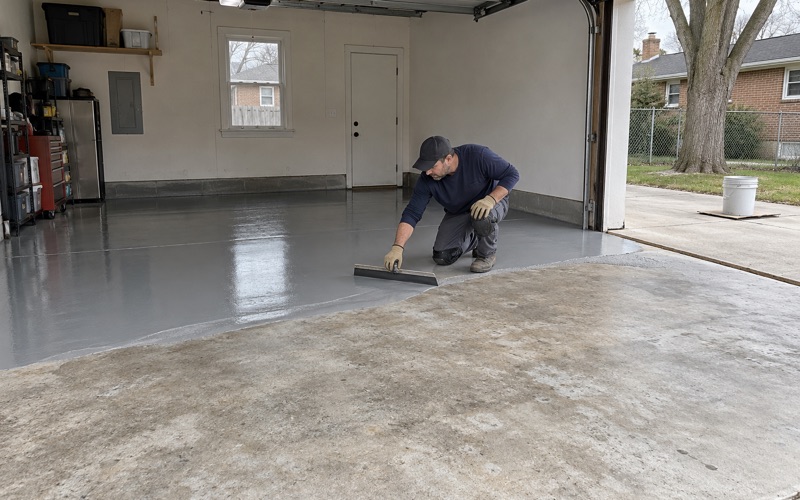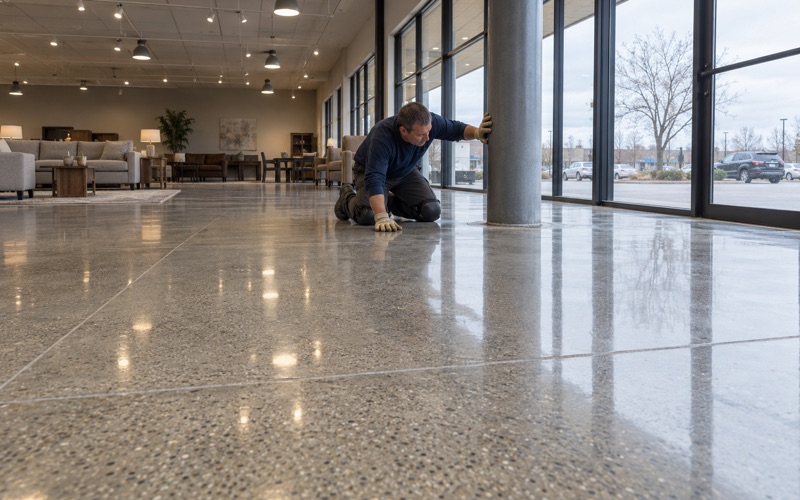
Oak Lawn Epoxy Flooring has spent more than 20 years on epoxy flooring in Midlothian and the rest of the southwest suburbs, and the floors that test a coating hardest are the ones that never get a quiet day. A grocery aisle, a retail sales floor and a two-car garage each fail for different reasons, so every job starts with working out which kind of failure the slab is headed toward.
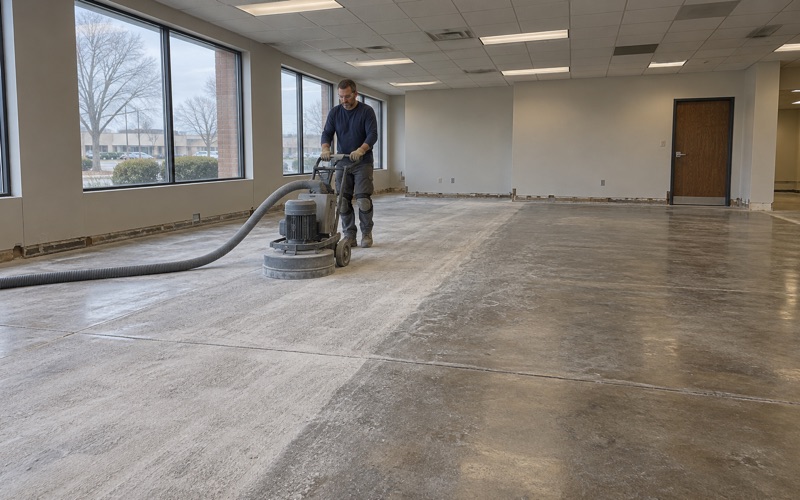
The method does not change with the room. We open the concrete with a diamond grinder or a shot blaster rather than acid, we test the slab for moisture before the price is settled, and the written proposal names the product line, the coat count and the finished thickness so the owner can hold the result against the quote.
Most of this page is about one demanding kind of commercial floor: the supermarket aisle that stays open fourteen hours a day, every day. It also covers what the village asks of a flooring contractor. The last section follows the same methods into a Midlothian garage or basement.
A 30,000-Square-Foot Grocery Floor on 147th Street
Berkot’s Super Foods opened its Midlothian store in December 2014 at 4640 147th St, in Bremen Township, on the stretch of 147th Street that also carries Illinois Route 83. The store is a 30,000-square-foot supermarket assembled from the former Century Foods store plus part of the building the St. Vincent DePaul thrift shop used before that shop relocated.
We have no relationship with Berkot’s and have not seen its floor, so nothing here describes its finish. We use the store because it is the clearest public example in the village of a floor that has to serve shoppers every hour it is open and still be maintained. The questions it raises are the ones any large food retailer on this corridor would face.
Two buildings, one sales floor
A store built from a former supermarket and part of a former thrift shop can sit on slabs poured at different times for different uses. Where two slabs meet there is usually a joint, sometimes a step in elevation, and often a different history of coverings and adhesives. Before any coating is priced, we map those transitions along with cracks, spalls and old coatings, and we say plainly when a section needs repair first.
Carts, pallet jacks and the nightly scrubber
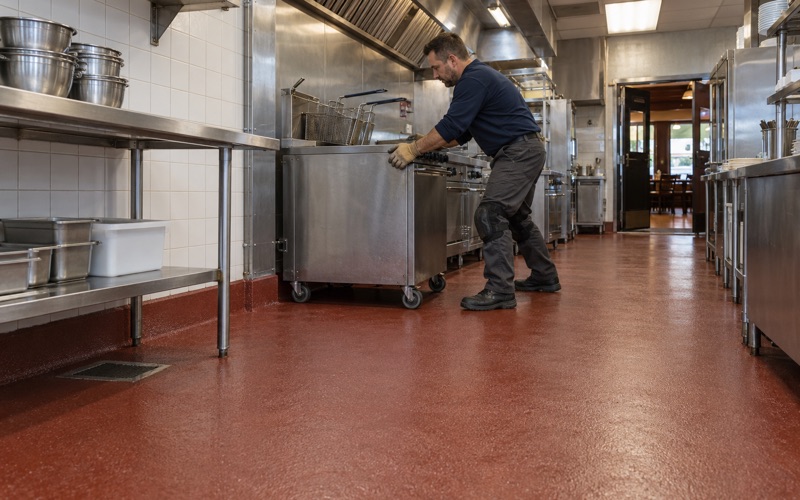
Grocery floors carry heavy displays, loaded shopping carts, pallet jacks and constant foot traffic, and the wear concentrates where those loads turn. End caps, the receiving door and the lanes in front of the registers take point loads from small hard wheels that a home floor never sees. Pallet jack wheel loads in particular chew at joint edges and at any spot where a coating went down thin.
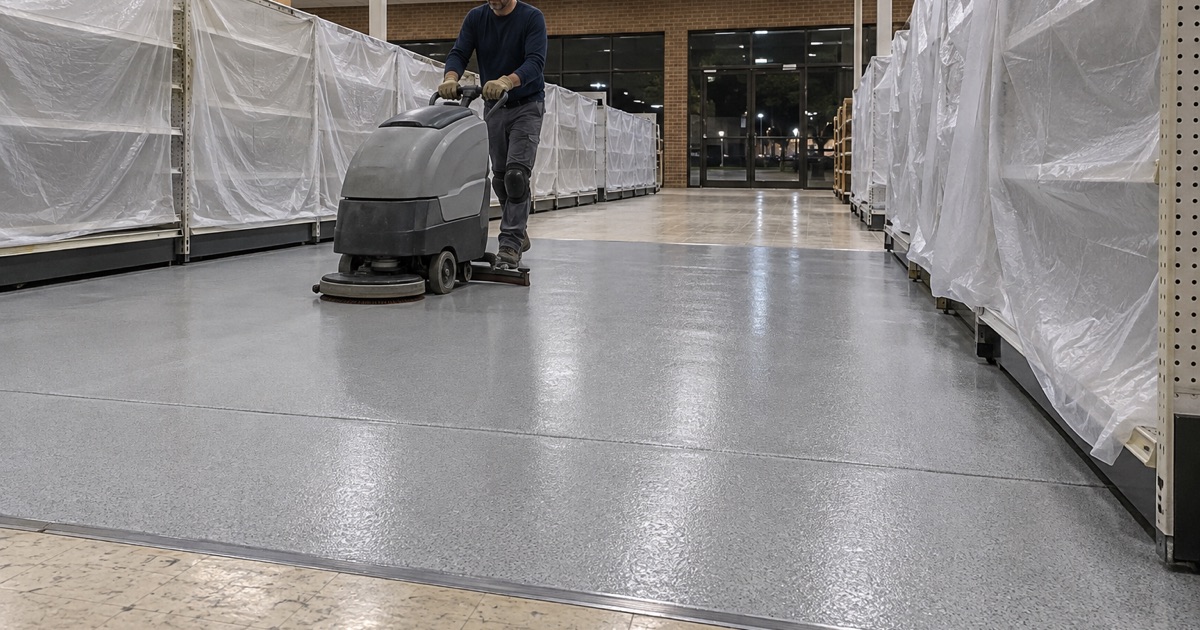
Then the floor is scrubbed after hours, typically by an auto scrubber dragging water, detergent and pads down every aisle. A finish that softens under repeated wet cleaning or dulls in the traffic lanes ends up recoated far more often than anyone budgeted. The floor has to survive both the daytime abuse and the nightly cleaning that follows it.
The corridor around it
No industrial park turned up inside the village, so the commercial floors here are corridor retail on 147th Street, Cicero Avenue, Kedzie and Pulaski. One 147th Street listing cited more than 18,000 vehicles a day on the Route 83 stretch. The grocery floor is simply the largest-scale version of what the smaller shops along those streets deal with: wheeled loads, wet cleaning and no convenient time to close.
Looking for epoxy-flooring closer to Lyons? See Epoxy-Flooring in Lyons.
Working Aisle by Aisle Between 9 p.m. and 7 a.m.
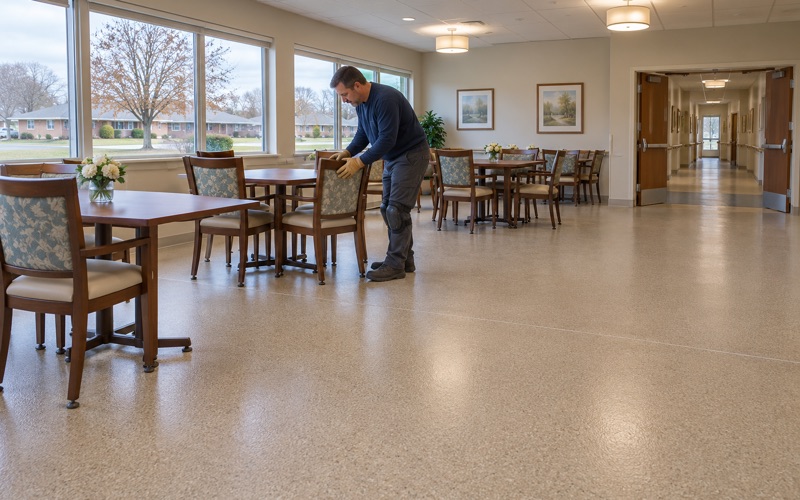
A store open 7 a.m. to 9 p.m. every day of the week never offers a closed weekend. Any resinous floor installed under those hours has to go down in pieces, inside the overnight gap, with each piece back in service before the doors open. We phase retail, medical and restaurant floors this way routinely, because most of those spaces cannot close for a week.
Sizing each night’s section
The working window is roughly ten hours, and grinding, vacuuming, priming, coating and curing all have to fit inside it, with shelving moved and returned. That usually means one aisle, or part of one, per night rather than a large open area. Fixtures are pulled back or protected, the section is barricaded, and the neighboring aisles stay clean and walkable for the morning.
Coordinating with receiving and stocking
Overnight in a grocery store is not empty time. Stocking crews, back-door deliveries and the cleaning crew all work the same hours, so each night’s section is agreed with the store in advance and fenced off from the routes those crews need. Receiving areas, where pallet jacks run hardest, are best scheduled for the nights with the lightest deliveries.
Dust and odor in an open food store
Grinding in a building full of packaged food means dust is captured at the machine by a vacuum, not swept up later or rinsed down a drain. Odor matters just as much, because the air has to be clear before shoppers return. That pushes the overnight system toward fast-curing, low-odor products chosen inside the Illinois VOC limits for floor coatings, which bind the applicator and not only the manufacturer.
A cure that respects the opening bell
A coating still soft at 6:00 a.m. will take marks from the first cart and a dent from the first pallet jack. We set each night’s cure schedule from slab temperature and dew point measured on site, and we lean on polyaspartic or urethane cement topcoats where return-to-service time is the controlling number. If the readings say a section will not be ready, it waits a night.
Ending the Strip-and-Wax Cycle
Many supermarkets use a floor finish that has to be stripped and rewaxed on a recurring schedule to keep its shine. That cycle is a standing overnight labor cost, it closes aisles every time it comes around, and it adds stripping chemicals to the nightly routine. We describe it here as a common grocery choice, not as any particular store’s practice.
What a resinous topcoat changes
Coating manufacturers market resinous topcoats for grocery floors on one main promise: staying clean and glossy without constant stripping or waxing. Once the floor is sealed, routine care becomes a scrubber pass with the right pad and cleaner rather than a periodic strip. The trade-off is a more involved installation, and a poor one is far harder to undo than a bad coat of wax.
Building a system for carts and wheels
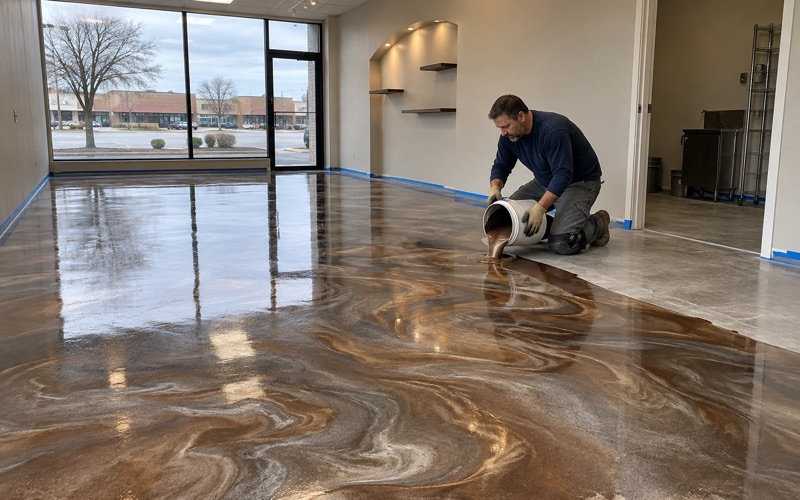
For a sales floor we would typically start from a 100% solids epoxy base for build and impact resistance, topped by a polyaspartic or urethane coat for abrasion and gloss retention. A quartz aggregate broadcast can add texture at entries and in departments where wet floors are routine. The proposal states the product line, each coat and the finished thickness, so a store manager can check what was installed against what was sold.
Moisture before money
A slab that has carried tile or sheet goods for years can hide a moisture problem that only shows once sealed resin is on top. We run ASTM F2170 in-situ relative humidity probes or ASTM F1869 calcium chloride tests as part of the written scope, and before anything is signed we explain what the coating warranty leaves out, starting with moisture. Where readings are high, a moisture-mitigation primer goes into the price rather than into a later dispute.
Where it does not pay off
A coating is not the answer for every aisle. A slab with widespread cracking, heaved joints or old adhesive that will not grind clean may need repair or partial replacement first, and we would rather say that at the walk-through than after the first section lifts. Sometimes the honest recommendation is to keep the existing finish and plan the conversion around a future remodel.
Village Rules and the Floors Closer to Home
Illinois licenses no general, flooring or coatings contractor, so the rules that matter are the Village of Midlothian’s own. Every contractor working in the village needs an annual license, $100 for a trade or $300 for a general contractor, plus a $10,000 bond and a certificate of at least $1 million in liability coverage naming the village. All of those licenses expire December 31, and we confirm the current requirements with the village before a job is booked.
The Building Department on Pulaski Road
The Building Department works out of village hall at 14801 S. Pulaski Road and enforces the 2018 International Building Code, adopted by ordinance in 2019. Inspections need one business day’s notice and run Monday through Friday only, which matters when the coating work itself happens overnight or on a weekend. Whether a given floor job needs a permit is the department’s call, and we ask rather than assume.
Garage floors that take road salt
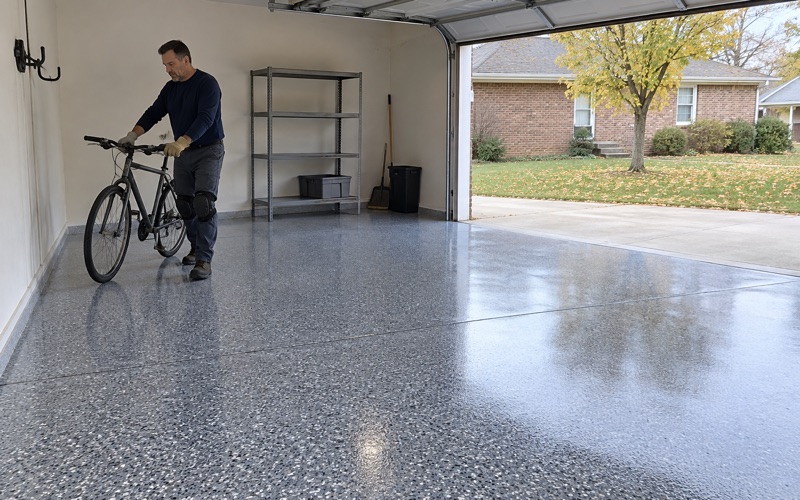
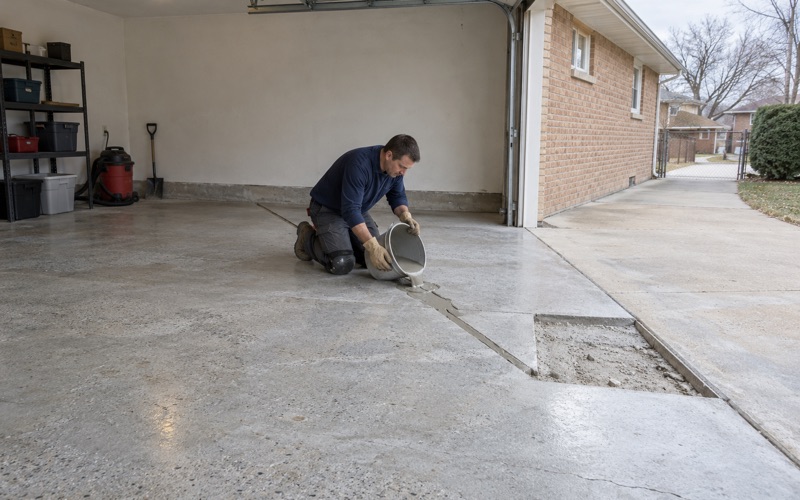
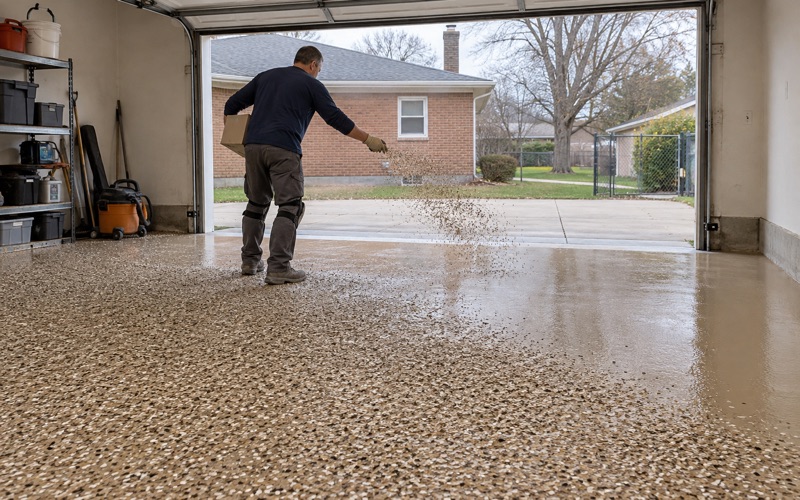
Most of the village’s housing is detached single-family homes, and a garage slab there takes brine and rock salt off the tires all winter. We choose garage systems for that exposure, usually a ground slab, an epoxy or polyurea base, a vinyl flake broadcast and a polyaspartic topcoat that resists hot tire pickup. An unheated garage in deep winter is told to wait, because slab temperature decides the cure, not the calendar.
Basements on an older slab
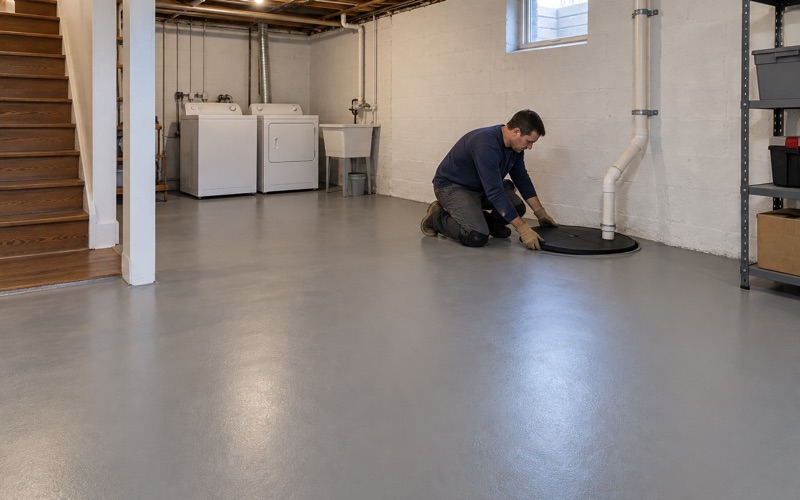
A basement coating here is a retrofit over concrete that has been down for decades. We start with an ASTM D4263 plastic sheet test or probes and look for efflorescence and signs of hydrostatic pressure, because a surface coating does not stop water coming up from below. Nor do we ever sell a floor coating as radon reduction, which in Illinois is licensed mitigation work.
For homeowners, a job over the state threshold comes with a written contract and the Home Repair: Know Your Consumer Rights pamphlet before any grinding begins. The dust stays in the vacuum, not on the driveway or in a storm inlet. And if a slab needs repair before it should be coated, the quote says so in writing.
- 20+ Years Coating Concrete
- Moisture Tested Before Pricing
- Free Written Estimates