Oak Lawn Epoxy Flooring has spent more than 20 years on epoxy flooring in Mokena and the surrounding southwest suburbs, and the floors we think hardest about are the ones where dirt is the real problem. A coated slab that stays sealed, mops clean and gives off no grit does more in a working shop than look good. It keeps the floor from becoming one more source of the dust a mechanic is trying to keep out of an open engine.
That standard holds whether the room is a commercial rebuild bay or a home garage where someone tears down a small engine on the weekend. We open every slab mechanically, test it for moisture before the price is set, and write the product line, coat count and finished thickness into the proposal so the floor can be checked against what we promised.
What follows is how we approach a contamination-conscious floor in Mokena, what we use in place of the usual shortcuts, and what we confirm with the village before work starts. None of it depends on a particular brand of machine; it depends on a floor that does not shed.
An Equipment Rebuild Shop on 88th Avenue, and Why Microns Matter
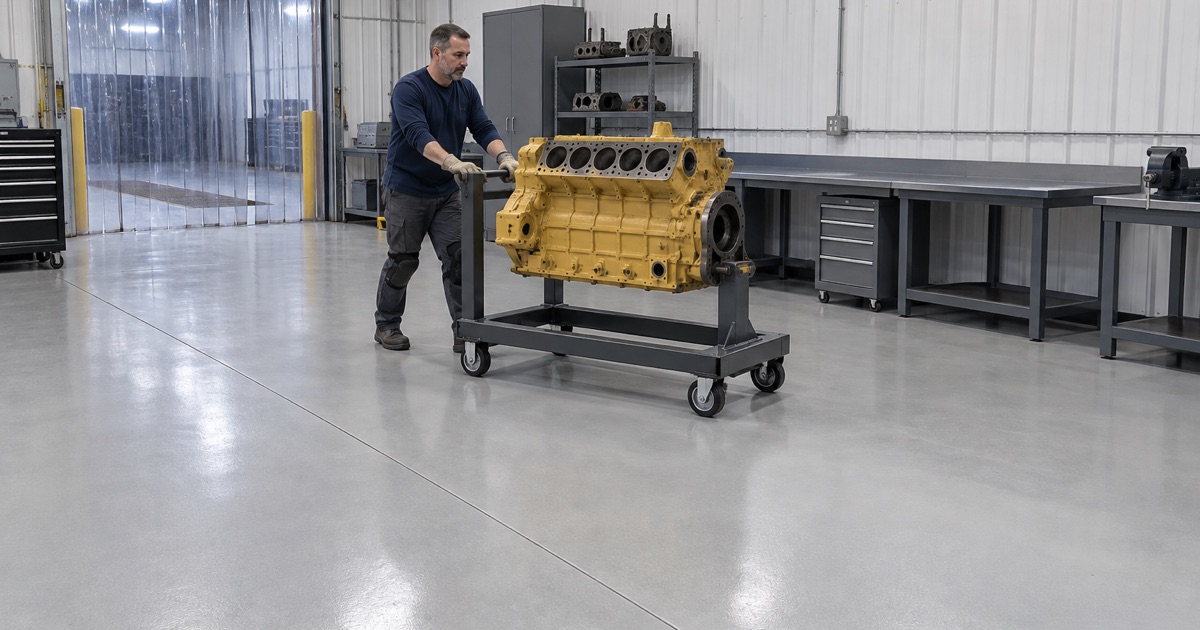
What happens at 19001 S. 88th Avenue
Altorfer Cat, a Caterpillar dealer, runs a location at 19001 S. 88th Avenue, an address that sits inside Mokena village in Frankfort Township, Will County. The site covers 23.7 acres at 88th Avenue and 191st Street, just south of I-80. Its main structure is a 60,000-square-foot pre-cast building with 30-foot clear heights, put up for the servicing, repair and rebuilding of equipment, engines and components, along with warehouse space for replacement parts.
A second 7,000-square-foot building handles equipment and vehicle wash and welding services, apart from the main shop. Published descriptions of the site also mention cranes, heavy concrete foundations and oil separation and recovery systems. We have no relationship with Altorfer or Caterpillar and have never seen that shop’s floor, so we point to it only as the clearest local example of a shop laid out around keeping work clean.
Two to 30 microns
Caterpillar’s contamination-control brochure, PEDJ0028-01, says modern machine systems work within tighter tolerances, between 2 and 30 microns. At that scale, the particles that do harm can be smaller than anything the eye picks out on a shop floor. A component rebuilt in a dusty bay can carry that dust straight into a hydraulic circuit or a fuel system.
That is why the floor matters in a rebuild bay in a way it does not in a parking area. Bare concrete dusts as it wears, and a broken or worn coating sheds flakes and grit that end up on benches, parts and hands. A shop chasing clean assemblies needs a floor that stops adding particles in the first place.
Looking for epoxy-flooring closer to Chicago Ridge? See Epoxy-Flooring in Chicago Ridge.
Clean, Sealed Floors and the Case Against Floor-Dry
What Caterpillar’s guidance actually says
Under a heading on clean facilities, the same brochure states that dirty floors and cluttered work areas contribute to contamination, and that clean, sealed floors and well-organized work areas create an atmosphere of professionalism. It also notes that each Cat dealer facility is rated on factors that include wash facilities, shop cleanliness and organization, and parts and fluid storage. The brochure does not name a floor product, and it is general guidance rather than an audit of the Mokena shop.
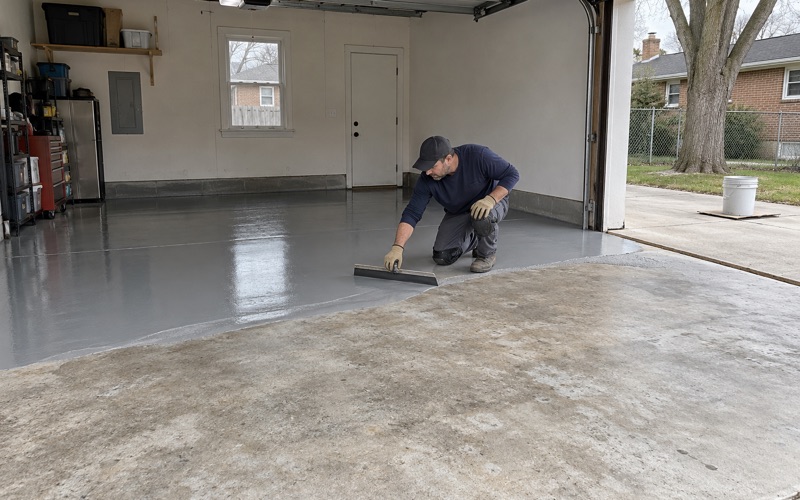
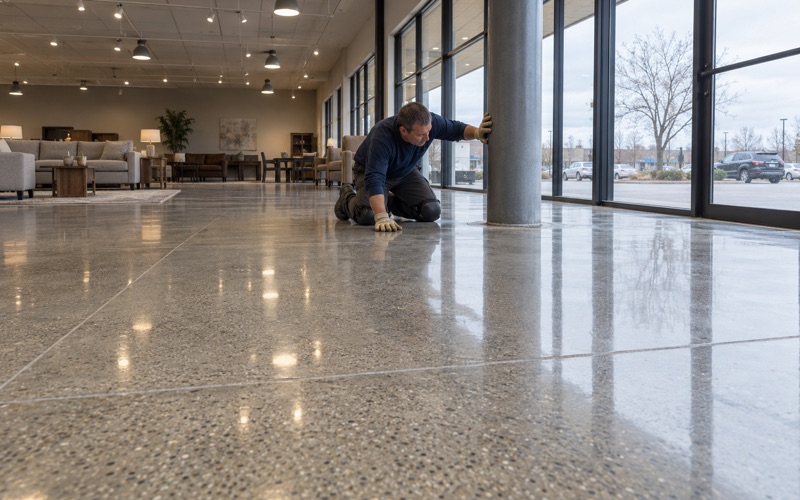
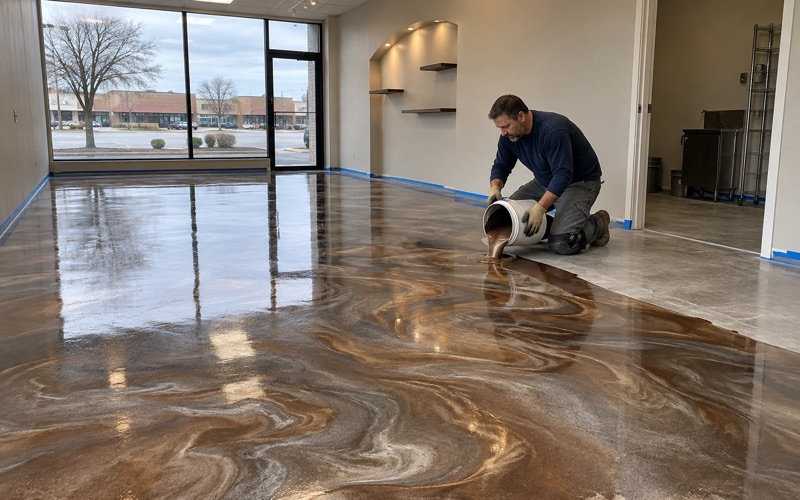
We read the word sealed as the practical part. A sealed floor is one where oil, coolant and fine dirt sit on the surface until they are wiped up, rather than soaking into the pores of the slab and working back out later as stain and dust. In shop work, that usually means a 100% solids epoxy body coat over a mechanically profiled slab, finished with a topcoat chosen for the fluids and cleaners actually used in the room.
Pads and mops, not granular absorbents
The brochure is direct about spills: use absorbent pads, mops and scrubbers to clean up oil right away, and avoid granular materials. Its reasoning is that sawdust and other granular absorbents can produce dust that sticks to containers, parts, machines and hands. A bag of floor-dry solves the slip problem and creates the contamination problem.
Floor-dry gets used on bare concrete because bare concrete gives a mop little to work with once the oil has gone in. A coated floor changes that, because a spill stays on top where a pad lifts it and a mop or auto-scrubber finishes the job. When we specify texture for a shop, we keep it fine enough that a mop still glides and a scrubber still picks up, since a coarse grit that traps dirt works against the whole point.
Texture without trapped dirt
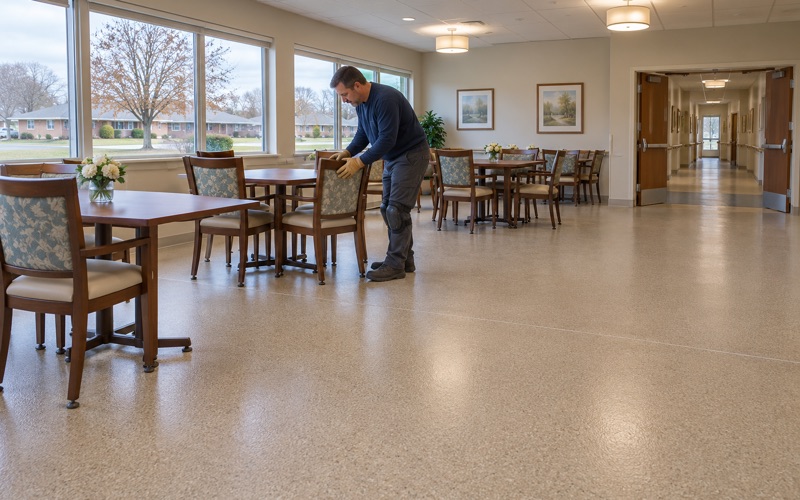
Some slip resistance still makes sense where fluids land. We tune it with a light quartz aggregate broadcast or a fine additive in the topcoat, kept tighter at benches and drains and smoother in aisles where carts and creepers roll. We bring samples before the job so the owner can feel the difference between a profile that grips and one that holds grime.
Wash First, Then the Shop Floor
The apron and the wash bay
Caterpillar’s guidance also covers what happens before a machine reaches the bench. It recommends washing machines and components before they enter the shop for disassembly, and it notes that a concrete apron around shop doors reduces the dirt and mud that machines, vehicles and people track inside. The Mokena site’s separate wash and welding building follows the same logic of keeping the messiest steps out of the main bay.
On the yard side, published descriptions say fifteen acres of that site are heavy-poured concrete, asphalt paving and hard packed stone aggregate for moving, storing and displaying equipment. Stone fines and mud from a yard like that are exactly what an apron and a wash step are meant to stop at the door. The floor inside only stays clean if less arrives on it.
For an owner planning a floor, that split matters. A wash bay sees constant water, detergent and grit and calls for a different system and texture than a rebuild room where the goal is a smooth surface that wipes clean. We scope those areas separately, with their own coat counts and thickness written into the proposal, rather than running one product wall to wall.
Preparing the slab without adding dust
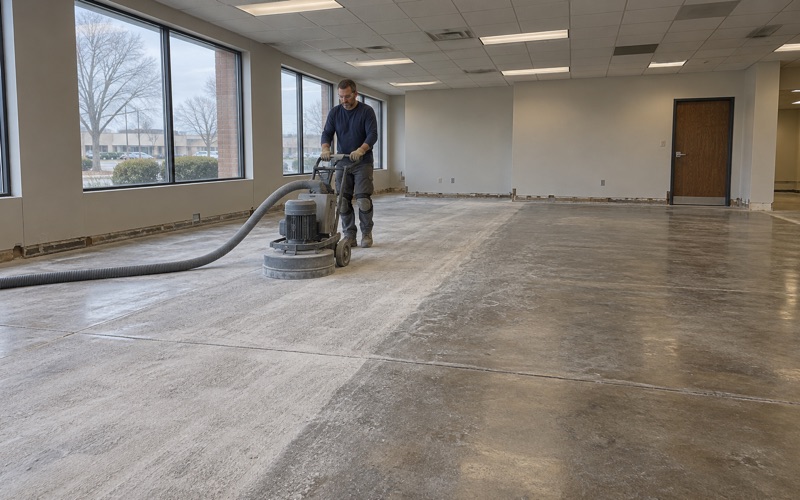
Every slab we coat is opened with a diamond grinder or a shot blaster to the ICRI concrete surface profile the system calls for, never with an acid etch. Grinding makes dust of its own, so we capture it at the machine with a vacuum rather than rinsing it toward a floor drain or out a door. In a working shop, that also keeps fine concrete dust from settling into stored parts during the job.
A working shop rarely can shut down for a week. We phase commercial floors in sections around operating hours, using overnight and weekend windows, and keep parts and benches covered while the neighboring section is ground.
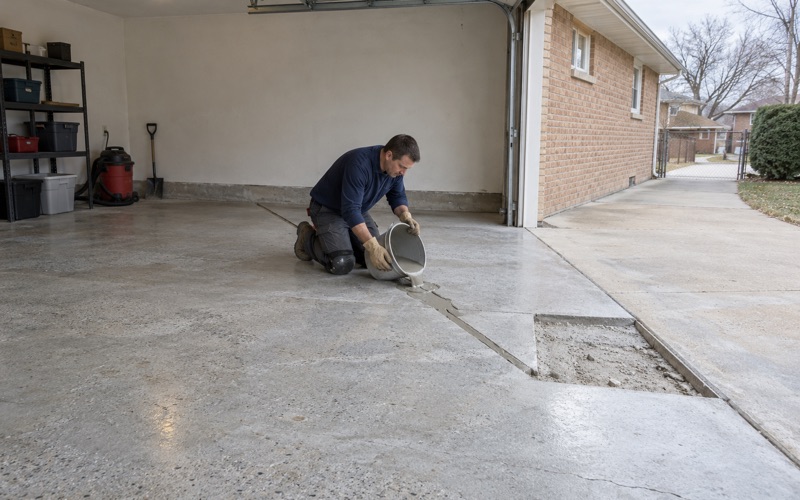
Before any coating goes down, we map cracks, spalls and old coating that is lifting. A shop slab with failed patches under a new system will open back up, and a coating that cracks or peels becomes a fresh source of flakes. When a section needs repair or replacement first, we say so instead of coating over it.
Moisture before price
A moisture test is part of the written scope before the price is final. Depending on the slab, that may be ASTM F1869 calcium chloride testing, ASTM F2170 in-situ relative humidity probes, or an ASTM D4263 plastic sheet test as a first read. High readings point to a moisture-mitigation primer, and we explain up front that moisture is the first exclusion on most coating warranties.
A Sealed Floor for a Home Shop That Rebuilds Engines or Hydraulics
Not every rebuild happens at a dealer. Most owner-occupied homes in Mokena are single-family houses, and some of their garages host engine teardowns, hydraulic cylinder reseals on a compact tractor, and other work where a speck of grit in the wrong place costs a second rebuild.
What changes in a home shop
The same principles scale down. A home shop benefits from a sealed surface that keeps oil on top, a texture fine enough to mop, and the habit of reaching for pads instead of kitty litter under a leaking engine. We usually pair a 100% solids epoxy base with a polyaspartic or polyurea topcoat that resists hot tire pickup and is chosen against the cleaners a home mechanic actually uses.
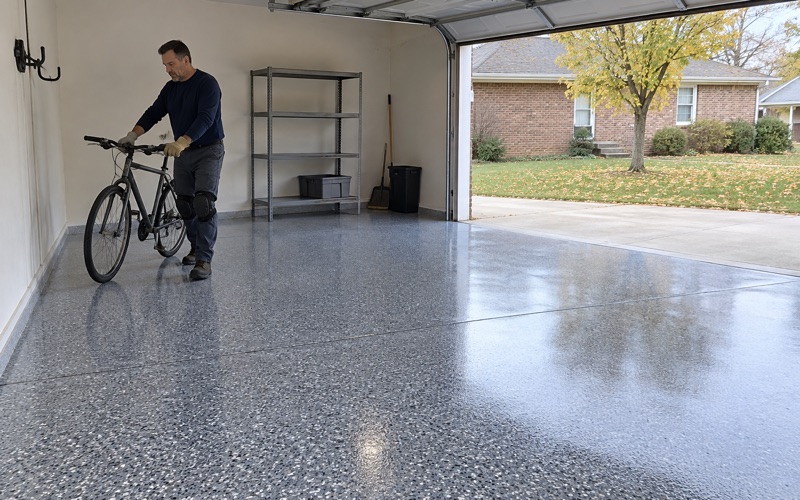
A vinyl flake broadcast is fine in a home garage and hides small marks, but in a bay used for assembly we keep it tight and fully topcoated so no flake edges stand proud to catch dirt. Where an owner wants a work zone and a parking zone, we can finish them differently in one job.
Cure and schedule
Cure schedules follow slab temperature and the dew point spread at the slab surface, not the calendar. If a garage is unheated and the slab is too cold, we tell the owner to wait, because a coating that cures poorly can show amine blush and soften under the first hot tire. We would rather move the date than leave a floor that starts shedding within a year.
Paperwork with the village
Illinois has no state license for flooring or coating contractors, so the local rules are the ones that count. The Village of Mokena Community Development Department, at 11004 Carpenter Street, requires contractors to register before working, with a $150 fee, general liability coverage of $500,000 each occurrence, workers’ compensation coverage of $500,000 each occurrence, and a $10,000 surety bond. We confirm that registration is in place before a Mokena job is booked.
The village’s permit list exempts finish work such as painting, tiling and carpeting, but floor coating is not named either way. The village asks anyone whose project is not listed to contact Community Development before starting, and that is the call we make on each job. Home projects above the state threshold also get a written contract and the Home Repair: Know Your Consumer Rights pamphlet before any grinding begins.
Products are chosen inside the Illinois VOC limits for floor and industrial coatings, which bind whoever applies them. And on any job, we never sell a floor coating as radon reduction, because in Illinois that is licensed mitigation work.
- 20+ Years Coating Concrete
- Moisture Tested Before Pricing
- Free Written Estimates