Oak Lawn Epoxy Flooring has handled epoxy flooring in Palos Heights and the surrounding southwest suburbs for more than 20 years, and the floors we think hardest about are the ones that never get a quiet day. A food counter that runs from late morning to near midnight, a garage that collects salt brine from November to March, a slab with a damp corner: each one changes what we put down and when we put it down.
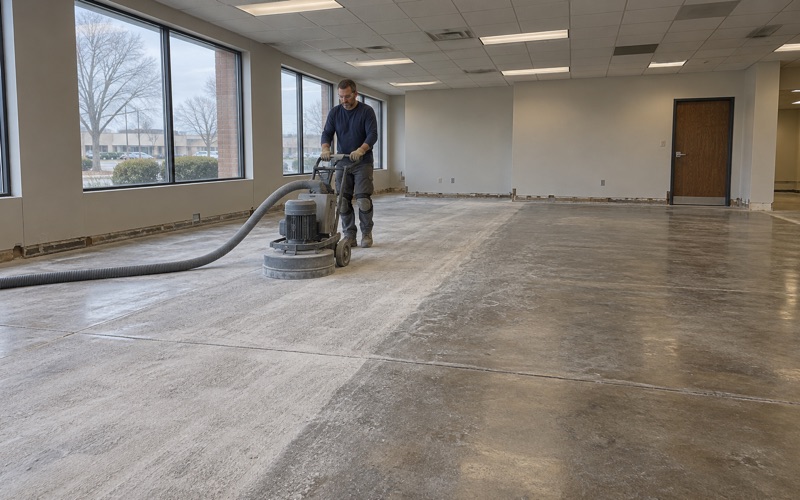
Every slab we coat is opened mechanically, with a diamond grinder or a shot blaster rather than an acid etch, so the first coat bonds into a measured profile instead of a smooth trowel skin. Our written proposal names the product line, the coat count and the finished thickness, which lets you hold the installed floor up against the quote line by line.
Before a price is final we run a moisture test and map every crack, spall and old coating on the slab. If the concrete needs repair or replacement before anything should go on it, we say so first, and we explain what the coating warranty leaves out, starting with moisture.
A Custard Counter on Harlem Avenue
Andy’s Frozen Custard opened at 12805 S. Harlem Ave on January 15, 2021, at 11 a.m., and at opening it ran from 11 a.m. to 11 p.m. daily. The address geocodes inside Palos Heights, in the part of the city that lies in Worth Township, along the Harlem Avenue restaurant row. We have never worked in that building and have not seen its floor.
We use it because its published operating pattern is the clearest local example of the kind of food-service floor we plan around. The schedule, the product and the cleaning cycle together set the conditions a coating behind a dessert counter has to survive, and they set the hours in which anyone could work on it.
A fresh batch every 45 to 60 minutes
The chain’s own FAQ says its custard is made fresh every 45-60 minutes. That is a chain-wide statement rather than something read from the Palos Heights store, but it describes a working rhythm: machines filled, run, drained and cleaned many times a shift, with liquid mix, sugar and rinse water within reach of the floor on each cycle.
Summer hours on the chain’s published schedule run from 11 a.m. to 11:30 p.m. Sunday through Thursday and to midnight on Friday and Saturday, while winter hours close at 11 p.m. on weeknights and 11:30 p.m. on weekends. The stated closures are Thanksgiving, Christmas Eve, Christmas Day and New Year’s Eve, plus an early 6 p.m. close the day before Thanksgiving.
What that schedule asks of a floor
A counter on that schedule has almost no closed day to hand a contractor. The floor behind it likely sees little dry time during service either, because sugar residue and rinse water return before the previous spill has been fully mopped and rinsed away.
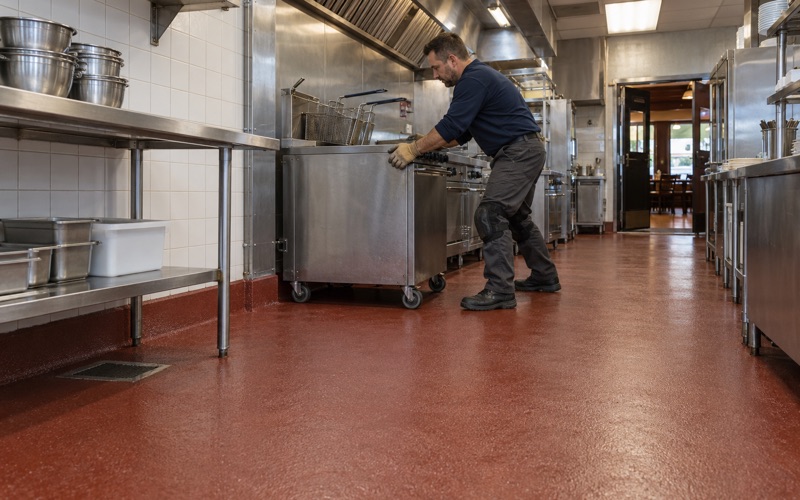
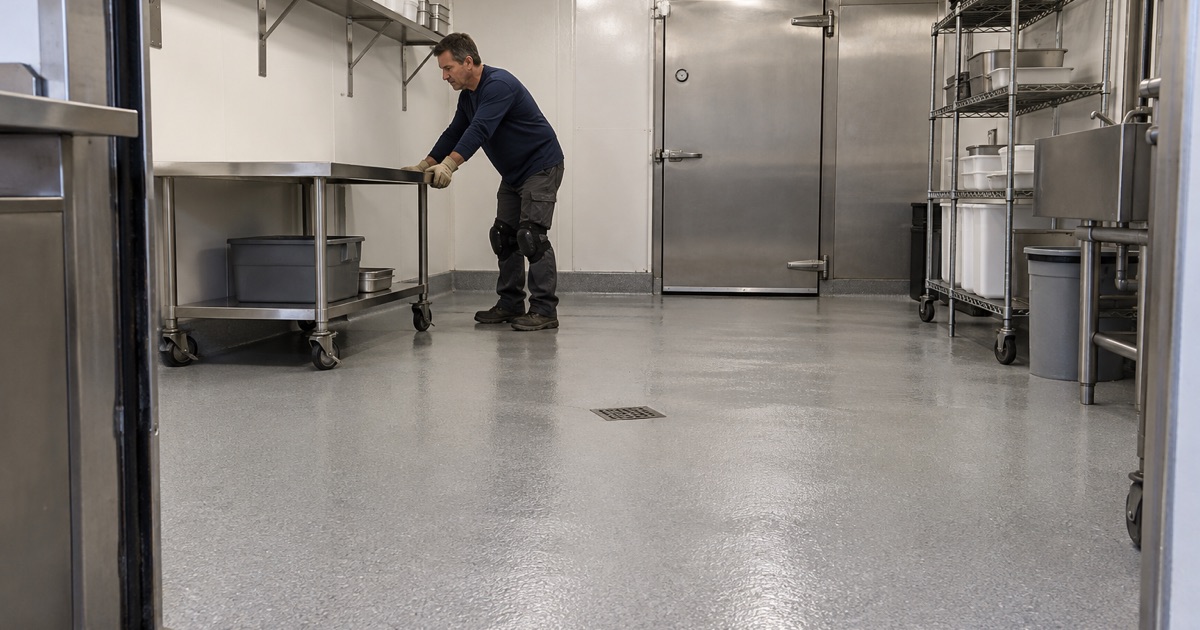
For a Palos Heights food counter with a pattern like that, we plan for three things together. The surface should be seamless, with no grout lines to hold sugar, it should keep its grip under wet shoes, and it should be laid in stages that each cure inside a single night.
When a Harlem Avenue space changes hands
Food businesses on Harlem Avenue in the city also turn over. The former Joe Daniel’s Neighborhood Eatery & Pub building at 12218 S. Harlem Ave is being marketed for restaurant, bar or hospitality reuse, and a local business listing reported the owners of Harvest Restaurant remodeling the building at 127th and Harlem.
A change of tenant is the rare moment a kitchen or service floor sits empty for days rather than hours. When a new operator takes over a space like that, we can grind off the previous coating, repair the slab and install a full system before the equipment goes back in.
Looking for epoxy-flooring closer to Justice? See Justice Epoxy-Flooring.
Why Spilled Mix Turns Acidic on Concrete
Milk sugar does not stay sweet once it sits. As spilled dairy sours, bacteria convert lactose into lactic acid, and that acid attacks the cement paste in bare or poorly sealed concrete, loosening the sand and leaving a rough, pitted surface that holds even more residue.
The dairy trade treats this as a known floor hazard. In a published Sika case study on Arla Foods’ Leeds dairy, the floors had to withstand the cumulative corrosive effect of lactic acid from milk along with the products used in a thorough cleaning regime, and the specified system was a urethane cement chosen for that performance and a slip-resistant finish.
That plant is a large dairy, not a custard counter, and the system it used was not epoxy. We cite it for what it shows about the chemistry, and we carry it over to a dessert counter’s mix-handling area by inference rather than by any rule written for custard shops.
Choosing a system rated for the exposure
A thin roll-on coat is a poor match for a floor that stays wet with souring residue through a long shift. Thin films wear through along the traffic path, and once acid reaches the concrete underneath, the damage spreads beneath the coating from its edges.
For a mix-handling floor we compare heavy-build systems against each product’s own chemical resistance data for lactic acid. Urethane cement is the family the dairy trade reaches for, and where a 100% solids epoxy is under consideration, its published data for that exposure decides whether it belongs on the floor at all.
Texture, coves and the health authority
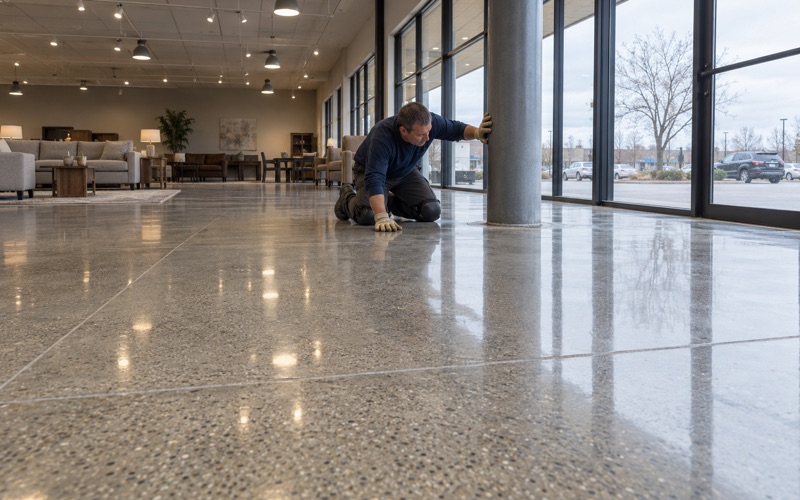
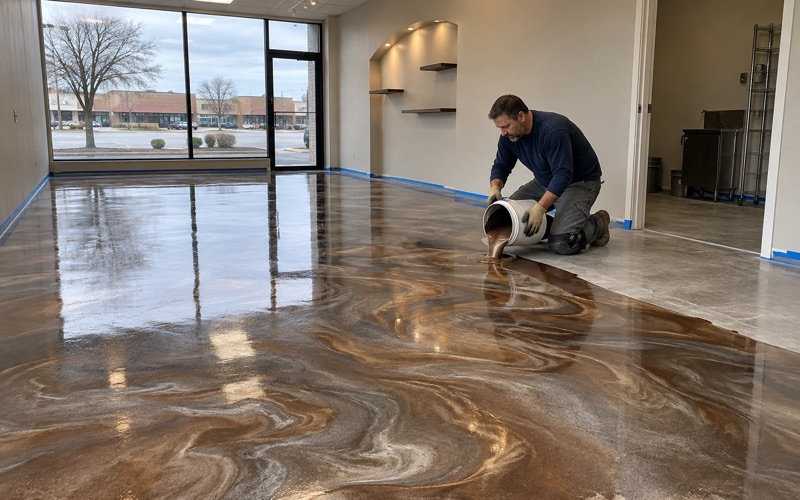
Wet sugar is slippery, so the finish needs real grip. We broadcast quartz aggregate into the body coat and lock it in with a topcoat, setting the texture coarse enough for wet soles and fine enough that a deck brush still cleans it at closing.
The FDA Food Code addresses both concerns: section 6-201.13 calls for coved, closed floor and wall junctures where floors are cleaned by water flushing, and 6-201.11 allows antislip floor coverings for safety. Palos Heights places public health under Cook County, so the Cook County Department of Public Health is the authority to keep in mind when the cove detail and texture are settled.
Working Between Closing Time and the Next 11 a.m. Opening
A counter that closes at 11 p.m. and reopens at 11 a.m. leaves about twelve hours, and on the chain’s summer weekend schedule closer to eleven. Into that window go equipment moves, containment, grinding, crack repair, coating, cure to foot traffic and a cleanup that leaves the room fit for food handling again.
Splitting the floor into night-sized sections
We plan a counter floor as a sequence of zones rather than one pour. One night might open and repair the slab behind the machines, the next night coats it, and the service side follows once the first area is back in use, with a clean, straight termination line between old and new work.
Our grinders run with vacuum extraction at the machine, so dust is captured as we cut instead of settling on stainless steel or being rinsed toward a floor drain. In a room where food is made a few hours later, that capture is part of the job rather than a courtesy.
Cure chemistry on a short clock
A short night pushes us toward fast-cure materials such as polyaspartic topcoats, but speed only helps if the slab is ready for it. We check the dew point spread at the slab surface before each coat, because condensation on fresh resin causes amine blush and weak adhesion between layers.
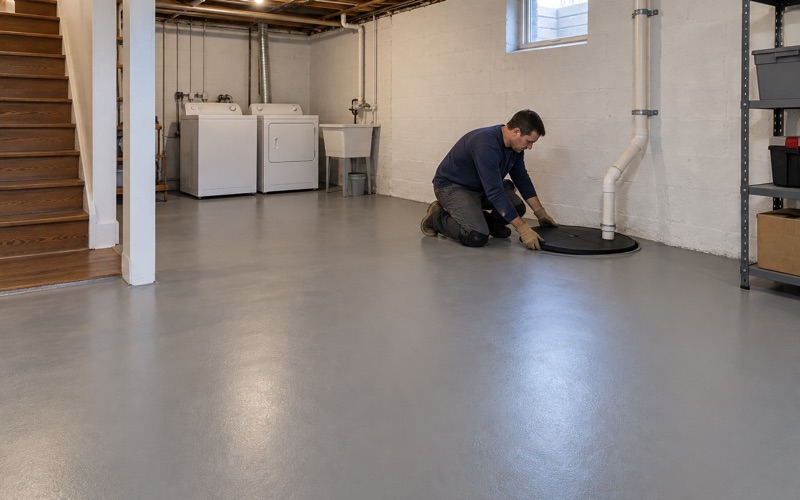
Moisture is measured before the job is priced, with ASTM F2170 in-situ relative humidity probes or ASTM F1869 calcium chloride testing as the slab allows. A floor that fails gets a moisture-mitigation primer first, and that extra step is built into the nightly sequence rather than discovered at 2 a.m.
Registration and permits in Palos Heights
Illinois licenses no general, flooring or coatings contractor, so each municipality’s own rules govern the work. In Palos Heights, contractor registration with the Building Department at 7607 W. College Drive must be completed in person between 7:30 a.m. and 2:30 p.m. on weekdays or by mail, emailed registrations are refused, and permits are picked up in person.
We settle registration and any permit question before booking a night, since a schedule built on overnight windows cannot absorb a lost evening at the counter. Products are chosen inside the Illinois VOC limits for floor and industrial coatings, which bind whoever applies them.
Owner-Occupied Homes and Townhome Garages
Most of our work in this city is residential rather than commercial. Census figures put owner occupancy at 93.4 percent, and 1,020 of the city’s owner-occupied homes are single-family attached units, so a large share of garage floors here sit under an association’s rules as well as the owner’s own preferences.
Attached-home garages and association rules
Before we quote a townhome garage, we ask whether the association sets rules on work hours, contractor insurance or what can be parked in a shared drive. The coating stays inside the unit, but the equipment trailer, the grinder noise and the vacuum hoses all pass through common space for a day or two.
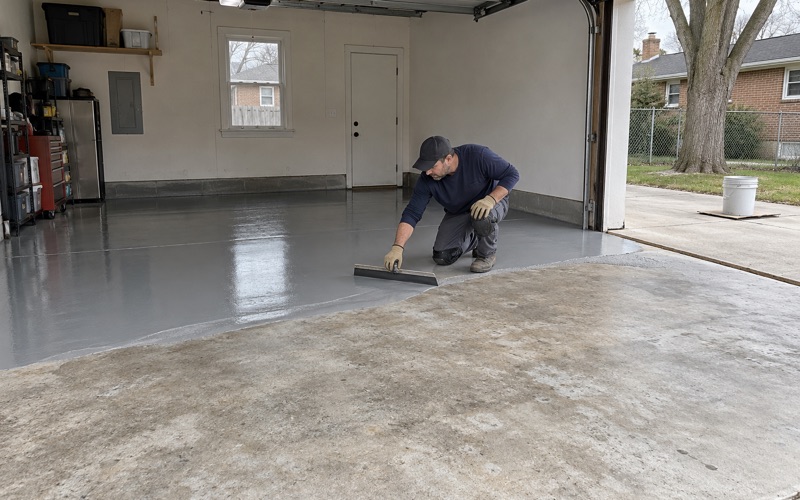
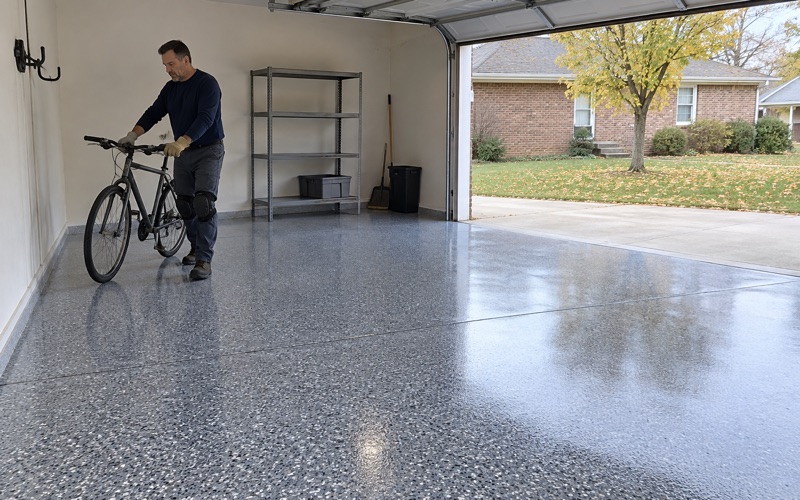
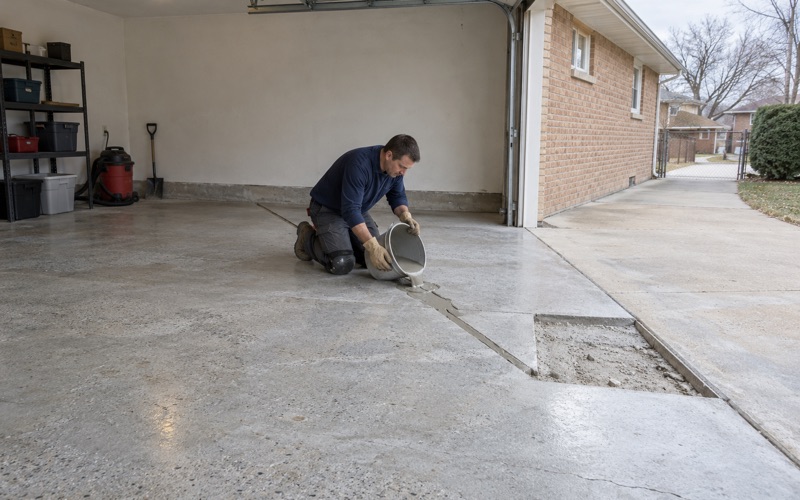
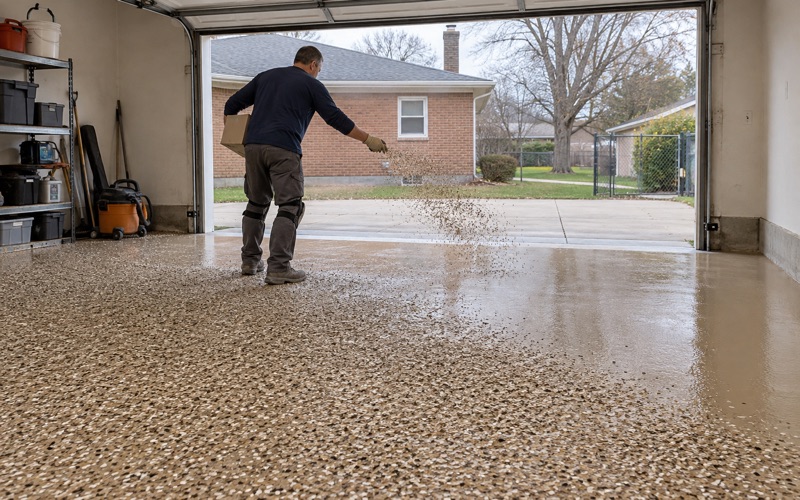
Inside the garage, the system is built for winter. Rock salt and calcium chloride brine ride in on tires from the first snow, so we favor a 100% solids epoxy base with a vinyl flake broadcast and a polyaspartic or polyurea topcoat, which also stands up to hot tire pickup in summer.
Winter timing and newer slabs
Cure schedules follow slab temperature and dew point rather than the calendar. An unheated garage in deep winter is told to wait for warmer slab conditions, and we would rather move a date than coat concrete that will not let the resin cure as designed.
The city also reports teardown-and-replacement permits for existing houses and new construction on vacant lots, so some garages here sit on recent pours rather than older concrete. A new slab still needs time to release its mix water before coating, and we test it rather than assume it is ready.
Contracts, and claims we will not make
Home jobs over the state threshold get a written contract and the Home Repair: Know Your Consumer Rights pamphlet under the Illinois Home Repair and Remodeling Act before any grinding starts. We also never sell a floor coating as radon reduction, because in Illinois that is licensed mitigation work under IEMA.
- 20+ Years Coating Concrete
- Moisture Tested Before Pricing
- Free Written Estimates