Oak Lawn Epoxy Flooring brings more than 20 years of work to epoxy flooring in River Forest, and one kind of garage job here comes with a fixed order: the one where a Level 2 car charger is going in during the same season as the floor. The coating is our work. The charger belongs to an electrician, and the village treats it as electrical work it inspects twice.
Getting the sequence wrong costs real money. A conduit run cut through a freshly coated slab leaves a scar that has to be patched, and a pedestal anchored after the coat goes down breaks the film at exactly the spot where tires turn. Set the penetrations first and the coating simply finishes around them.
This page walks through how the village permits a home charger, where its two inspections fall in a combined job, and how we schedule grinding, coating and cure around them. It also draws a clear line between what we do and what we leave to a village-licensed electrical contractor.
How River Forest Permits and Inspects a Home Charger
The Village of River Forest publishes its own page on electric vehicle charging station permits, and it reads like any other electrical permit. The applicant files the village’s Electrical Permit Application through the online portal, attaching a copy of the contract and scope of work, a complete electrical plan, and the manufacturer specifications for the charger. A Level 1 plug-in charger does not need the specifications.
A Level 2 unit on its own circuit is the case the full packet is written for, and it is the one that tends to put conduit near or into the floor. A Level 1 cord plugged into an existing outlet rarely touches the slab, so it seldom changes our schedule at all.
What the packet has to show
The village applies the National Electrical Code 2017 Edition and the International Code Council’s 2018 code series to this work. Permits are issued within 10 business days of a complete packet, so an incomplete one is the usual source of delay. Fees start at a $100 base, plus $9 per circuit and $1.75 per opening, with a service fee from $75 at 200 amps or less up to $200 at 800 amps and above.
For a floor owner, the scope of work in that packet matters more than the fee. If the electrical plan shows conduit running under or through the slab, or a charger standing on a pedestal rather than hanging on a wall, that tells us the slab will be opened before we ever coat it. We ask to see the plan before we price the floor.
Two inspections, two moments in the job
The village page is direct about it: all work is subject to rough and final inspections. Each one has to be scheduled 24 hours in advance, and the village completes it within 5 business days. Those two visits are the hinges our own schedule turns on.
The rough inspection looks at the electrical work while it is still open, which in a garage can mean conduit in a sawcut trench, a stub for a pedestal, or a box and raceway on the wall before anything is covered. Nothing we do should go down over work an inspector has not yet seen. Once the rough inspection passes, the slab openings are closed and patched, and the floor becomes ours.
The final inspection comes when the charger is mounted and connected. That is why we plan for the final to land after our cure, not before our first coat. A charger mounted over a floor that is still soft invites ladders, drill dust and boot traffic onto a surface that is not ready for any of it.
Looking for epoxy-flooring closer to Bellwood? See Bellwood Epoxy-Flooring.
Through the Slab Before the Coat: Conduit, Pedestals and Anchors
Most of what can go wrong in a combined job happens at the slab. An electrician may need to sawcut a trench for underground conduit, core a hole for a stub, or set anchors for a freestanding charger pedestal beside the parking space. Every one of those is a penetration, and a penetration is far easier to coat around than to cut through a finished floor.
Patching the cut before we grind
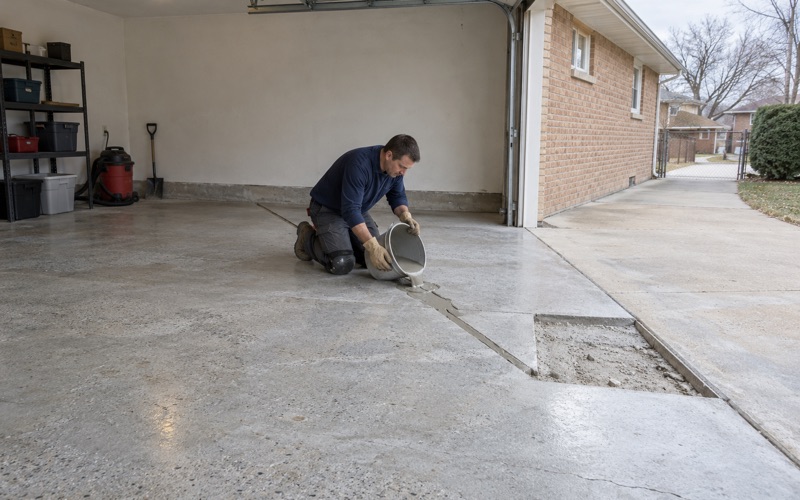
After the rough inspection passes, the trench or core has to be filled and allowed to harden before we touch it. We map the patch along with any existing cracks, spalls or old coatings, and if the patch has settled or pulled away from its edges we say so before quoting the coat. A patch that is not sound will show through any system laid over it.
Where an older coating is already on the floor, the electrician’s sawcut usually exposes how well it was bonded. We read the cut edge as part of our slab map, and a coating that lifts at the trench tends to lift elsewhere too. In that case the whole old film comes off before anything new goes down.
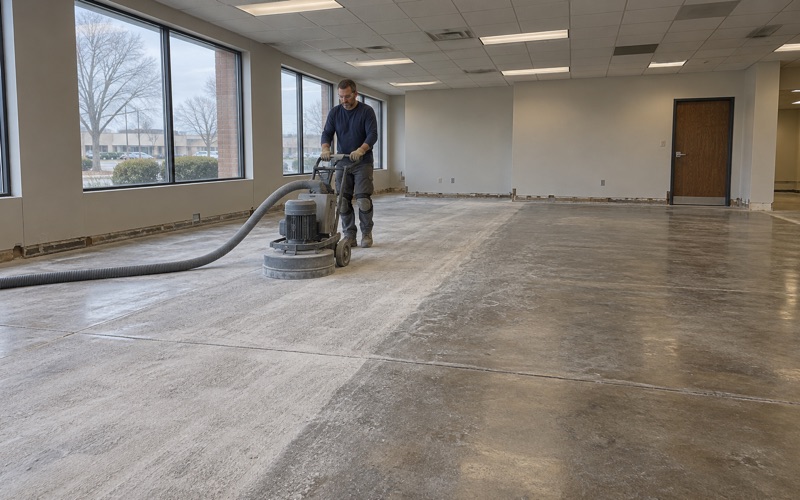
Every slab we coat is opened with a diamond grinder or a shot blaster, never an acid etch, and a fresh patch is no exception. Grinding brings the patch and the surrounding concrete to the same ICRI concrete surface profile, so the primer grips one consistent surface rather than two different ones. Dust is captured at the machine with a vacuum instead of being washed toward a floor drain.
Coating around what stays in the floor
A pedestal base, a floor-mounted junction box or a conduit stub stays in the slab for good. We terminate the coating cleanly at each one, with a tight edge rather than a film smeared up the side of a fitting. Where an electrician plans to anchor a pedestal after the floor is done, we ask that the anchor holes be marked and drilled before we coat, so the film is never broken over bare concrete later.
Moisture is the other reason the sequence matters. A moisture test is part of our written scope before the price is final, using ASTM F2170 in-situ relative humidity probes or ASTM F1869 calcium chloride testing as the slab calls for. A freshly patched trench holds water longer than the concrete around it, which is one more reason the electrical work goes first and the test comes after.
Coat, Cure, Then Mount: One Garage, Start to Finish
Here is the order we plan when a River Forest homeowner tells us a Level 2 charger is coming. The electrician files the permit, runs the rough-in and calls for the rough inspection. When it passes, the penetrations are patched and the floor is turned over to our crew.
Our part of the sequence
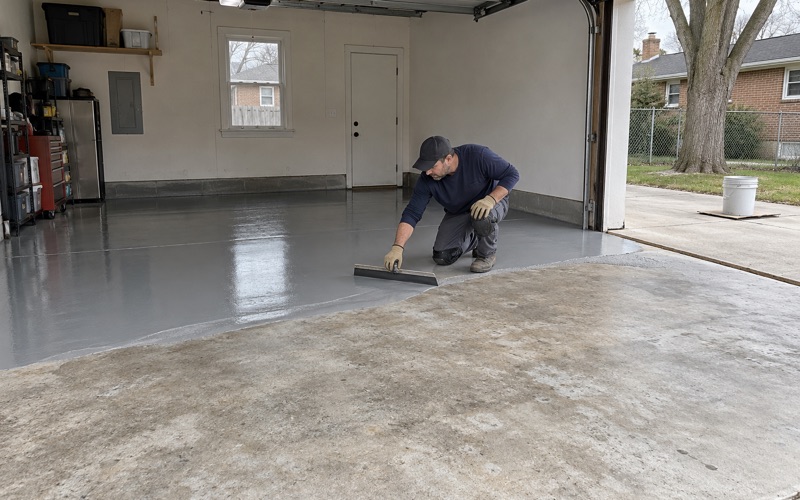
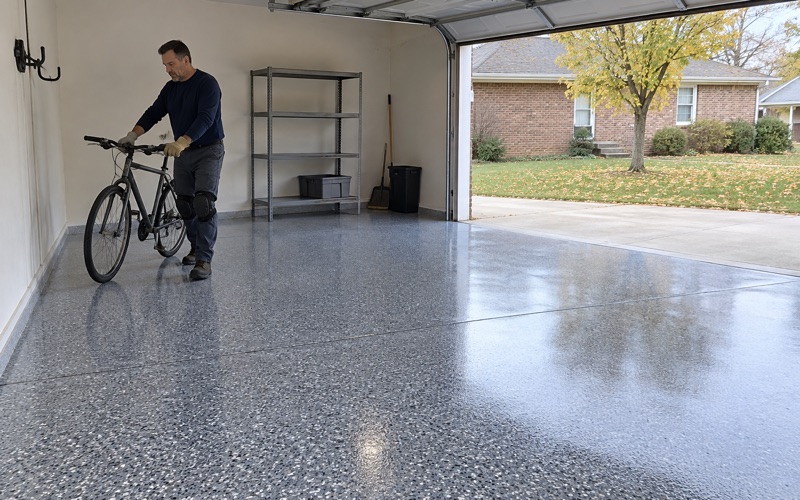
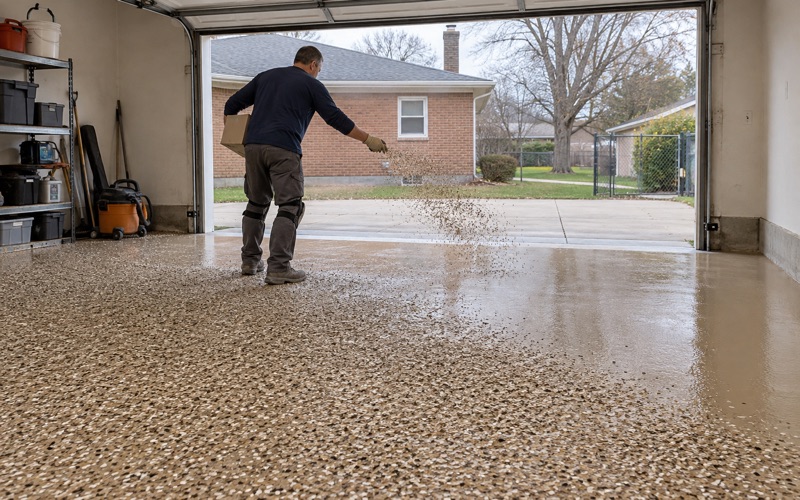
We grind, test, prime and build the coating the proposal describes, whether that is a 100% solids epoxy base with a vinyl flake broadcast or a polyaspartic topcoat over a quartz aggregate broadcast. The proposal names the product line, the number of coats and the finished thickness, so the homeowner can check the floor against the quote. Cure follows slab temperature and dew point, not the calendar.
A garage getting a charger also needs some thought about where the car sits. We ask where the charger will hang and where its cord will lie, because a cord dragged across the same lane every night becomes a wear path. A quartz broadcast with a tougher topcoat can make more sense along that lane than a smooth, glossy finish.
Back to the electrician
Only once the coating has cured enough for foot traffic and ladders does the electrician return to hang or set the charger and make the final connection. Then the final inspection is scheduled, again with 24 hours of notice. Parking a car on the new floor waits for the longer cure that prevents hot tire pickup, and we put that date in writing.
We also explain what a coating warranty leaves out before the job is sold, and moisture is the first exclusion we name. A floor that has to be drilled or patched after it cures no longer carries the finish we laid. That is why we would rather finish before the mounting starts than coat around a charger already on the wall.
Who Does What, and a Village Getting Ready for EVs
Charger Wiring Stays With the Electrical Contractor
River Forest requires that any contractor performing work on a charging station project be licensed as an electrical contractor with the Village of River Forest. We are a floor coating company. We do not install chargers or pull electrical permits, and the homeowner hires the electrician directly.
What we do is coordinate. We ask for the electrician’s name and the electrical plan, we book our grinding after the rough inspection, and we leave a date open for the mounting once the cure allows. The village reports about six to ten renovations a year in its moderate and very high-end housing, and on a renovation with several trades, that coordination is often half the job.
Our own paperwork
Illinois has no state flooring license, so before a job is booked we check what the village asks of a flooring contractor in registration, bond and insurance. Home jobs over the state threshold get a written contract and the Illinois Home Repair: Know Your Consumer Rights pamphlet before any grinding starts. Products are chosen inside the Illinois VOC limits for floor coatings, which bind whoever applies them.
A village preparing for EVs
River Forest joined the second cohort of the Metropolitan Mayors Caucus EV Readiness program, which began in August 2023. On March 25, 2024, the Village Board unanimously forwarded zoning text amendments to the Zoning Board that would allow EV charging stations as accessory uses and count charging spaces toward minimum parking. We have not seen whether those amendments were adopted, so we plan only around the permit rules the village has published.
The village sits beside Oak Park, with a Metra station on the Union Pacific West Line and two universities, Dominican University and Concordia University Chicago, inside its limits. None of that changes the order in a home garage. When a charger and a coated floor are on the same list, the job starts with a call between the two trades, not a patch on a finished floor.
- 20+ Years Coating Concrete
- Moisture Tested Before Pricing
- Free Written Estimates