Oak Lawn Epoxy Flooring approaches epoxy flooring in Riverdale with more than 20 years of slab work behind every estimate, and on an industrial job our first question is what the floor will be wetted by. Water, hot oil, acid and caustic each break a coating down in a different way. A floor that shrugs off one can blister, soften or lift under another, so that answer decides the system long before color or texture comes up.
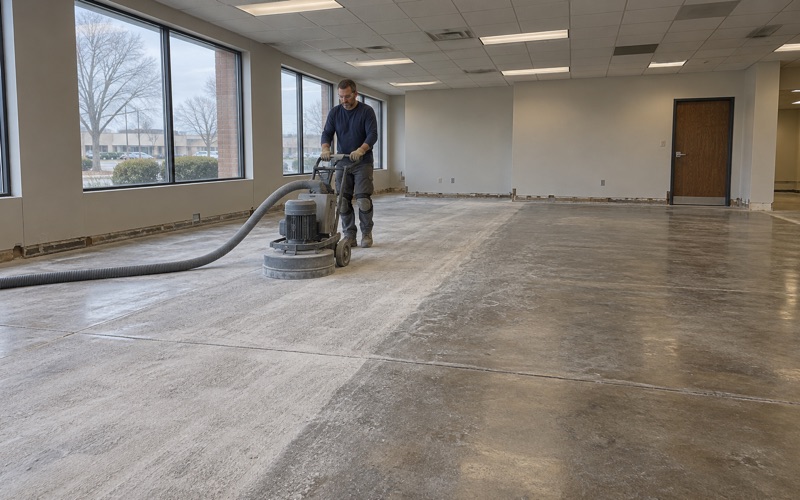
Our scope starts the same way on every slab. We map cracks, spalls and old coatings, write a moisture test into the proposal before the price is final, and open the surface with a diamond grinder or shot blaster rather than an acid etch. The proposal then names the product line, the coat count and the finished thickness, so a plant engineer or owner can hold the installed floor up against the paper.
This page covers how that method meets a mixed-process industrial building, where one part of the slab takes chemical drips and another takes heat, oil and heavy parts. It also marks where a coating contractor’s job ends and where a plant’s environmental permit and its own engineering take over.
A Plating and Heat-Treat Shop on 134th Street
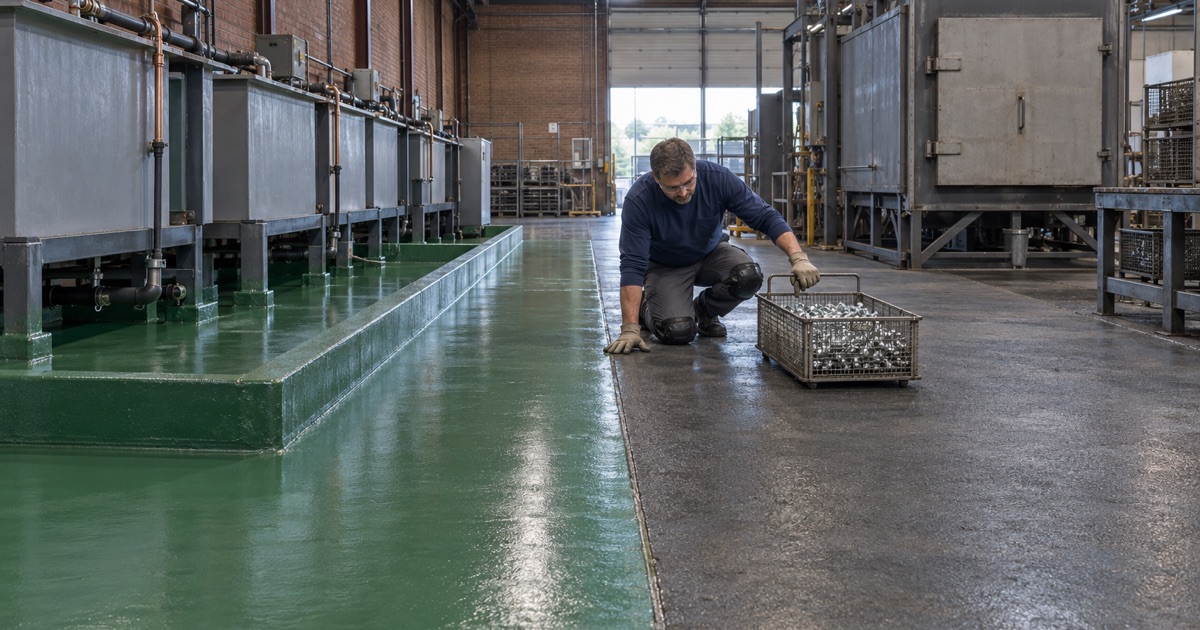
What the building holds
Riverdale Plating & Heat Treating sits at 680 W. 134th St, an address that geocodes inside the village in Calumet Township. The company describes itself as an ISO 9001:2015 heat treating and electroplating job shop for fasteners and stampings, in business since 1950, working out of a 125,000-square-foot facility that houses heat treating, plating and fastener sorting equipment. Its service list includes a zinc plating line.
We have no relationship with that company and have not been inside the plant, so nothing here describes its floors as they stand today. We use it because it is the clearest example in Riverdale of a building where two processes with opposite demands share one slab. Any shop that plates and heat treats under one roof faces the same split, and the floor decision follows from it.
Why the sewer district has a say
The Metropolitan Water Reclamation District of Greater Chicago lists Riverdale Plating and Heat Treating among its significant industrial users, regulated under 40 CFR 413, the federal electroplating standard. That status means what leaves the building through its drains is permitted and monitored. On the plating side, the floor is part of how spills are kept away from those drains, not just a surface people walk on.
That changes who sets the rules for the floor. A plant’s environmental staff and its MWRD permit decide what containment has to do, how it is inspected and where liquid is allowed to go. A coating contractor works inside those requirements, and we say at the first walk-through that we do not design regulated secondary containment.
A village built on industry
Riverdale’s hazard-mitigation annex describes it as a mostly industrial, landlocked village, and it names the CSX and IHB yards as two of its largest railroad yards. In a place described that way, the floors worth planning hardest are the ones that carry chemistry. That is why a plating example leads this page rather than a garage or a basement.
Looking for epoxy-flooring closer to Markham? See Markham Epoxy-Flooring.
Plating-Line Drips and Why Ordinary Coatings Fall Short
What lands on the floor near the tanks
An electroplating line moves parts through a sequence of cleaning, activation, plating and rinse baths, and every transfer carries some solution with it. That carryover, called drag-out, drips off racks and barrels onto the floor between tanks. Depending on the stage, those drips can be strongly acidic or strongly alkaline, and they land again and again in the same spots.
A zinc plating line illustrates the problem well, because cleaners, acid steps and the plating bath itself can sit within a few feet of each other. We do not know which baths any particular Riverdale line runs, and we would not guess. On any plating job we start from the safety data sheets for each bath, because the resin has to be matched to the worst chemical that will reach it, at the strength and temperature it arrives at.
Where a standard floor coating stops
A conventional 100% solids epoxy is a dense, strong floor and the right answer for a great deal of industrial space. Against concentrated acids and caustics left on the surface for hours, though, a general-duty epoxy can soften, stain and eventually lose its bond. Polyaspartic and polyurea topcoats add abrasion and UV resistance, but they are not containment linings either.
Containment linings
For tank rows, trenches, troughs and pump pads in chemically aggressive plants, manufacturers market vinyl ester novolac linings for primary and secondary containment of a broad range of acids, caustics and solvents. Those systems come in fiberglass-reinforced versions for containment areas, and with carbon aggregate where hydrofluoric exposure is possible. They are a different product class from a general-duty floor, with tighter application windows and thicker builds.
What a lining like that needs from the slab is unforgiving. The concrete must be ground or blasted to a deep enough ICRI CSP profile, dry enough by ASTM F2170 in-situ relative humidity readings, and free of old coatings and contamination the lining will not tolerate. A continuous seal into curbs, trenches and the base of walls matters as much as the resin, because a lining that leaks at a joint is not containing anything.
Whether a given lining satisfies a plant’s permit is a question for its environmental staff and engineer, not for us. Our part is to install the specified system to the manufacturer’s requirements and to document the prep, the moisture readings and the thickness. That record gives the people who sign off something concrete to check.
Hot Oil and Heavy Parts on the Heat-Treat Side
Heat and oil on the slab
Heat treating hardens and tempers parts in furnaces, and many processes quench hot parts in oil. Wherever that happens, the floor takes oil carried out on baskets and parts, some of it still warm, along with heat radiating from the furnace line. We are describing the general mechanism of the process here, not the quench setup at any particular Riverdale shop.
Oil does two things to a floor. It soaks into bare or poorly sealed concrete and keeps weeping back out, which ruins adhesion for any coating laid on top later. On a finished floor, an oil film turns a smooth surface slick, so slip resistance with oil present has to be designed into the texture rather than added afterward.
Parts handling and impact
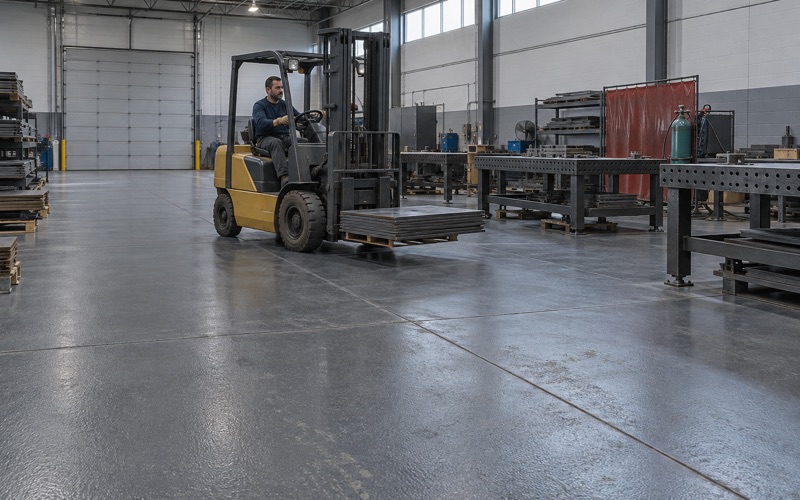
Fasteners and stampings move in heavy baskets and bins, and forklift and pallet jack wheel loads concentrate that weight onto small contact patches. Dropped steel parts chip thin, brittle coatings at their edges. A heat-treat aisle generally wants a thicker, impact-tolerant system, and urethane cement is a common choice where heat, oil and thermal shock meet, because it tolerates temperature swings that would crack a thin epoxy film.
Texture comes from a quartz aggregate broadcast into the body coat, sized to hold grip with oil present while still letting a scrubber clean it. We settle that balance with the people who sweep and scrub the floor every shift, not only with the person who signs the purchase order.
Getting oil out before anything goes down
An existing heat-treat floor is often the hardest slab in a building to prepare. Oil that has soaked in for years may need repeated degreasing and deeper grinding, and a slab saturated past the point of cleaning has to be cut out and replaced before it should be coated. We say that plainly at the estimate, because a coating over oil-soaked concrete fails from underneath no matter how good the product is.
One Building, Two Floor Systems
Drawing the zone lines
In a building that both plates and heat treats, the practical answer is rarely one coating across the whole slab. We walk the floor with the plant’s people, mark where chemical exposure ends and where heat and oil begin, and size each zone with a margin, because drips and drag-out travel on wheels and boots. Transitions are detailed so each system terminates cleanly into the other rather than overlapping.
Prep and scope for both zones
Both zones start from the same foundation: mechanical prep with a diamond grinder or shot blaster, cracks and spalls mapped and repaired, and any slab too damaged to hold a coating called out before a price is set. Grinding dust is captured at the machine by vacuum rather than washed toward a floor drain, which matters more than usual in a building whose drains are permitted.
Moisture testing goes into the written scope for each zone. The proposal names the product line, coat count and finished thickness for each system separately, so the plating side and the heat-treat side can each be checked against what was quoted.
Scheduling around production
Industrial floors rarely get a quiet month. We phase the work zone by zone, using weekend and overnight windows where a line cannot stop, and cure times follow slab temperature and dew point rather than a fixed calendar. Products are chosen inside the Illinois VOC limits for industrial coatings under 35 Ill. Adm. Code Part 223, and the plant is told plainly what any warranty excludes, starting with moisture.
Permits and the village
Riverdale Inspectional Services, at 725 W. 138th Street, lists installing floor covering and basic concrete crack repair among minor work that may be done without a permit, and tells owners to check with the office for anything else. We confirm a coating project with Inspectional Services before booking, along with any village registration, bond and insurance rules, since Illinois has no state flooring license. Work that touches drains, trenches or containment goes through the plant’s own environmental review first.
- 20+ Years Coating Concrete
- Moisture Tested Before Pricing
- Free Written Estimates