Oak Lawn Epoxy Flooring has put more than 20 years into epoxy flooring in Summit and the communities around our home base, and the jobs that teach us the most are the ones that cannot stop. A food plant that runs every shift, a counter that opens before sunrise, a line that gets hosed down while it is still running: those floors go in piece by piece, on a schedule the owner sets.
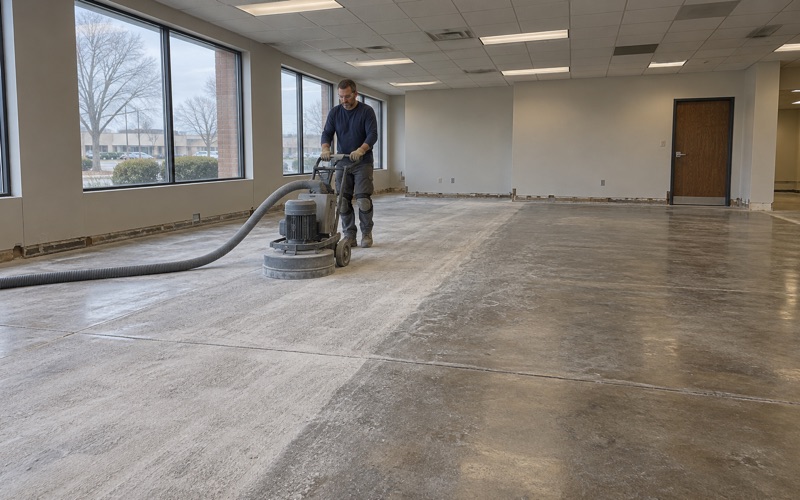
We open every slab mechanically, with a diamond grinder or a shot blaster, and we never acid etch. Before a price is final we test the concrete for moisture and write that test into the scope. The proposal then names the product line, the coat count and the finished thickness, so a plant manager can hold the finished floor up against the quote.
This page is about the production floor that never gets a dark weekend, and what that changes about grinding, coating and curing one. If your building runs around the clock, the questions below are the ones we would bring to the first walk-through.
A Summit Bakery That Never Goes Dark
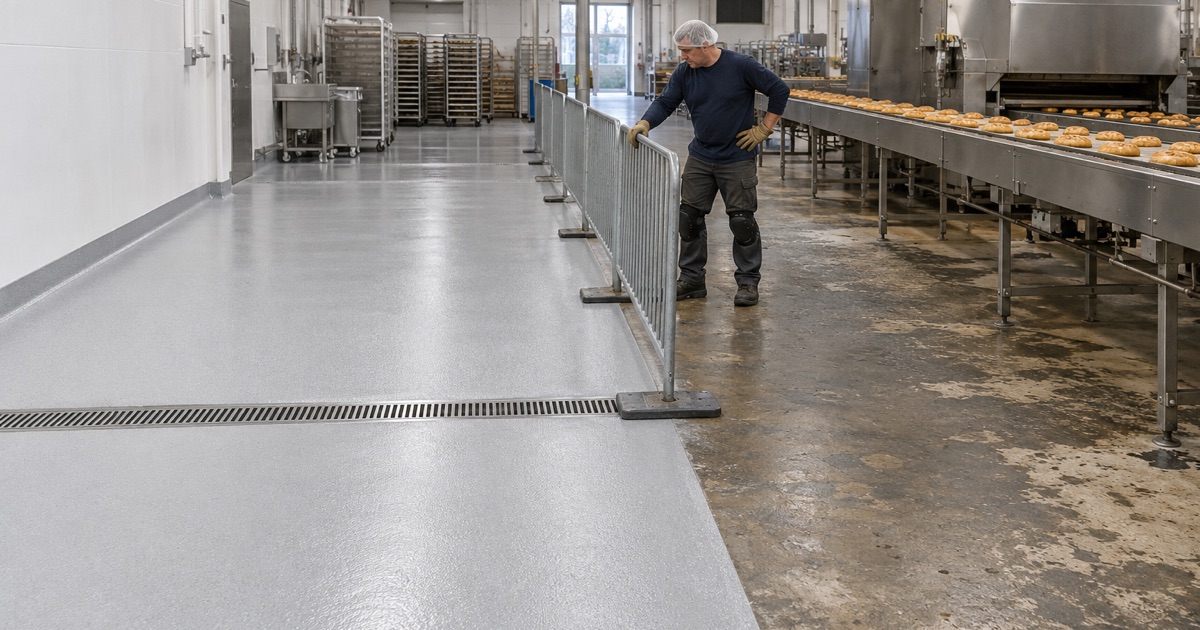
Summit is a small Cook County community in Lyons Township, with 11,161 residents at the 2020 census. Its name, in use since 1836, refers to the highest point on the Chicago Portage between the Chicago River and the Des Plaines River, just north of town. It is also home to Talerico, a bakery established in 1984, with a wholesale operation listed at 7224 W. 60th St and a retail store at 7334 W. 63rd St.
Food has shaped this corner of the county for a long time. In 1907 Corn Products began building its huge corn-processing plant south of Summit, in what is now Bedford Park, and food processing companies tied to that Argo plant grew up nearby. The Argo plant itself sits across the line in Bedford Park, so we treat any job quoted off a Summit Argo address as a question to check, not a given.
Production 24 hours a day, seven days a week
A 2016 trade profile in Packaging Strategies described Talerico-Martin Wholesale Bakery as running continuous production seven days per week, 24 hours per day. At that time it counted about 1.5 million baked goods a week, roughly 400,000 pounds of Danish, muffins, cookies and donuts for over 600 wholesale customers. Those are dated 2016 figures, and we quote them as that rather than as today’s output.
The company’s own site now describes fresh bakery made 365 days a year and a frozen manufacturing facility of almost 100,000 square feet, shipping thaw-and-serve donuts and muffins to all 50 states. Which of the two addresses holds that plant is not something we have confirmed. For flooring, the schedule is the point: a building run that way has no Saturday-to-Monday gap in which to strip and recoat a room.
What a no-shutdown schedule does to a floor job
Most coating specs quietly assume an empty building for two or three days. A plant on continuous production has to buy that time back bay by bay, so the grinding, the coats and the cure all have to fit inside windows the production manager can actually give up. One bay may be free for a night during a changeover, while another opens only during planned maintenance.
We have not worked inside Talerico, and nothing on this page describes its floors. We name it because it shows, in public and dated terms, the kind of round-the-clock food operation that exists in Summit and the floor problem that kind of operation brings to a contractor.
Looking for epoxy-flooring closer to Midlothian? See Midlothian Epoxy-Flooring.
Oil, Sugar Glaze and Flour Paste on a Production Floor
A bakery floor collects a mix most coatings were never tested against. Fryer oil migrates out from the donut line, sugar glaze drips and hardens, and flour settles everywhere and turns to paste the moment water hits it. Washed with hot water while the lines keep running, that floor is wet, warm, greasy and abrasive within the same shift.
Why a thin coating fails in a bakery
A thin epoxy rolled onto concrete that was etched rather than ground has little to hold onto, and hot water cycling across it every shift finds that weakness quickly. Oil wicks under any lifted edge, and glaze and flour paste pack into the gap. Once a coating starts peeling in a food area, it becomes a sanitation problem as well as a flooring one.
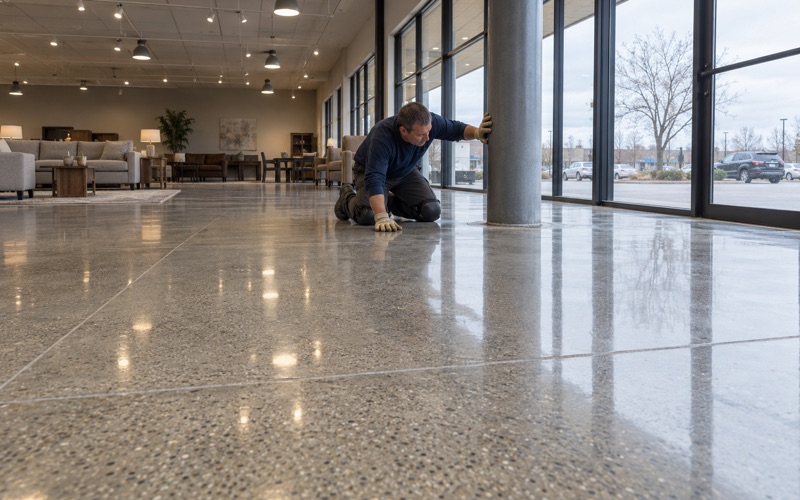
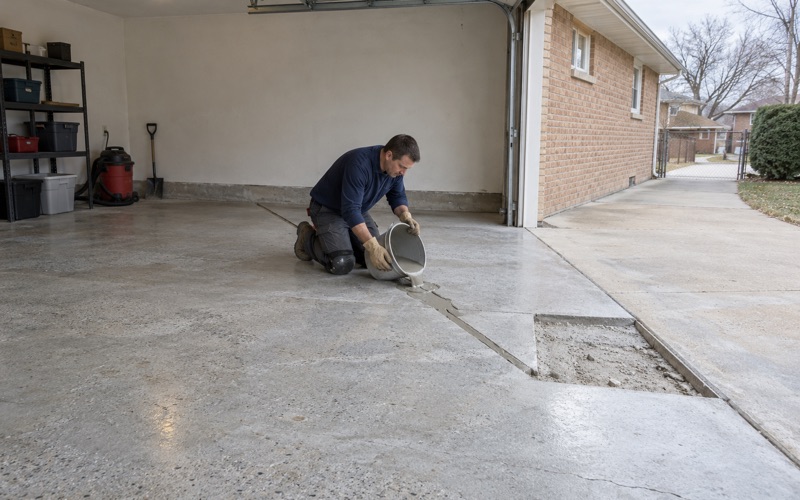
That is why we profile the slab to the ICRI concrete surface profile the chosen system calls for, using diamond grinding or shot blasting instead of trusting an etch. Cracks, spalls and old coatings are mapped before we quote. If a section of slab needs repair or replacement before it should be coated, we put that in writing.
Getting through the old floor
A production floor that has been washed with hot water for years is rarely clean concrete underneath. Oil can soak into the top of the slab, and an old coating may be bonded in some places and loose in others. We grind past the contaminated layer and record what we find, because a fresh coat over oil-soaked concrete will not stay down.
Where oil has gone deeper than grinding can reach, we tell the owner that section needs repair or a different approach before anything goes on it. That costs a conversation up front rather than a failed floor six months into production.
Urethane cement, texture and coved edges
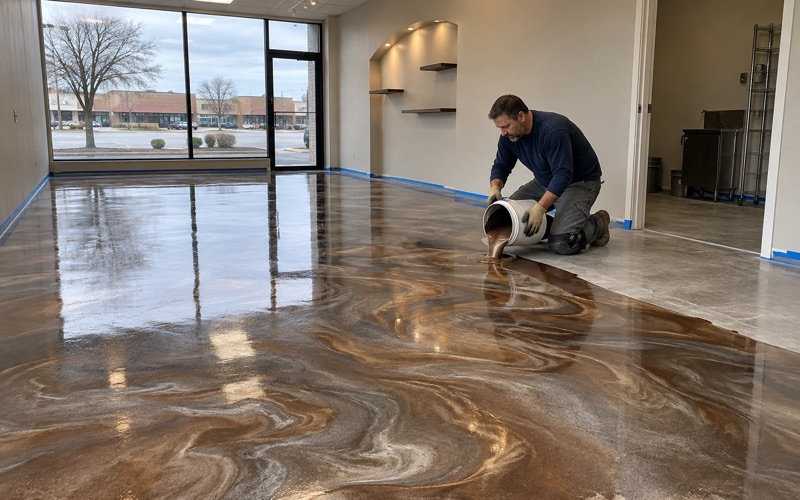
For wet, hot, greasy process areas, urethane cement is the system we usually point an owner toward, because it handles the thermal shock of hot-water washdown better than a standard epoxy. A quartz aggregate broadcast adds texture underfoot where oil and water meet. In drier packing or dry-storage rooms, a 100% solids epoxy with a polyaspartic topcoat can be the better value.
Food areas also bring their own code language. FDA Food Code 6-201.11 allows antislip floor coverings where safety calls for them, and 6-201.13 calls for coved, sealed floor and wall junctures where floors are cleaned by water flushing. A seamless cove run up the wall keeps flour paste and water out of the joint where the slab meets a block wall.
One Zone at a Time, Never a Shutdown
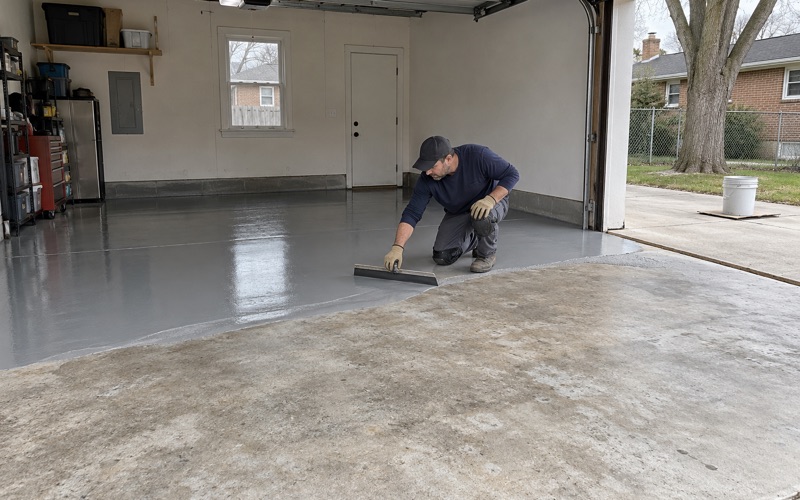
When a plant cannot close, the floor is installed the way a remodel happens in an occupied house: one room or one bay at a time. We walk the building with the production manager, mark which lines can move or pause, and draw the floor into zones that match those pauses. Each zone is ground, coated and cured before the next one opens up.
The seam where one zone meets the next is planned as well. We end each section at a saw-cut termination line, so the edge is anchored into the slab rather than feathered out where a pallet jack wheel or a floor squeegee can catch it and start a peel.
Dust, odor and the line next door
Grinding beside food production means dust control is not optional. Our grinders run with vacuum capture at the machine, so concrete dust goes into a bag instead of into the air or down a floor drain. Plastic containment around the active zone keeps the neighboring bay producing while we work.
We also choose products inside the Illinois VOC limits for floor and industrial coatings in Part 223 Subpart C of the state’s air rules, which bind whoever applies them. On some jobs the lower-odor choice matters more than the fastest cure, because the line a few feet away is still packing product.
Cure time follows the slab, not the clock
A zone handed back too early fails early. We schedule cure by slab temperature and the dew point spread at the slab surface, and we watch for amine blush on epoxy coats laid down in cool, humid air. Hot-water washdown should not reach a fresh floor until it has cured as far as its maker requires.
Before any zone is coated, we test it with ASTM F2170 in-situ relative humidity probes or an ASTM F1869 calcium chloride test, and the result goes into the written scope. Moisture is also the first exclusion we name on a coating warranty, so an owner knows before signing what the warranty will not cover.
Who signs off in the village
Commercial work here goes through the Village of Summit Building and Public Works department at the Strzelczyk Municipal Center, 7321 W. 59th Street. Illinois has no state flooring license, so we check the village’s own registration, bond and insurance rules before a job is booked. For a food establishment, the health authority is the Cook County Department of Public Health.
The 5:30 a.m. Counter on 63rd Street
The other half of the picture is retail. Talerico’s store at 7334 W. 63rd St opens at 5:30 a.m. Monday through Saturday and closes at 7:00 p.m., with shorter Sunday hours from 7:00 a.m. to 3:00 p.m.
A floor in a shop with hours like that has to be finished between closing and the first customer of the morning, or spread across several nights. That changes the system we would choose and the way the work is split.
Overnight windows for a storefront floor
For a retail or restaurant floor that cannot close, we work overnight and in short weekend windows. Fast-curing polyaspartic topcoats over a ground and primed slab let a section go from bare concrete to walkable far sooner than a standard epoxy. A busy front area can be split in two, so the counter stays reachable while the other half cures.
What we will not do is shorten the moisture test or skip the grind to fit a single night. If a slab needs more than one window to be done properly, the schedule says so before the job starts, not after a coating lifts in front of the display case.
Sales floor versus back of house
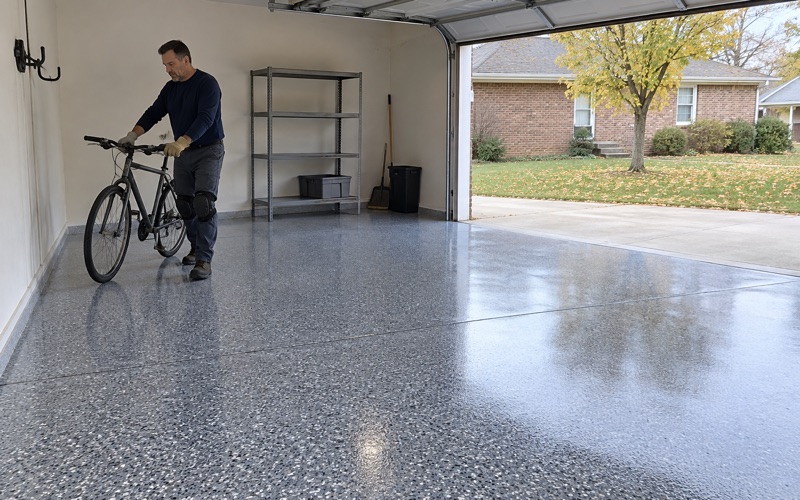
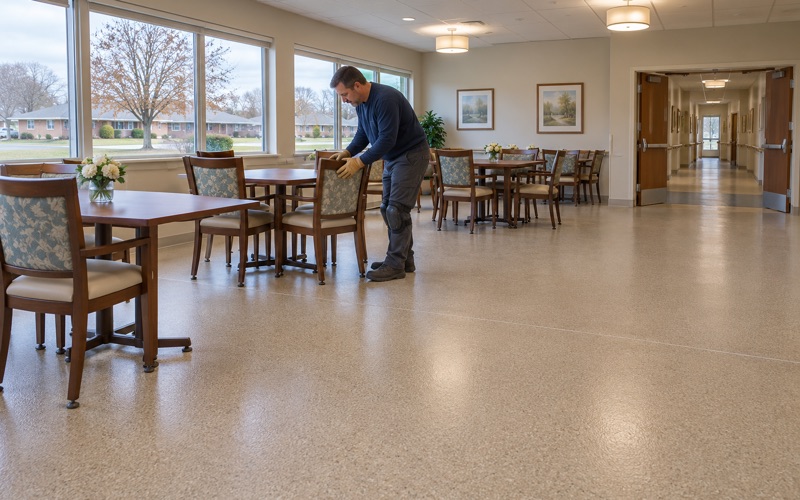
A bakery’s retail space usually carries two very different floors. The sales floor sees foot traffic, spilled coffee and the rock salt that rides in on boots, which a vinyl flake broadcast under a clear topcoat handles well. The prep and dish area behind it sees the same oil, glaze and hot water as a plant, so we specify it more like a production floor.
If you run a bakery, kitchen or food plant in Summit, we will walk the floor with you during a shift and tell you plainly which zones can go first and what the moisture test shows. Every zone then gets its own line in the proposal, with its own window and its own cure time.
- 20+ Years Coating Concrete
- Moisture Tested Before Pricing
- Free Written Estimates