Oak Lawn Epoxy Flooring has handled epoxy-flooring in Western Springs for more than 20 years, and a good share of that work begins with a floor somebody else has to take up first. Carpet tile, vinyl plank, sheet goods and rubber cove base all come off a slab eventually. What they leave behind decides how a new coating performs far more than the color chart does.
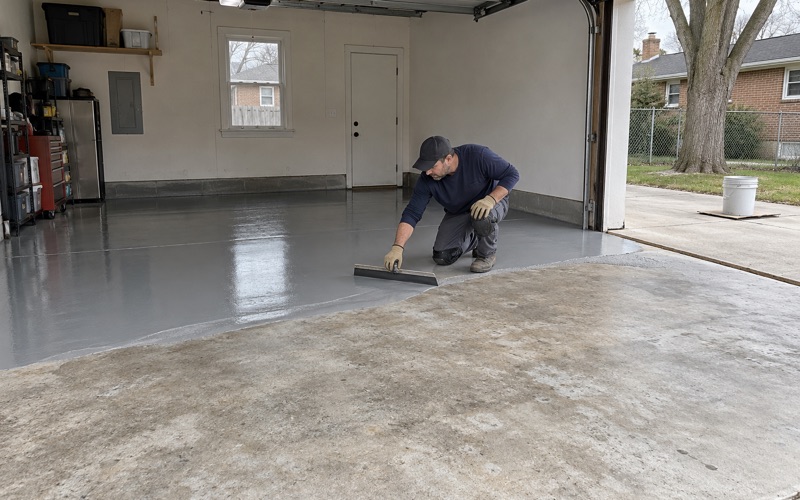
Our part of the job is the stretch between removal and installation. We open the concrete with a diamond grinder or a shot blaster rather than an acid etch, check what the slab is doing with moisture before the price is final, and write the product line, the coat count and the finished thickness into the proposal. A homeowner or a facilities manager can then hold the finished floor up against the paper and see whether it matches.
This page follows one sequence closely: tear-out, preparation, coating. It is the same order a public owner writes into a bid when it replaces its own floors, and it is the order most private jobs try to shorten.
The Village Bids Out Its Own Floors, in Order
What the 2026 Flooring Replacement covers
The Village of Western Springs posted its 2026 Flooring Replacement invitation for bids in May, with a mandatory pre-bid meeting on May 21 and bids due May 28, 2026. The work is office floors rather than shop floors: offices in the Public Works building at 1440 Hillgrove Avenue, some of them listed as alternates, and the administrative offices at the Recreation Center at 1500 Walker Street. A fire station gym floor rounds out the list as one more alternate.
Both addresses sit inside the village limits, in Lyons Township, Cook County. Bonds are required and prevailing wages apply, so the job carries the paperwork of any public contract. We had no part in that bid, and the posting we read does not name the new flooring product or the contractor who won it.
Remove, prepare, install
What the posting does spell out is the scope, and the scope is the useful part for anyone planning a floor of their own. It runs in a fixed order: supply the materials, remove the existing flooring and wall base, prepare the flooring for the new install, install new flooring and wall base, then haul away and dispose of what came out. Preparation gets its own line between removal and installation, treated as work to be done and paid for rather than something that happens on the way to the new floor.
Homeowners and small business owners tend to skip that middle line. A basement rec room or a converted office comes out of carpet or vinyl on a Saturday, and the coating is expected the following week on whatever the slab looks like underneath. The village’s order is the right one for a coating, and we price a private job the same way.
Looking for epoxy-flooring closer to La Grange Park? See La Grange Park Epoxy-Flooring.
What Old Flooring and Wall Base Leave Behind
Adhesive lines and glue films
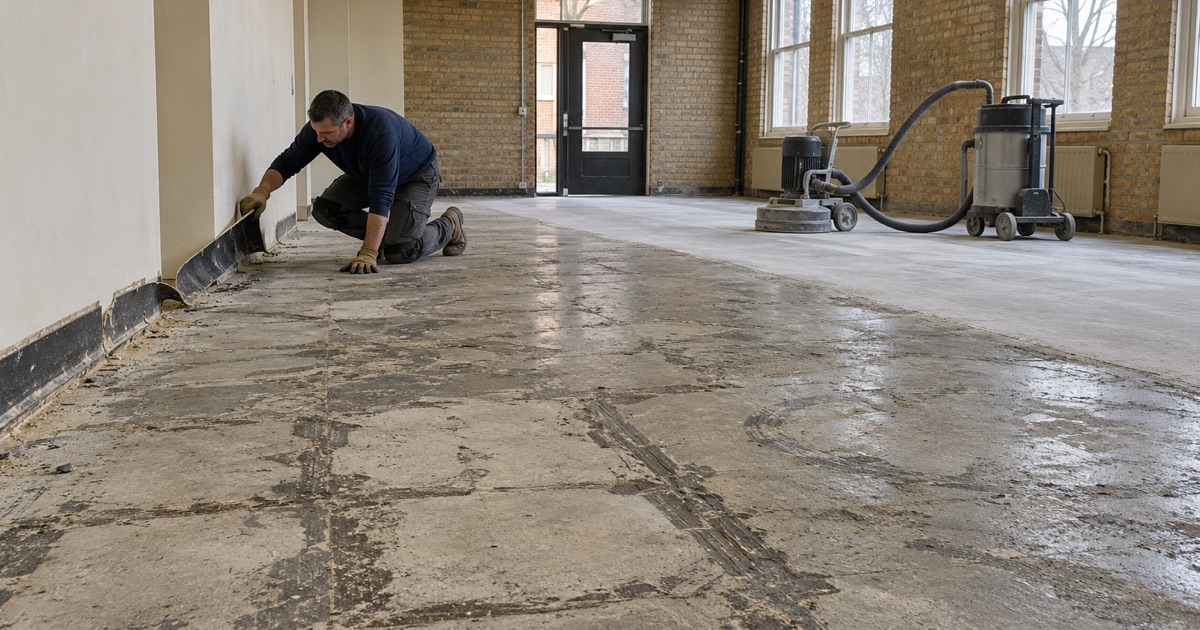
Pulling up flooring rarely pulls up the adhesive with it. Carpet tile leaves a tacky release film, glued-down vinyl leaves trowel ridges of mastic, and older sheet goods can leave a hard, shiny layer bonded tight to the concrete. None of those is a surface an epoxy can trust: the coating bonds to the glue, and the glue lets go of the slab.
Where the age or makeup of an old adhesive is uncertain, we have it tested before a grinder touches it. Some older black mastics contained asbestos, and that question is answered by a lab rather than by looking at the color. Testing adds a few days to the schedule, and it is the only responsible way to start grinding a floor of unknown history.
The wall base line
Wall base is the strip most people forget. Rubber or vinyl cove base is glued to the drywall and often to the first inch of slab, and when it comes off it leaves a band of adhesive right at the wall, plus whatever squeezed out underneath. That band sits exactly where a new coating has to turn up into a cove or stop cleanly.
Grinding the open field of a room is straightforward, but the last few inches at the wall take an edge grinder and hand work. We map that perimeter strip along with cracks, spalls and any old patch or coating before quoting. The proposal then reflects the edges as well as the open floor, and nobody is surprised by the labor on day two.
Tack strip, patches and leveling compound
Carpet installations leave nail holes from tack strip along the walls, and earlier remodels often left leveling compound or patch in low spots. Some of those patches are softer than the concrete around them and will not hold a coating. When a slab carries enough of them that coating over it would be a gamble, we say so plainly and recommend repair or replacement first.
Grinding to a Profile: the CSP Scale
What CSP 1 to CSP 10 measures
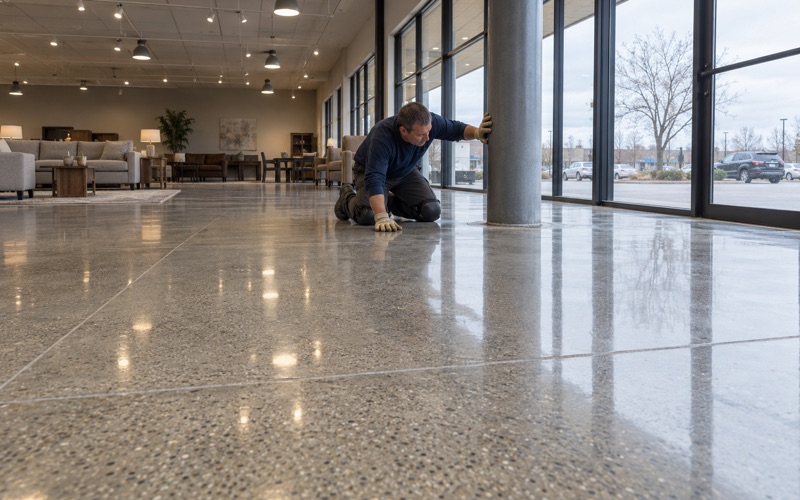
The International Concrete Repair Institute’s Guideline 310.2R grades prepared concrete on a concrete surface profile scale running from CSP 1, nearly flat, to CSP 10, with an amplitude over a quarter inch. Each number describes a physical texture, and reference chips let the result be compared by hand instead of described in adjectives. That turns a vague promise that the floor was prepped into something two people can check.
Where adhesive removal and thin coatings land
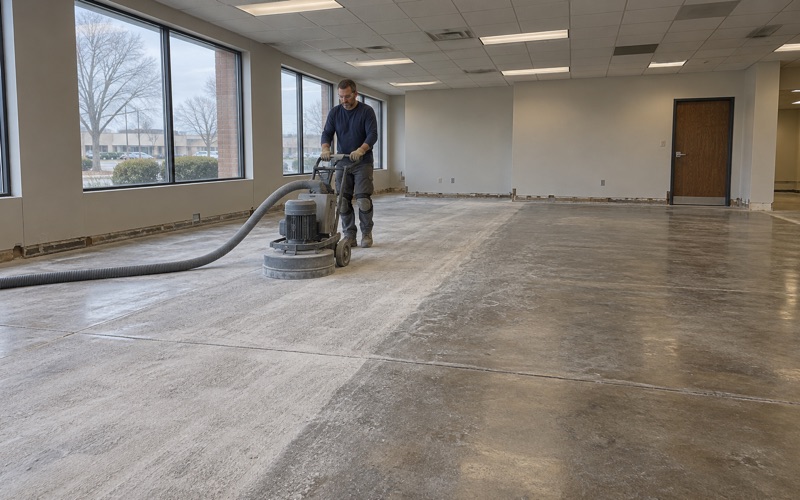
The low end of the scale, CSP 1 through CSP 3, is the range for thin-film coatings and sealers and for removing adhesives, paint or old coatings, and diamond grinding is the usual way to reach it. Light shot blasting lands around CSP 4. On a typical office or basement floor coming out of glued-down flooring, the grinder removes the residue and leaves a profile in that low range in the same pass.
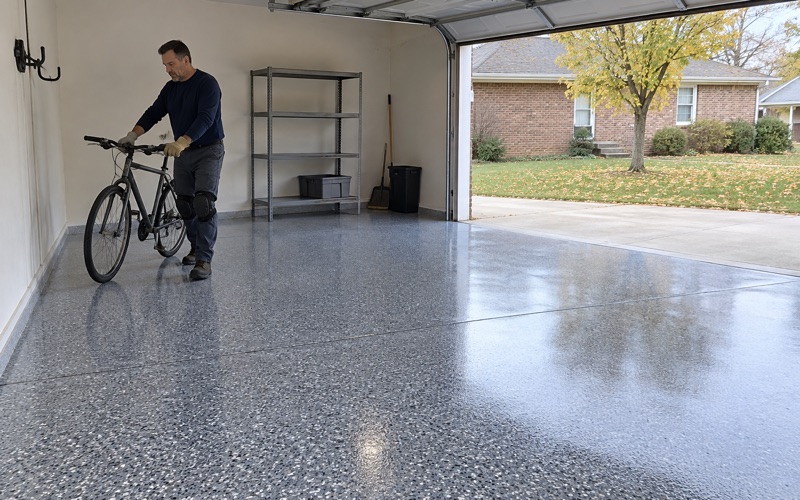
The target profile follows the coating system, not the other way around. A thin 100% solids epoxy under a polyaspartic topcoat wants a tight, clean profile, while a heavier quartz aggregate broadcast or a urethane cement system wants more tooth. We write the target into the scope so the grind can be checked against it before any material is mixed.
Why we never acid etch
Acid etching cannot do this job. It does nothing to adhesive, it leaves no measurable profile on a glue-stained slab, and it puts water onto concrete that then has to dry out before anything can be tested. Every slab we coat is opened mechanically for that reason.
Grinding glue and old concrete also makes fine dust, and in an occupied building that matters as much as the profile does. Our grinders run attached to vacuums that capture the dust at the machine. Nothing is rinsed toward a floor drain or carried out to a storm inlet.
Testing before the price is final
A clean profile is not the only gate. Once the old flooring is off, the slab can be checked for moisture with an ASTM F2170 in-situ relative humidity probe or an ASTM F1869 calcium chloride test, and the readings go into the written scope before the price is final. Moisture is also the first exclusion we name when we explain what a coating warranty does not cover.
Moving Furniture and Working Around Offices That Stay Open
What sits on the floor has to go somewhere
The village bid made the contractor responsible for moving furniture, naming file cabinets, desk workstations and vending machines. That is real work in any office floor replacement, and it is easy to leave out of a private quote. A full file cabinet is heavy, a vending machine has to be unplugged and kept upright, and a workstation may have power and data running to it.
We agree up front who moves what, where it waits while the floor cures, and when it comes back. Equipment set down on a coating before it has cured long enough can mark or break the surface. The move-back date is tied to the cure, not to the end of the install day.
Phasing an office that cannot close
A working office seldom has a week to spare. A coating project in an office suite, a medical space or a retail back room is phased one room or zone at a time while the rest stays in use, with overnight and weekend windows where a space cannot shut during business hours. Grinding is the loud, dusty step, so it is scheduled away from the hours people are at their desks.
Cure times are set by slab temperature and the dew point spread at the surface, not by the calendar. A cold slab cures slowly, and a room opened back up too early is where amine blush and soft spots show up later. We would rather hold a zone closed an extra night than reopen it on a schedule the coating cannot meet.
Paperwork before the first pass
Illinois has no state flooring license, so before booking a job in Western Springs we check what the village itself requires. Its Community Development department answers permitting and registration questions at 708-246-1800, and its own permit guides, the detached-garage guide among them, require registered contractors. On a home job over the state threshold, the owner gets a written contract and the Home Repair: Know Your Consumer Rights pamphlet before any grinding starts.
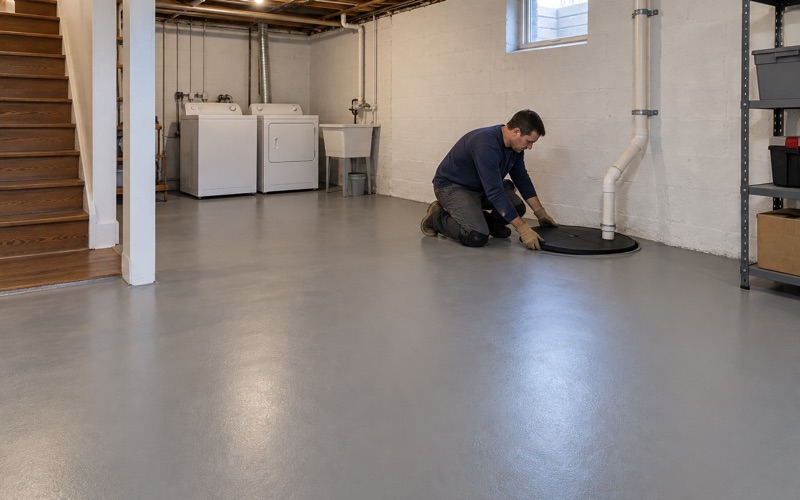
The order the village wrote into its bid is the order we follow on a single basement room: take the old floor and wall base out completely, grind the slab to a profile that can be measured, test it, and only then coat. Skipping the middle step saves a day at the start and usually costs the floor later.
- 20+ Years Coating Concrete
- Moisture Tested Before Pricing
- Free Written Estimates